

“Use DOT 4” is the advice most Audi owners find, and it's also the advice that leaves out the important part. The bottle matters, but Audi's time-based replacement interval matters more. Brake fluid absorbs moisture while the car is driven, parked, and stored, so low mileage doesn't protect it from aging.
For most Audi road cars, the sensible strategy is straightforward: use a verified fluid that matches the vehicle's specification, choose low-viscosity DOT 4 LV when the application calls for it, and replace the fluid on Audi's schedule rather than waiting for a soft pedal. Racing fluid has a place, but a higher boiling-point label doesn't automatically make it the right choice for a daily-driven A4, Q5, or S4.
Table of Contents
- Why the 2-Year Brake Fluid Rule Matters More Than the Bottle You Buy
- Understanding DOT Ratings and Low-Viscosity Specs
- How Moisture Sneaks Into Brake Fluid and Wrecks Performance
- Matching the Right Brake Fluid to Common Audi Models
- Track Day Audis Versus Street Cars, The Fluid Strategy Split
- Bleeding Brake Fluid Safely on an Audi at Home
- Practical Recommendations and the Mistakes That Undo Good Fluid
Why the 2-Year Brake Fluid Rule Matters More Than the Bottle You Buy
Brake fluid isn't just a specification to look up at a parts counter. It's a hydraulic medium that must remain stable while transmitting pedal force through the master cylinder, ABS unit, brake lines, and calipers. Glycol-based fluid is hygroscopic, which means it absorbs moisture over time. That process continues even when the car covers very little distance.
Audi's owner-facing service guidance recommends brake-fluid replacement every 2 years, and the recommendation is treated as a time interval rather than a mileage trigger in Audi maintenance guidance (Audi service and maintenance guidance). The same guidance says the reservoir level should stay between the MIN and MAX marks. A noticeable fall isn't normal fluid consumption, it can indicate a leak or another fault that needs investigation.
Why parked cars still age their fluid
Moisture enters through the reservoir's venting system and through microscopic clearances around seals and hydraulic components. Heat cycles can accelerate the movement of humid air through those paths. A lightly used, garaged A4 therefore isn't exempt from fluid aging just because its odometer advances slowly.
The consequence isn't always visible. Fluid can look clean while its moisture content has reduced its boiling margin. That's why waiting for dark fluid, a spongy pedal, or an obvious braking complaint is poor maintenance practice. By the time the pedal changes under normal driving, the fluid has already lost part of its original reserve.
Practical rule: Treat brake fluid like a calendar service, not a wear item that announces itself through mileage.
A premium bottle won't rescue a system that remains filled beyond the recommended interval. The correct sequence is to confirm the specification, buy fresh fluid from a reliable source, and bleed the system properly. Audi owners researching other age-related maintenance should also separate brake-fluid servicing from unrelated work such as tensioner and pulley replacement, because neither service replaces the other.
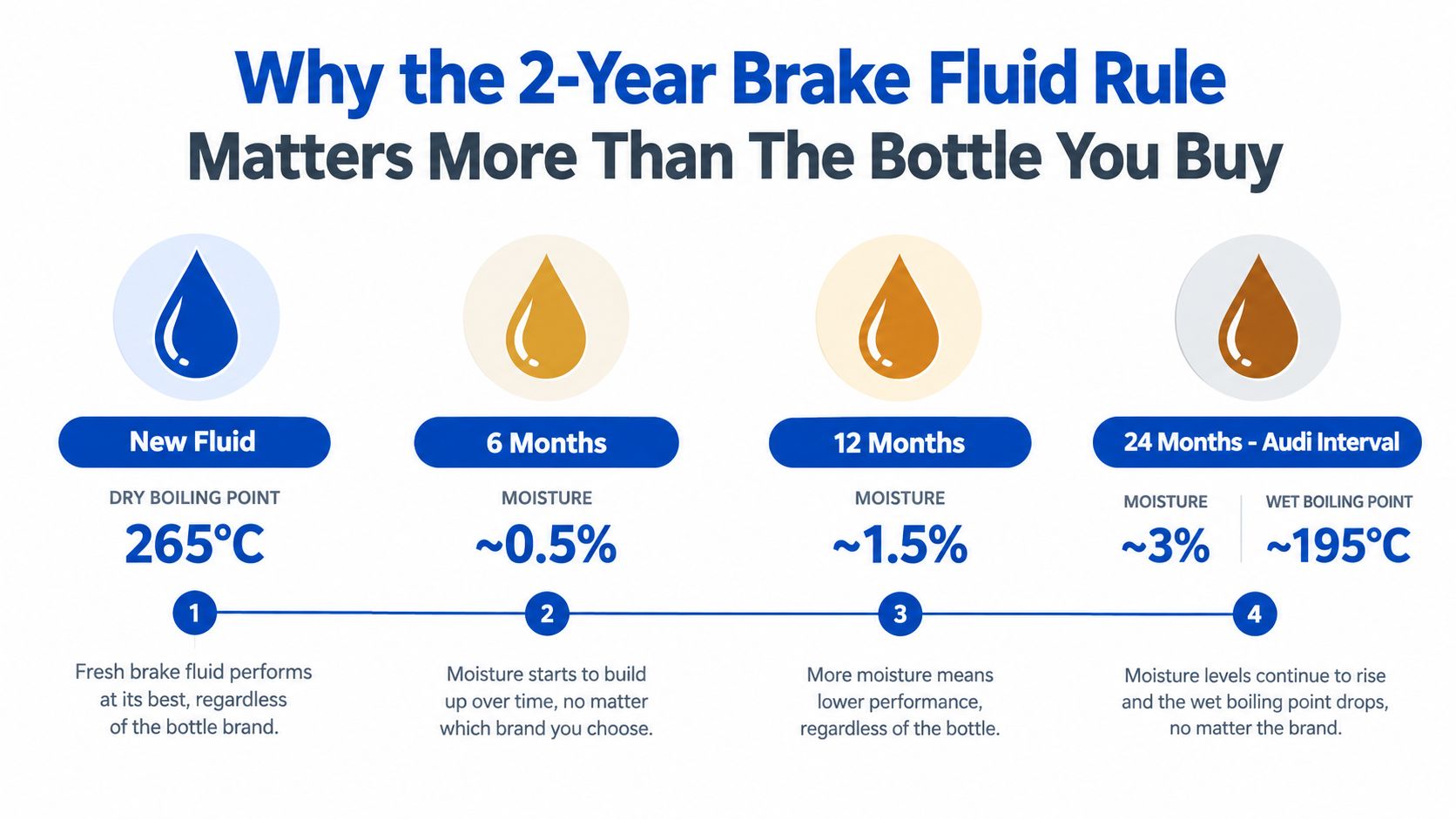
The bottle is downstream of the interval. Once the fluid has aged, changing to a more expensive formulation without flushing the old fluid from the lines, calipers, and ABS hydraulic unit doesn't deliver the intended result.
Understanding DOT Ratings and Low-Viscosity Specs
DOT ratings describe minimum performance and chemical requirements, but they don't create a simple ladder where the highest number is always best for an Audi. The useful distinctions are dry boiling point, wet boiling point, chemical base, and viscosity at low temperature.
DOT 3, DOT 4, and DOT 5.1 are glycol-based families. DOT 5 is silicone-based and should be kept out of Audi systems designed for glycol fluid. DOT 4 LV remains a glycol-based option, but it adds a low-temperature viscosity requirement intended for modern ABS, ESC, and traction-control hydraulics.
What the pedal analogy tells you
Think of the hydraulic circuit as a fast mechanical conversation between your foot, the control module, and the caliper. A fluid with the correct low-temperature viscosity can move through small passages quickly when the system intervenes. That matters during rapid ABS or ESC modulation, particularly during cold starts.
A thicker fluid isn't automatically unsafe, but it can be the wrong match for a system calibrated around low-viscosity behavior. Conversely, a racing fluid chosen only for its dry boiling number may sacrifice the fitment characteristics Audi expects. DOT 4 LV isn't a boiling-point grade by itself. It identifies a viscosity class, commonly associated with FMVSS 116 and ISO 4925 Class 6 requirements.
| Rating | Dry boiling point | Wet boiling point | Viscosity at -40°C | Audi fitment |
|---|---|---|---|---|
| DOT 3 | Minimum defined by the applicable standard | Minimum defined by the applicable standard | Standard-dependent | Only where the vehicle specification permits it |
| DOT 4 | Minimum defined by the applicable standard | Minimum defined by the applicable standard | Standard-dependent | Common Audi baseline |
| DOT 4 LV | Product-dependent | Product-dependent | Low-viscosity limit, commonly specified for LV applications | Appropriate where Audi or the component reference calls for LV |
| DOT 5 | Product-dependent | Product-dependent | Silicone-fluid behavior | Not compatible with Audi glycol systems |
| DOT 5.1 | Higher boiling class than basic DOT 4 | Higher boiling class than basic DOT 4 | Product-dependent | Not a substitute for checking Audi viscosity requirements |
Audi-compatible listings commonly reference DOT 4, FMVSS 116, SAE J1703/J1704, and ISO 4925 Class 4, while some low-viscosity applications reference Audi 501 14 and ISO Class 6 requirements (Audi-compatible DOT 4 fluid specifications). Some product data also lists low-viscosity formulations with a viscosity limit of ≤ 700 mm²/s at -40°F, so check the label and technical sheet instead of assuming every DOT 4 bottle is equivalent.
For a road Audi, the useful question isn't “What has the highest number?” It's “Does this fluid meet the required Audi, FMVSS, or ISO specification for this hydraulic system?” A verified DOT 4 brake-fluid product is a starting point, but the vehicle's service information remains the final authority.
How Moisture Sneaks Into Brake Fluid and Wrecks Performance
Fresh brake fluid has a dry boiling point. As it absorbs water, the more relevant wet boiling performance falls. That distinction matters because hard braking heats the fluid near the calipers, and water contamination lowers the temperature at which vapor can form.
Audi documents its Genuine brake fluid as having a wet boiling point about 10°C higher than standard DOT 4 fluid, creating additional thermal margin under repeated heavy braking (Audi Genuine brake fluid technical document). That advantage doesn't make neglected fluid safe indefinitely, but it shows why wet boiling performance matters more than a dry number printed on a new bottle.
The path from air to hydraulic risk
The reservoir must accommodate fluid-level changes, so its cap and venting arrangement can't isolate the fluid from the atmosphere forever. Moisture can migrate through the master-cylinder reservoir, seal interfaces, and hydraulic components as the system heats and cools. Each cycle creates opportunities for humid air to interact with the fluid.
Once the fluid becomes hot enough, absorbed moisture can contribute to vapor formation. Gas bubbles compress where liquid should transmit pressure, so the pedal can travel farther and feel unexpectedly soft. In severe cases, the driver can press the pedal toward the floor without generating the expected hydraulic response.
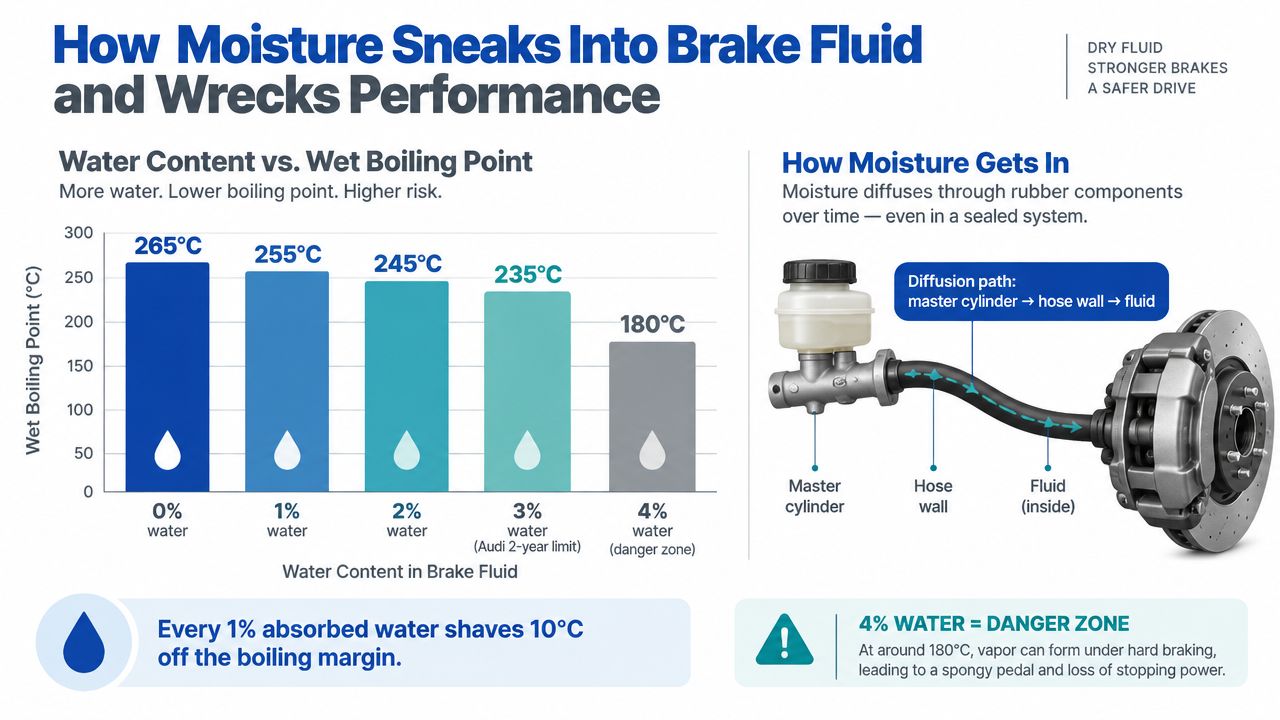
The 10°C wet-boiling advantage of Audi Genuine fluid becomes more relevant on heavier performance models and cars used on long descents or circuits. Those vehicles put greater thermal demand through their calipers, so a small reserve can help delay vapor lock. It doesn't eliminate the need for a flush.
Freshness starts before installation
An unopened bottle is protected, not immortal. Once opened, it should be sealed promptly, because the fluid begins exchanging moisture with the air. A bottle that has sat open in a workshop is a poor choice for a safety-critical service, even if the brand is reputable.
The same principle applies to fluid already in the car. Color is only a rough visual clue, not a reliable measure of boiling performance. A moisture test can support a diagnosis, but Audi's time-based service interval remains the safer maintenance anchor.
Matching the Right Brake Fluid to Common Audi Models
Model families share broad fluid standards, but owners shouldn't choose solely from badges. Year, platform, ABS or ESC hardware, and the manufacturer's specification can change the correct choice. Parts catalogs commonly map Audi applications to DOT 4, while newer or more electronically managed systems may call for DOT 4 LV or an equivalent low-viscosity standard (Audi DOT 4 and DOT 4 LV fitment references).
A practical platform comparison
| Audi model or platform | Recommended spec | Minimum dry boiling point | Example fluids |
|---|---|---|---|
| A3 and A4 road cars | Verified FMVSS 116 DOT 4, or the specified LV equivalent | Use the vehicle and product specification | OEM-style DOT 4 or a compliant LV fluid |
| Q3 and Q5 | Verified DOT 4, with LV where specified | Use the vehicle and product specification | OEM-style DOT 4, ATE, Pentosin, or equivalent compliant fluid |
| S4, S5, and SQ5 | DOT 4 LV where specified by the system | Product-dependent | A verified low-viscosity DOT 4 formulation |
| RS6, RS7, RS Q8, and R8 | High-quality DOT 4 or a compatible performance formulation | Choose from the exact vehicle and use-case requirement | Audi Genuine or a compatible high-temperature DOT 4 |
| Q7 and Q8 | Follow the specified DOT 4 or LV requirement | Product-dependent | OEM-style DOT 4 or compliant LV fluid |
This table is deliberately conservative. A dry boiling point alone can't establish fitment, and the plan notes often repeated by enthusiasts, such as assigning exact fluid brands or temperature thresholds to every engine family, aren't a substitute for the VIN-specific service specification.
Where low viscosity earns its place
For a newer Audi with advanced ABS and ESC operation, DOT 4 LV can be the more sensible street choice than a thick, high-boiling racing formulation. Low-temperature hydraulic response and predictable modulation matter during ordinary winter braking, not only during a track session.
Older Audi systems may tolerate conventional DOT 4 more readily, but “tolerate” isn't the same as “specified.” Check the cap, workshop information, and product approval before filling the reservoir. Performance owners considering broader platform changes can also review Audi S4 modification options, but brake-fluid selection should remain tied to the hydraulic system, not the engine tune.
Track Day Audis Versus Street Cars, The Fluid Strategy Split
Street and track cars need different fluid strategies because they create different thermal loads. A daily-driven A4 or Q5 usually benefits from a compliant DOT 4 or DOT 4 LV fluid, a clean bleed, and adherence to Audi's service calendar. Installing an aggressive racing formulation without a matching use case can add cost and maintenance without improving normal pedal feel.
Track use changes the decision. Repeated high-energy stops can push caliper temperatures high enough for wet boiling performance and fluid freshness to become immediate concerns. A road fluid that feels perfectly firm during commuting can develop a long pedal after repeated circuit braking.
Street use rewards compatibility
For a car that spends most of its life on public roads, choose:
- Verified specification: Match DOT 4, DOT 4 LV, ISO, FMVSS, or Audi requirements shown for the car.
- Fresh fluid: Use a sealed bottle and don't pour fluid of uncertain age into the reservoir.
- Predictable service: Replace the fluid on Audi's time-based schedule rather than waiting for brake fade.
The attraction of a racing fluid is easy to understand. Its dry boiling figure may look impressive, but that figure describes new, dry fluid. Once moisture enters the system, wet performance and service discipline determine the actual result.
Track preparation needs a repeatable routine
A track-driven TT, TTRS, RS3, or RS6 deserves a pre-event inspection of pedal feel, fluid condition, pad thickness, rotor condition, and caliper bleeders. Use a compatible high-temperature DOT 4 or DOT 4 LV racing fluid only when its specification suits the car, and bleed again when the pedal becomes long or the fluid has experienced excessive heat.
Don't confuse brake fluid with a cure for inadequate hardware. Cooling, pad compound, rotor condition, and driver technique all influence brake temperature. The fluid is one part of the system, just as a properly selected Audi big-brake kit is only one part of a complete braking setup.
A street car needs reliable fluid over time. A track car needs reliable fluid after repeated heat cycles. Those are different maintenance problems.
An enthusiast who attends occasional events can use a compatible LV fluid year-round and perform a careful bleed before demanding use. A dedicated track car needs a more aggressive inspection and replacement routine, especially after any session that produces a long pedal.
Bleeding Brake Fluid Safely on an Audi at Home
A home bleed can work on many Audis, but it isn't a casual top-up. The job combines corrosive fluid, pressurized hydraulics, a raised vehicle on supports, and an ABS or ESC module that may retain old fluid. Work on level ground, use proper jack stands, and stop if a bleeder screw, hose, or line looks damaged.
The exact procedure varies by model. Some Audis require a scan-tool-assisted hydraulic-unit routine, and MQB or RS applications may specify a different wheel order. Use the factory procedure for the vehicle rather than treating the following sequence as universal.
Prepare the car before opening a bleeder
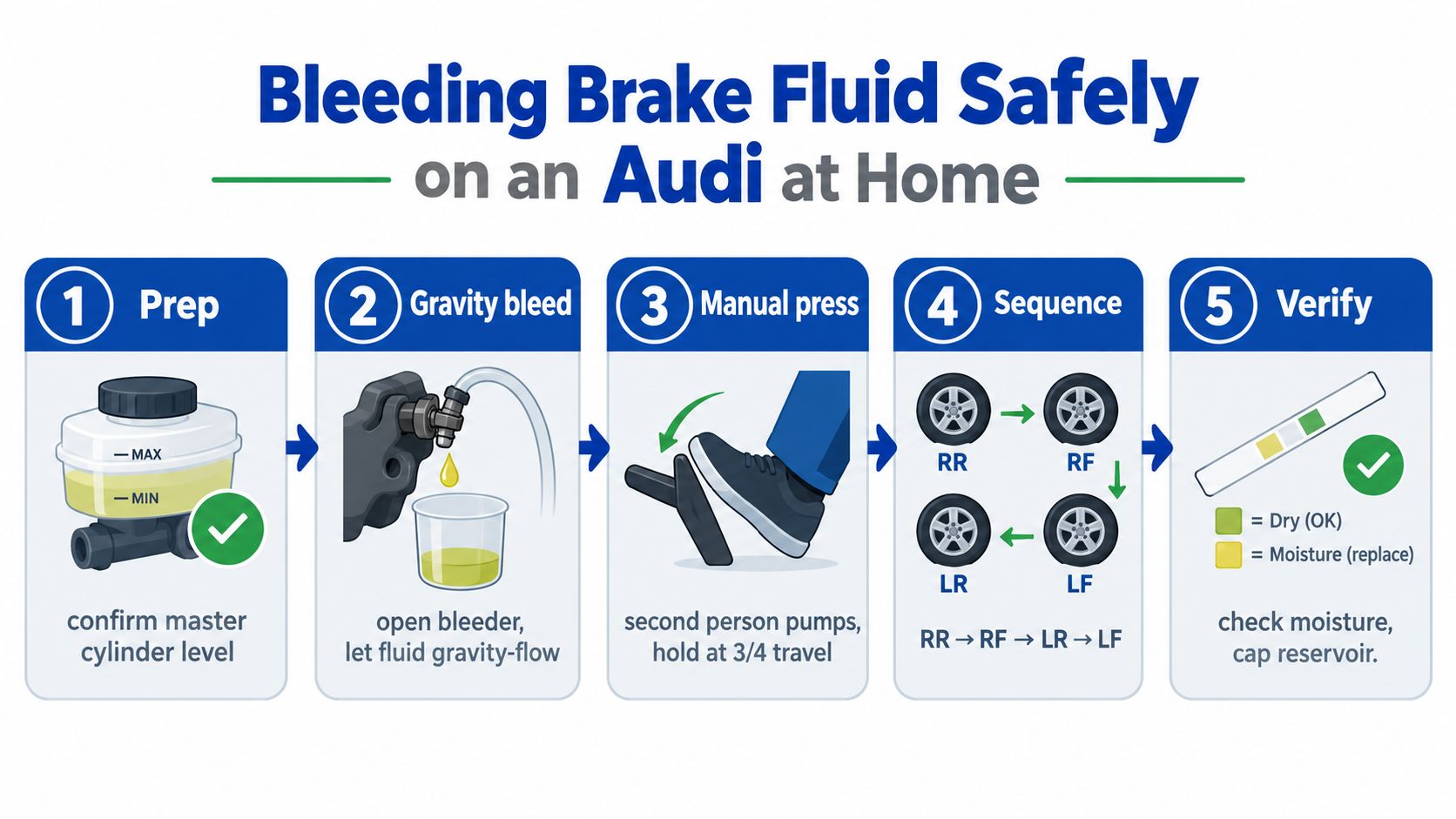
Start with the reservoir. Confirm that the fluid is at the correct level and use only fluid that matches the vehicle specification. Protect painted surfaces because brake fluid can damage paint, and keep a clean, sealed container ready for waste fluid.
Lift the car securely and remove the wheels if access requires it. Before applying force, check that every bleeder screw can open. A seized screw can turn a routine flush into a caliper or line repair, and a rounded hex usually means the wrong tool or excessive force was used.
- Support safely: Use level ground, rated stands, and wheel chocks. Never rely on a jack alone.
- Protect the reservoir: Keep dirt away from the opening and don't allow the level to fall below MIN.
- Inspect the hardware: Check hoses, calipers, bleeders, and visible unions for leaks before introducing fresh fluid.
Use a controlled two-person sequence
A gravity-plus-manual bleed is easier to monitor with two people. Fit a clear hose over the bleeder and place the other end in a container. Keep the hose submerged in discharged fluid only if the setup prevents air from being drawn back through the screw.
For many Audi layouts, a commonly used sequence is right rear, left rear, right front, left front, but the manufacturer's sequence takes priority. Begin with a gentle gravity flow to remove old fluid, then have the assistant press the pedal smoothly and hold it while the bleeder is opened. Close the bleeder before the pedal reaches the floor, then allow the pedal to return.
The assistant shouldn't pump aggressively or release the pedal while the bleeder is open. Rapid, uncontrolled strokes can aerate the fluid or move debris through the system. Refill the reservoir repeatedly, and never let it empty.
Don't skip the ABS or ESC hydraulic unit
The calipers aren't the entire hydraulic circuit. An Audi equipped with an integrated ESP or ESC pump may retain old fluid inside the module unless the valves and pump are cycled using a compatible diagnostic tool.
VCDS, OBDeleven, or another suitable scan tool may provide the required basic setting or brake-bleed function, depending on the vehicle. Follow the tool's instructions and the vehicle's repair procedure. If the system requests pedal movement, apply firm pressure while the bleeder is opened and close the bleeder before the pedal reaches the floor.
A pressure bleeder and diagnostic access can make a specialist service preferable. Vacuum bleeding can draw air past a loose bleeder-thread interface and create misleading bubbles, while an inexperienced operator can leave air trapped in the ABS unit.
A specialist should handle the job if the pedal was allowed to go empty, the hydraulic unit has been replaced, a line has been opened, the ABS warning light is active, or the bleeders won't open cleanly. The same caution applies if you lack a stable lifting setup or can't verify the vehicle-specific sequence.
The following video provides a visual reference for the general process. It doesn't replace the Audi repair procedure for your model.
Verify the pedal before driving
With the engine off, press the brake pedal firmly. It should feel high and solid, not spongy, sinking, or inconsistent. Inspect every bleeder and connection for seepage, refit the caps, confirm the reservoir level, and clean any spilled fluid.
Newer Audis with electronic pedal-feel systems may need an ignition cycle and a short, cautious drive to relearn pedal travel after service. That doesn't excuse a soft pedal. If the pedal remains low or sinks under steady pressure, don't drive the car in traffic. Recheck the bleed, inspect for leaks, and use a diagnostic-capable Audi specialist when necessary.
Owners working on earlier A3 applications can also review the fitment of a braided stainless-steel brake-line set, but replacing lines adds another reason to follow the correct bleed and ABS procedure carefully.
Practical Recommendations and the Mistakes That Undo Good Fluid
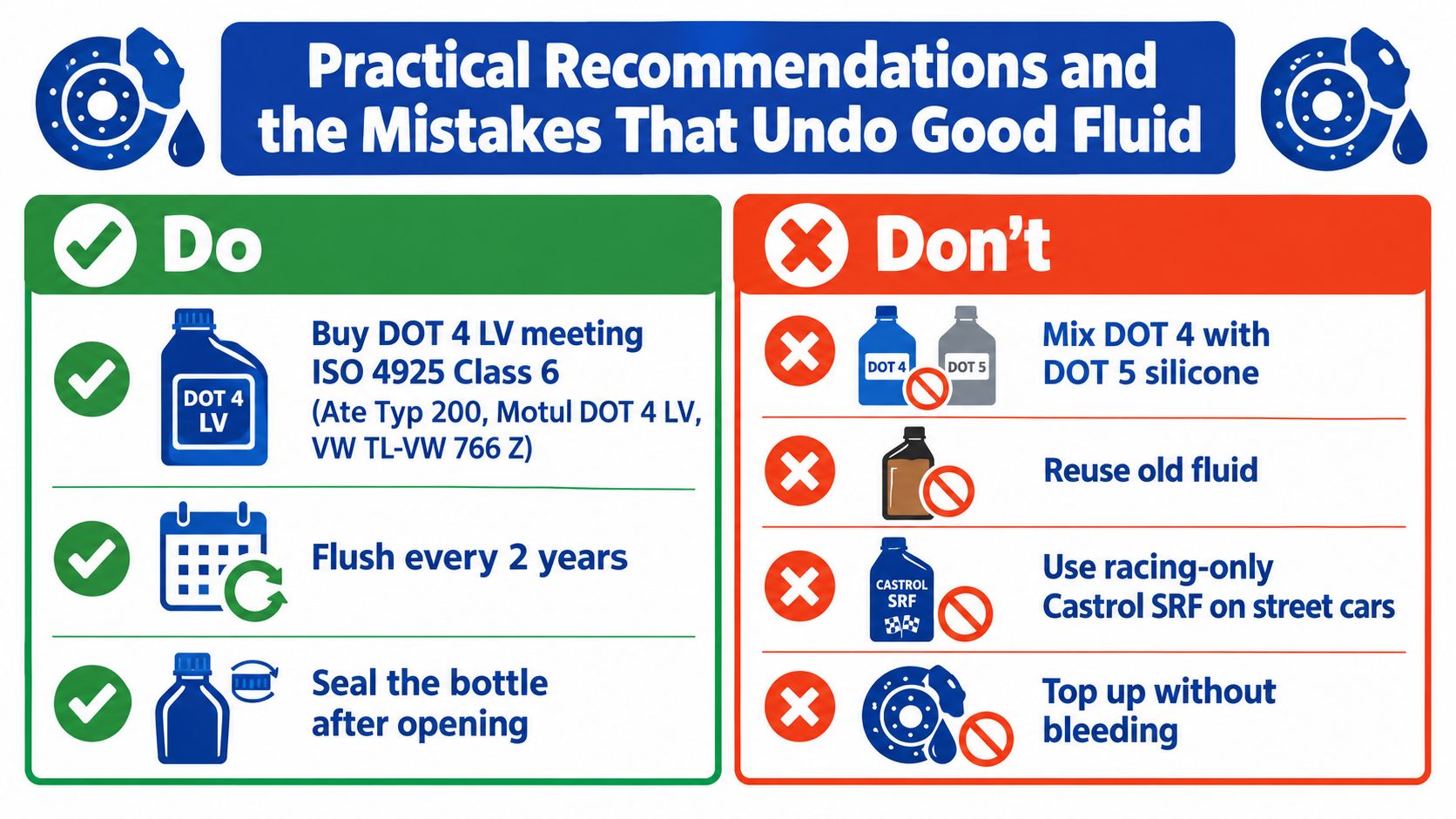
For most street-driven Audis, the default purchase should be a verified DOT 4 LV fluid that meets the required ISO or FMVSS specification, where the vehicle calls for low viscosity. This choice addresses modern ABS and ESC hydraulic behavior without forcing a daily driver into a track-only maintenance routine.
Check the bottle and technical sheet. A product that merely says “premium” or “racing” without clear certification, application guidance, and traceable manufacturer information isn't a sensible choice for a safety-critical system.
The street-car default
Use the following decision rule:
- Choose DOT 4 LV: Select it when the Audi specification or application reference calls for low viscosity.
- Choose standard DOT 4: Use it where the vehicle documentation specifies conventional DOT 4 and no LV requirement applies.
- Choose racing fluid selectively: Reserve high-temperature formulations for cars that see sustained track braking, then maintain them according to that use.
- Seal opened bottles: Don't leave the cap loose while completing other workshop jobs. Moisture contamination starts as soon as the fluid is exposed.
Audi's consistent 2-year service interval remains more important than chasing a fashionable brand. A technically excellent fluid that stays in the car too long is still old fluid.
Mistakes that create expensive problems
Mixing chemical families is the serious error. DOT 5 silicone fluid isn't the same chemistry as the glycol-based DOT 3, DOT 4, DOT 4 LV, and DOT 5.1 families used in conventional Audi systems. Don't pour DOT 5 into a glycol system, and don't assume a complete change can be achieved by draining only the reservoir.
Letting the reservoir run empty introduces air into the master cylinder and potentially the ABS hydraulic unit. That changes a simple flush into a more involved diagnostic and bleeding job. Watch the level continuously, not just between wheel positions.
Ignoring a low level can hide a leak. Audi guidance says the fluid should remain between MIN and MAX, so a meaningful drop deserves an inspection rather than a casual top-up. Pads, hoses, calipers, and hydraulic connections all need consideration before adding fluid.
The right bottle supports a good brake service. It can't compensate for air in the system, a leak, a seized bleeder, or an overdue interval.
If your Audi is due, don't wait for a soft pedal. Identify the correct specification, buy fresh fluid, and arrange a complete bleed that accounts for the ABS or ESC unit. For platform-specific maintenance parts, brake hardware, and Audi-focused workshop support, visit Vorsprung Autowerk, where the catalog covers Audi maintenance and performance applications. Their team can help you match the service approach to your car's platform and intended use.


