

Most Audi S5 builds start with the wrong question. Owners ask how much power a downpipe or tune can add, then discover that the car can't manage heat, the transmission calibration doesn't suit the new torque curve, or the maintenance backlog turns every modification into another repair bill. A fast dyno result means little if the car becomes inconsistent after repeated pulls.
A better Audi S5 build treats power, cooling, drivetrain, suspension, braking, and service history as one system. The right sequence depends on whether you're building an EA837-powered car for daily use or working with a newer turbocharged V6 platform, but the principle remains the same: establish a healthy baseline, control temperature, add power in measured steps, and validate every change under repeatable conditions.
Table of Contents
- Planning Your Audi S5 Build Strategically
- Selecting Power and Cooling Upgrades
- Upgrading Drivetrain and Suspension
- Choosing Wheels and Brake Packages
- Essential Tuning and Service Checklists
- Finalizing Your S5 Build Roadmap
Planning Your Audi S5 Build Strategically
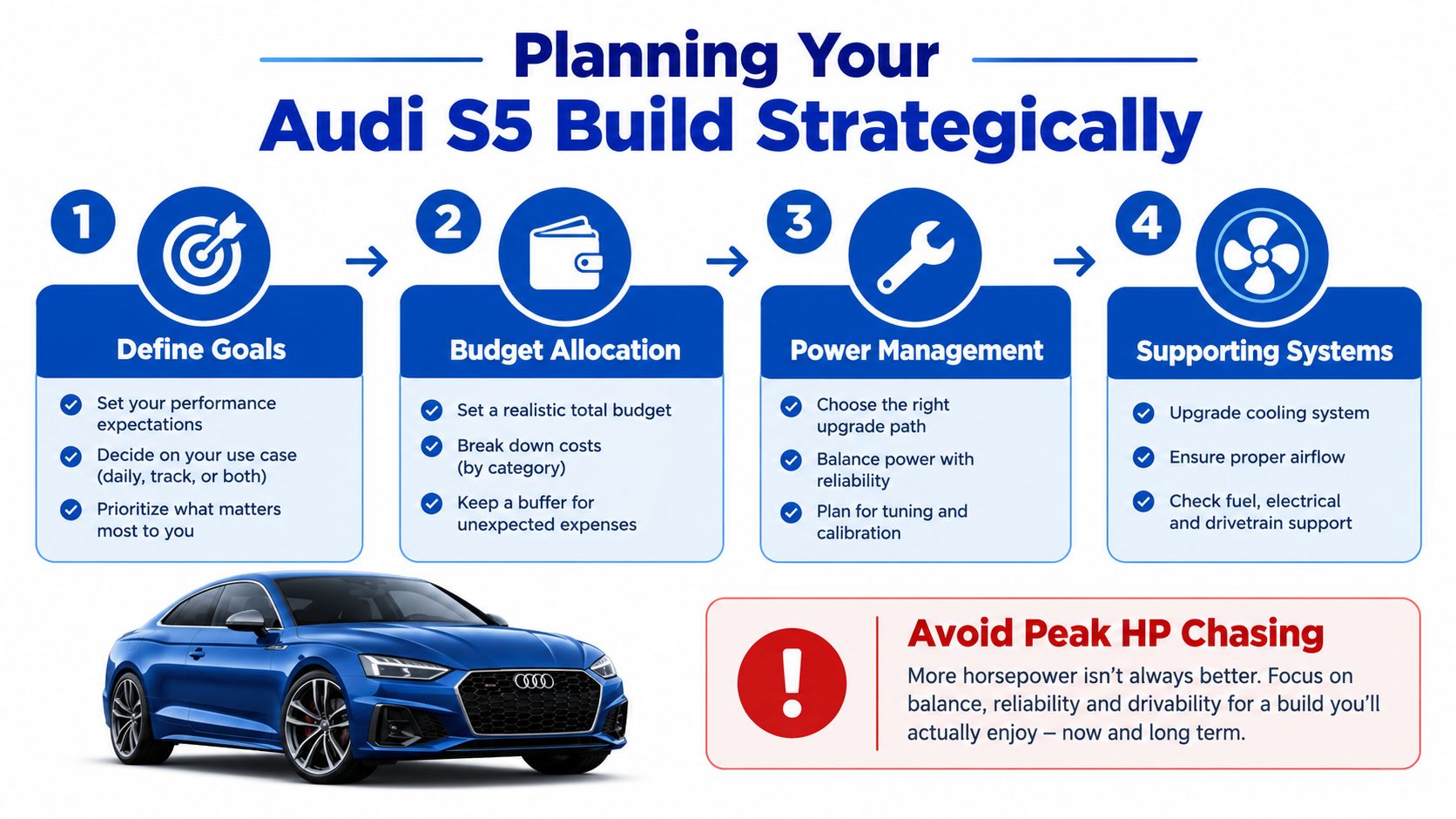
Peak horsepower is the wrong place to begin an Audi S5 build. Decide how the car will be used, then set power, cooling, drivetrain, suspension, and service priorities around that job. A commuter, weekend canyon car, and track-day S5 require different compromises in ride quality, tire wear, thermal capacity, and access for maintenance.
The S5 has existed since 2007, and the B9-generation car was unveiled in June 2016 before entering production in late 2017. The current global-market sedan specification lists a 3.0-liter turbocharged V6, 270 kW, or 367 hp, 550 Nm, a governed 250 km/h top speed, and 0–100 km/h in 4.5 seconds. Those figures, along with the platform history, are documented in the Audi S5 model history and specifications. That timeline covers major changes in engine architecture, electronics, drivetrain calibration, and aftermarket support. EA837 supercharged V6 cars and EA825 turbocharged V6 cars need different decisions about heat control, software, packaging, and long-term service.
Define the use case before buying parts
Write down what the car must do. A daily driver should retain reliable cold starts, air-conditioning performance, manageable ride quality, and practical tire wear. A track car needs cooling capacity, consistent brakes, controlled fluids, and repeatable alignment before cosmetic changes or peak-output hardware.
The listed sedan weight is 1,950 kg, so outright engine output is only one part of the result. Traction management, electronics, heat control, and tire selection strongly affect how that power works on the road.
Budget for the systems around the engine
Reserve funds for diagnostic scans, fluids, ignition components, cooling repairs, alignment, and tires instead of spending the full budget on tuning and exhaust work. Independent repair data gives the S5 a 2.0/5 reliability rating, with average annual repair costs of $1,164 and a 17% chance of a severe or major repair, according to RepairPal's Audi S5 reliability data.
These figures do not predict every owner's costs. They do show why a modified S5 needs a maintenance reserve. The total cost includes keeping the platform healthy, not only adding power.
Practical rule: Buy the healthiest platform you can verify, not the cheapest S5 you can find.
Build in phases
Begin with an inspection and baseline logs. Correct leaks, cooling faults, worn mounts, overdue fluids, and drivetrain service needs before installing intake, exhaust, software, or suspension parts. Record the engine code, transmission, body style, fuel availability, and existing modifications so each part matches the car.
Use this Audi performance upgrade guide as a parts-planning reference, then confirm compatibility against the specific car. A staged plan protects reliability, manages heat, and makes ownership costs easier to control.
Selecting Power and Cooling Upgrades
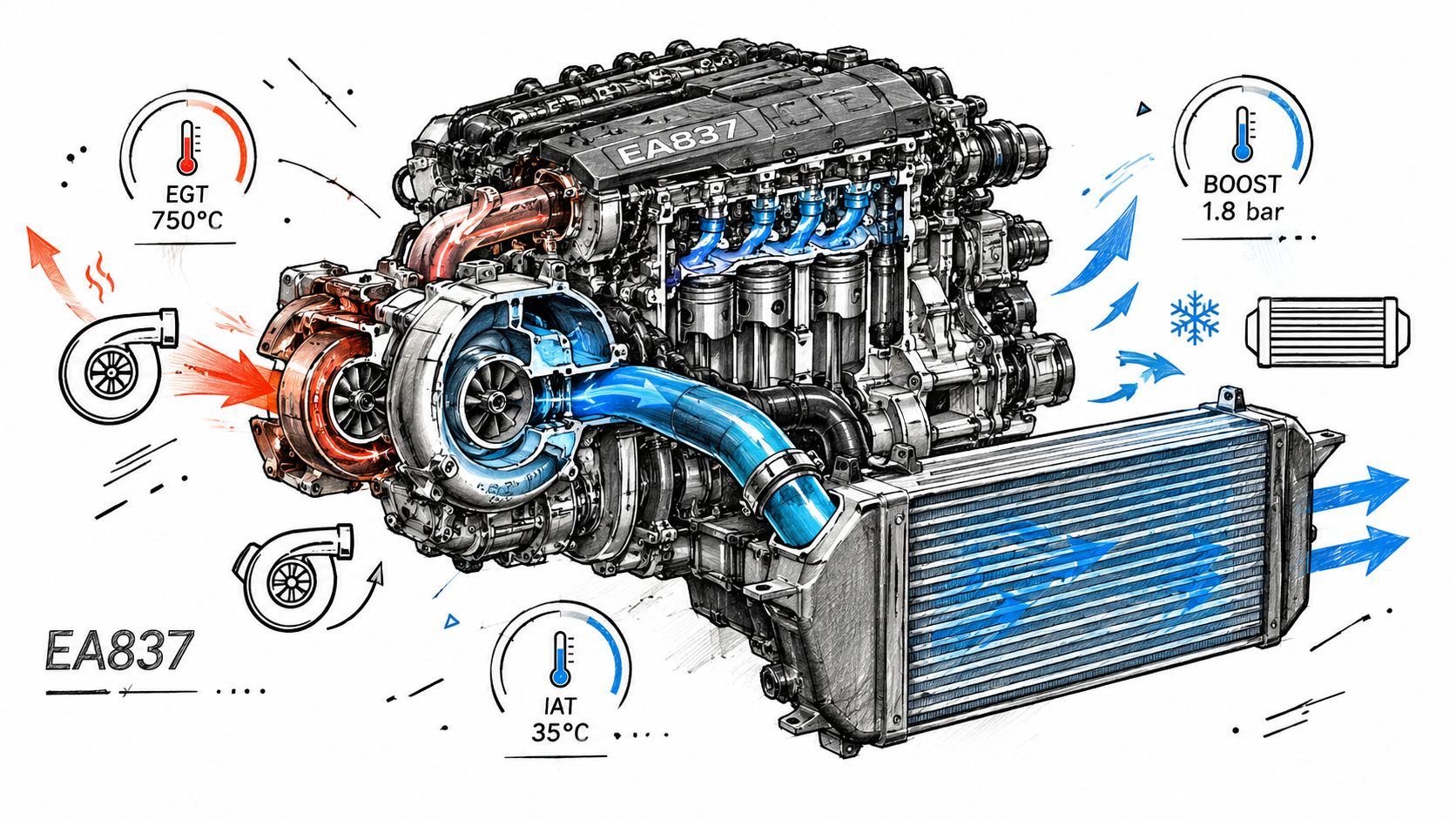
The most effective power upgrade on a street-driven S5 is often the part that keeps the car consistent. A cold dyno pull can make a build look impressive, while heat-soaked charge air removes timing and reduces repeatability. On the B9 and B9.5 3.0T platform, independent testing of an upgraded intercooler reported intake-air temperatures up to 11.4% lower across three consecutive wide-open-throttle pulls than the comparison performance intercooler, as documented in the IE Race FDS intercooler testing.
That result matters because the failure mode isn't a single cold pull. It's the second or third pull when the system has absorbed heat and the car can no longer reproduce its earlier performance.
Match hardware to the engine platform
The EA837 supercharged V6 needs a different supporting strategy from a turbocharged V6. Don't order parts by model badge alone. Confirm the generation, engine code, transmission, emissions equipment, charge-air layout, and software compatibility before buying.
For an EA837 street build, cooling hardware should come before aggressive pulley or calibration changes. A larger heat exchanger, a properly functioning auxiliary pump, a sound intercooler brick, and fresh coolant plumbing do more for repeatability than a louder intake. The Audi supercharger upgrade guide can help frame the hardware choices, but fitment must still be checked against the exact car.
Choose airflow parts for the complete system
An intake should provide a credible airflow path and maintain heat shielding. A polished pipe that draws hot engine-bay air can sound faster without delivering useful consistency. Check sensor placement, coupler quality, filtration, and clearance before considering appearance.
Exhaust selection involves a similar compromise. High-flow catalytic converters can reduce restriction while preserving more street usability than a fully uncatalyzed system. Test pipes or catless components may suit a dedicated competition car, but they can create emissions, odor, noise, and calibration problems for a road car. Don't treat exhaust flow as an isolated horsepower purchase. The tune must understand the hardware, and the fuel system must support the requested load.
Validate temperature before adding boost
Log intake-air temperature, coolant temperature, requested and actual boost, ignition timing, and fuel pressure on consecutive pulls. Leave a consistent cooldown period between runs, then repeat the test under similar fuel and ambient conditions.
A single best number doesn't prove the build works. If the first pull is strong and later pulls deteriorate, the next purchase should address heat management rather than chasing a more aggressive file.
Cooling is power you can use repeatedly. A smaller peak gain that survives heat soak is more valuable than a larger result that exists for one run.
Upgrading Drivetrain and Suspension
An S5's all-wheel-drive traction can hide weak links until the car is launched hard or driven repeatedly at high load. The engine may tolerate a power increase, while mounts, pulleys, transmission software, propeller-shaft components, or subframe bushings introduce vibration and inconsistent power delivery.
Start with inspection rather than replacement. Look for drivetrain movement, torn mounts, pulley wobble, fluid leaks, uneven tire wear, and evidence of previous impact damage. A crank pulley or tensioner upgrade only makes sense when the surrounding belt drive is healthy and the replacement part matches the engine generation.
Preserve the transmission's working range
A software calibration should shape torque delivery rather than just raise every limit. The car needs clean low-speed behavior, sensible shift timing, and torque management that protects the transmission during launches and repeated acceleration. A calibration that feels dramatic in one gear can become tiring on the street if it produces abrupt engagement or excessive wheelspin.
Quattro traction doesn't eliminate driveline stress. It transfers more of the engine's torque to components that must absorb it, especially when sticky tires and aggressive launches are involved. Transmission service history matters as much as the advertised tune stage.
The distinction between torque-sensing and electronically controlled all-wheel-drive layouts also affects how the car responds to modifications. The Torsen versus Haldex drivetrain guide provides useful context for understanding why different Audi platforms shouldn't be modified with the same assumptions.
Let the suspension support the tires
Suspension changes should follow the tire and usage decision. A mild spring or height-adjustable kit can improve body control, but lowering without correcting alignment can increase inner-edge wear and reduce usable travel. Excessive stiffness may feel impressive on smooth pavement and worse everywhere else.
For a road-focused S5, prioritize:
- Dampers and springs: Choose a matched combination rather than combining random springs with tired original dampers.
- Alignment: Set it for tire life and steering response, not an extreme show-car stance.
- Bushings and mounts: Replace worn rubber before adding harder components that transmit more noise.
- Chassis balance: Improve front-end response without making the rear unstable under braking.
A suspension setup should make the car easier to place, not merely lower it. If the car skips over uneven pavement, loses traction on corner exit, or becomes unpleasant on ordinary roads, the hardware is working against the build.
Choosing Wheels and Brake Packages
Wheels and brakes should be selected together. A wheel that looks ideal may not clear the caliper, and a heavy wheel can erase some of the response gained from suspension work. Brake clearance depends on spoke shape, barrel profile, offset, and the exact caliper, not diameter alone.
Compare wheel priorities honestly
A forged wheel generally offers more control over weight, width, offset, and finish than a generic cast replacement, but custom fitment costs more and still requires verification. A conservative wheel with a sensible tire often works better than an aggressive fitment that rubs, loads the bearings unnecessarily, or leaves no room for alignment adjustment.
For daily use, prioritize sidewall protection, tire availability, and the ability to rotate a square setup. For track use, prioritize brake clearance, heat tolerance, replacement cost, and access to suitable performance tires. A wider tire can add grip, but it also increases cost and may expose weaknesses in alignment or fender clearance.
The Audi wheel fitment guide is a useful starting point, but the final check should happen on the actual car with the actual brake package. Don't rely on a catalog photograph.
Match brake friction to the driving environment
Street pads usually offer quieter operation, predictable cold bite, and lower dust. Track-oriented pads tolerate higher temperatures but can squeal, produce more dust, and feel less effective before reaching their intended operating range. Neither is universally better.
A sensible street package combines quality rotors with a pad that matches normal temperatures and tire grip. A track package should include pads designed for the event, fresh high-temperature fluid, and a way to monitor wear. Bigger rotors alone don't solve pad fade, fluid boil, poor ducting, or incorrect bedding.
A brake upgrade must also preserve balance. Increasing front axle capacity without considering the rear system and ABS calibration can change pedal feel and intervention behavior. Test the package progressively, bed the pads according to the manufacturer's procedure, and inspect the hardware after the first demanding session.
The visual side matters, but function comes first. A clean wheel face, correct offset, and verified caliper clearance will age better than an oversized wheel that compromises ride quality.
Essential Tuning and Service Checklists
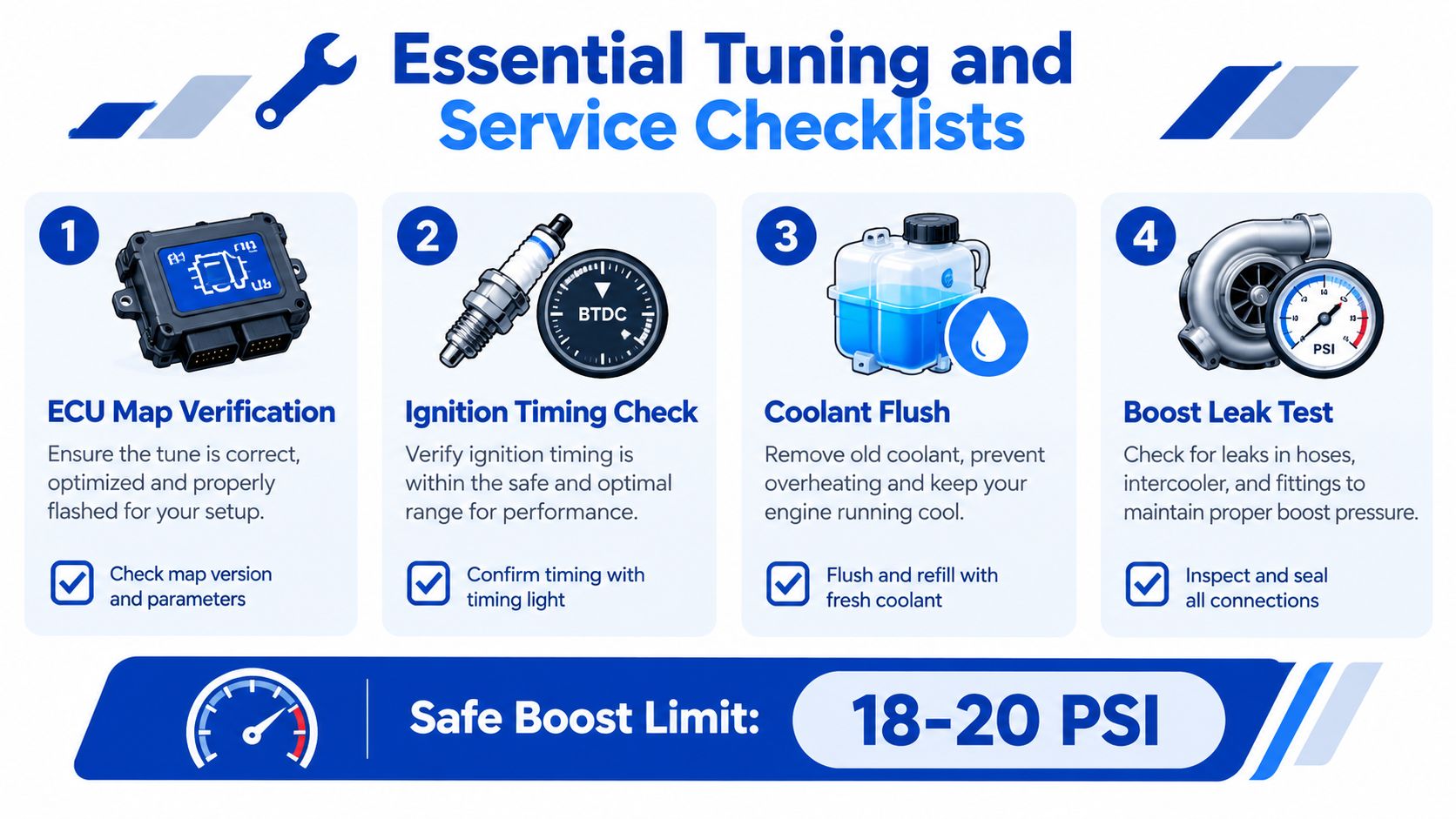
A tune should be the final adjustment to a healthy car, not a diagnostic tool. Before flashing software, scan all modules, document fault codes, inspect plugs and coils, pressure-test the intake system, and verify that fuel pressure follows demand. If the car has an unresolved cooling fault or a boost leak, more aggressive calibration will only make the problem harder to isolate.
The right file also depends on fuel quality and hardware. Keep a record of the calibration version, fuel used, intake and exhaust configuration, and any requested logging parameters. If the car changes hands, that information prevents the next owner or technician from guessing.
Verify the electronic side first
ECU and immobilizer issues can appear after module replacement, engine work, or calibration changes. Confirm that the ECU is correctly paired, that the immobilizer status is understood, and that no communication faults remain after the flash. Injector work also requires care. Rebuilt or replaced injectors should be tested, coded where required, and checked for consistent operation.
Use a platform-specific parts reference such as the Audi performance parts glossary when terminology differs between generations. Similar names don't guarantee interchangeable components.
Keep the service checklist mechanical
Complete the basic checks before judging the tune:
- Ignition timing: Review timing behavior under load and investigate corrections rather than masking them with more fuel or less boost.
- Boost integrity: Pressure-test the intake and charge-air system, inspect clamps, and confirm that actual boost follows the requested curve.
- Cooling system: Check coolant level, pump operation, hoses, fittings, and heat exchanger performance before repeated high-load driving.
- Crankcase ventilation: Inspect the PCV system and oil leaks, especially on older 3.0T cars with known maintenance concerns.
- Fluids and filters: Service the engine, transmission, differential, and cooling systems according to the correct platform requirements.
Don't create an arbitrary service schedule based only on mileage. Modified cars need inspection intervals based on use. Repeated track sessions, hard launches, short trips, and poor storage conditions all justify closer checks than gentle highway driving.
A reliable tune begins with reliable data. Save logs before and after every major hardware change, and compare repeatable runs instead of isolated peaks.
Finalizing Your S5 Build Roadmap
A balanced Audi S5 build follows a clear order. First, choose the generation and intended use. Second, repair the maintenance backlog and establish baseline logs. Third, improve cooling before increasing sustained load. Fourth, add airflow and software as a matched package. Fifth, upgrade drivetrain support, suspension, tires, and brakes according to how the car will be driven.
For a daily S5, restraint usually produces the best ownership experience. Keep the exhaust civil, retain useful sidewall, use a conservative calibration, and spend money on cooling, service, and tires. A weekend performance car can accept firmer suspension and more aggressive brake friction, provided you accept the noise, wear, and inspection burden. A track-focused build needs a different level of preparation, including repeatable temperature control and consumables that can be replaced without drama.
Performance testing should reflect the car's real mission. Independent testing recorded a 2013 S5 3.0T manual at 4.8 seconds from 0 to 60 mph and 13.4 seconds through the quarter-mile at 106 mph, while a 2023 S5 Sportback reached 60 mph in 4.3 seconds, according to the Audi S5 acceleration benchmarks. Different transmissions, body styles, conditions, and launch techniques explain why unrelated runs shouldn't be compared as if they came from one car.
Build for repeatability, inspect the systems that carry the power, and make every modification earn its place.
Vorsprung Autowerk offers Audi-focused exhaust, cooling, drivetrain, suspension, brake, forged-wheel, and ECU-related solutions for platforms including the EA837 and EA825. Visit Vorsprung Autowerk to review platform-specific parts and plan an S5 build around your engine, driving goals, and maintenance needs.


