

You know the pattern. The first acceleration run in your Audi feels sharp, the second still pulls hard, and by the third the car feels noticeably flatter. The turbocharged or supercharged engine hasn't suddenly lost its capability, but intake temperatures have climbed, charge density has fallen, and the ECU may begin protecting the engine by reducing ignition timing or changing boost strategy.
That experience is why the most valuable intercooler benefits often don't appear in a single peak dyno number. On an Audi EA837 3.0T or EA825 4.0T, effective charge-air cooling is about holding power together under repeated load, not just producing an impressive first pull. The right system gives the calibration cooler, denser air to work with and creates more consistent performance on the street, during hot-weather driving, and on track.
Table of Contents
- The Heat Soak Reality for Audi Owners
- How Intercoolers Recover Air Density
- Measurable Performance and Reliability Gains
- The Trade-offs of Size and Airflow Restriction
- Defeating Heat Soak on Repeated Pulls
- Selecting the Right Cooling Components
- Final Verdict on Thermal Management
The Heat Soak Reality for Audi Owners
Heat soak isn't a mysterious fault. It's what happens when the cooling system absorbs more heat than it can reject, causing intake temperatures to rise during repeated acceleration or sustained boost. A car can feel perfect leaving the workshop and still lose its edge after several hard runs because the factory system has reached its thermal limit.
The usual owner report is easy to recognize. The first pull is strong, the second is acceptable, and the third feels soft. Throttle response becomes less urgent, the car may stop carrying power at the top of the rev range, and logged intake temperatures continue climbing even though the driver hasn't changed the route or driving style.
Audi's packaging decisions explain much of this behavior. The EA837 and EA825 platforms deliver substantial forced-induction performance in road cars that also need to meet requirements for emissions, noise, serviceability, crash packaging, and cost. The original cooling hardware is therefore a compromise, not necessarily a defect. It works within its intended operating window, but a tuned car asks it to move more air and reject more heat.
Why the first pull can mislead you
A cool first run tells you very little about how the car will behave after repeated load. A short dyno session can show a healthy peak result while hiding the temperature rise that appears during a longer road pull, a track session, or several back-to-back launches.
That makes intake-temperature logging more useful than relying on feel alone. Compare intake temperature, boost behavior, ambient conditions, and repeatability across similar runs. If the car loses urgency as heat accumulates, adding more engine power before correcting charge-air cooling usually makes the underlying limitation more obvious.
Practical rule: If your Audi is already heat-soaking, a more aggressive tune won't remove the problem. It can make the cooling system reach its limit sooner.
The wider forced-induction system matters too. Owners considering a supercharger upgrade for an Audi should treat thermal capacity as part of the upgrade plan rather than an afterthought. More airflow and higher load increase the demand placed on the intercooler circuit, so the cooling system has to match the engine's actual use.
How Intercoolers Recover Air Density
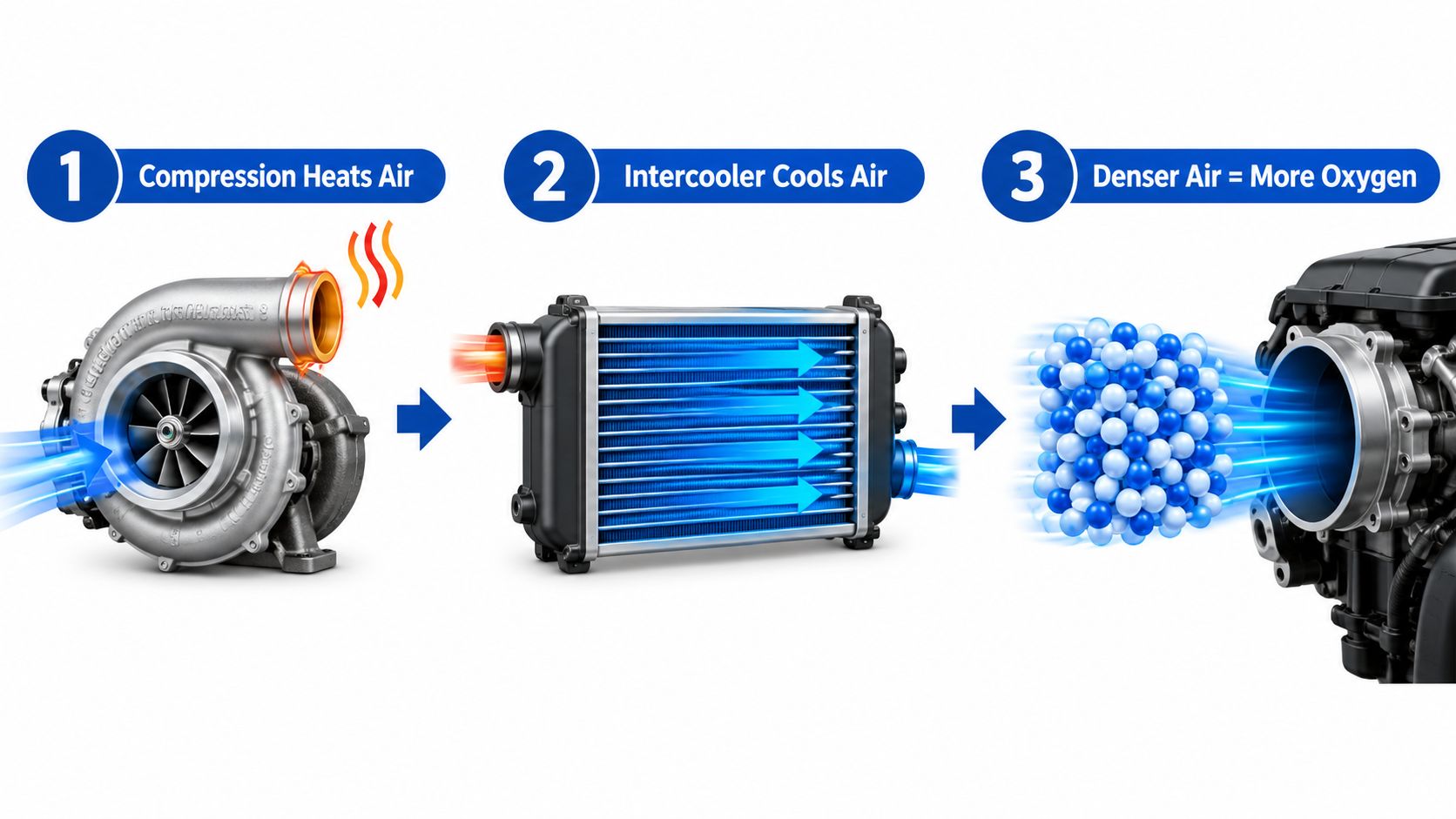
An intercooler doesn't create oxygen. It recovers usable air density after the compressor has raised the air's pressure and temperature. Think of a given volume of hot air as a crowd that has expanded into more space. Cool that same charge, and the molecules occupy less space. The engine can then ingest more oxygen through the same intake volume.
The process is straightforward:
- The turbocharger or supercharger compresses the incoming air.
- Compression raises the charge temperature.
- The intercooler transfers that heat into a separate cooling medium or into ambient airflow.
- The cooler charge becomes denser before entering the engine.
- The calibration can use that denser charge more consistently.
Charge air leaving a turbocharger is often around 100°C or higher, and an intercooler can reduce intake temperature by more than half. In a reported test, adding an intercooler brought intake manifold temperature down to 79°F, a 72% reduction, while boost pressure fell 35% to 8.9 psi because the cooler, denser air needed less boost to deliver the same airflow, as documented by Haltech's explanation of intercooler operation.
EA837 and EA825 cooling layouts
The EA837 3.0T V6 uses water-to-air intercooler bricks positioned in the engine valley. That layout keeps the charge-air path compact and supports fast temperature control, but it also places the bricks in an area surrounded by engine heat. The bricks themselves are only one part of the system. The front heat exchanger, coolant volume, pump capacity, lines, and airflow through the front of the car determine how quickly the circuit can remove stored heat.
The EA825 4.0T V8 uses its own tightly packaged charge-air arrangement around the twin-scroll turbo setup. Its physical layout and thermal loads differ from the 3.0T, so a component that works well on an EA837 isn't automatically the right answer for an EA825. Fitment, coolant routing, core capacity, and the way the system handles repeated load all matter more than a headline core size.
That distinction is central when comparing an Audi air-to-water intercooler system. Air-to-water hardware can transfer heat efficiently in a compact package, but the whole circuit must stay within its ability to reject heat. A larger brick without adequate downstream heat rejection stores more heat before reaching the same problem.
Measurable Performance and Reliability Gains
The useful performance gain from an intercooler comes from maintaining charge density, not from a temperature number viewed in isolation. Cooler air reduces the engine's tendency toward knock and gives the ECU more room to maintain a stable ignition and boost strategy. That doesn't mean every car receives the same peak horsepower result. It means the engine is less likely to lose the conditions that produced its original power.
A published engineering report on a replacement intercooler recorded an average outlet-temperature reduction of 28°F versus the stock unit and an additional 8 horsepower on the dyno. The same report measured average OEM efficiency at about 79%, compared with 86% for the upgraded unit, according to the Mishimoto intercooler engineering report.
What the temperature drop changes
When intake air is cooler and denser, the engine can fill the cylinders with a more predictable mass of air. That supports more stable combustion and reduces the likelihood that high charge temperature will force the ECU to intervene. On a modified Audi, that consistency is often more valuable than a small improvement on one isolated pull.
Lower charge temperature can also reduce thermal stress throughout the operating system. The effect isn't limited to the intercooler itself. Cooler inlet conditions can help the engine operate with less knock tendency and lower the demand placed on the calibration during high-load use. That matters on an aggressive tune, where the engine has less thermal margin than a standard car.
A properly matched intercooler can therefore serve as both a performance component and a durability component. It doesn't replace correct fueling, healthy ignition hardware, or proper calibration, and it won't repair a boost leak. It gives those systems a more stable thermal environment.
Calibration matters: The air is only useful if the ECU strategy, fueling system, and boost targets can take advantage of it. Hardware and software should be evaluated as one system.
The practical test is repeatable data. Record intake temperatures and power behavior under comparable conditions before and after the installation. A single dyno result can confirm a gain, but repeated runs show whether the cooling system keeps delivering the conditions the tune expects.
For owners mapping out broader Audi S4 modifications, intercooling should be considered early. Exhaust flow, intake changes, pulley combinations, and calibration all increase the importance of controlling charge temperature.
The strongest builds aren't necessarily the ones with the most dramatic first-run number. They're the ones that keep their response, boost delivery, and timing behavior consistent when the driver continues asking for power.
The Trade-offs of Size and Airflow Restriction
The largest intercooler that fits isn't automatically the most effective choice. A core has to reject heat while allowing the required charge-air volume to pass without creating excessive pressure drop. It also has to coexist with the engine radiator, air-conditioning condenser, oil coolers, crash structure, fans, and the rest of the vehicle's front-end airflow.
A very large or densely packed core may look impressive on a product page, but it can create problems if the end tanks distribute air poorly or the frontal stack becomes too restrictive. The engine might receive cooler charge air while the radiator receives less ambient airflow. On sustained-load driving, that trade can move the thermal problem from the intake system to the coolant system.
Pressure drop is part of the result
Pressure drop is the difference between the air pressure entering and leaving the intercooler. Some restriction is unavoidable, but excessive loss forces the compressor to work harder for the pressure the engine needs. That can slow response, raise compressor outlet temperature, and reduce the benefit of the larger core.
An engineering study reported intercooler effectiveness of 94.5% to 98.5% across thermal capacity ratios of 0.027 to 0.125, while charge-air pressure drop remained 5 to 9 kPa, or roughly 6% to 10% of total charge-air pressure, as shown in this engineering study of intercooler effectiveness and pressure loss. Those figures illustrate the target: high heat rejection with controlled restriction.
What good design looks like
Core volume matters, but internal fin design, tube shape, end-tank geometry, and airflow distribution matter just as much. A well-designed unit spreads air across the core instead of allowing the charge to favor one section and leave the rest underused.
Use these checks when comparing designs:
- Pressure loss: Look for credible pressure-drop information at relevant airflow, not an unsupported claim that the core is unrestricted.
- Front-end airflow: Confirm that the intercooler won't unnecessarily block the radiator or other heat exchangers.
- End-tank design: Favor smooth transitions that distribute charge air evenly across the core.
- Fitment: Check pipe alignment, sensor positions, mounting points, and service access before installation.
- Duty cycle: A street car, drag-focused car, and track car may need different compromises.
The goal isn't the coldest possible number during one measurement. It's a balanced system that cools the charge without undermining radiator airflow or throttle response.
Defeating Heat Soak on Repeated Pulls
The clearest intercooler benefit appears after the first pull, when the factory system has had time to absorb heat. Independent testing found stock intercooler outlet temperatures rising from about 95°F to 118°F across back-to-back pulls, with inlet temperatures reaching 210°F or higher. Upgraded units held outlet temperatures near 90°F and reduced heat-soak losses by roughly 10°F to 23°F, depending on the test, according to the Mishimoto testing report on repeated-load intercooler performance.
EA837 requires a complete water circuit
On the EA837, upgrading the intercooler bricks can improve the point where heat leaves the charge air, but the system still needs somewhere to send that heat. A larger front heat exchanger increases the circuit's ability to reject it, while an uprated water pump helps maintain coolant movement when the engine is being worked repeatedly.
Those parts should be matched rather than installed at random. A larger brick paired with an unchanged, heat-saturated front exchanger may delay the problem without solving it. Conversely, a large heat exchanger can't compensate for a damaged or undersized brick that transfers heat poorly inside the valley.
An auxiliary radiator cooler for Audi applications can form part of that broader strategy when the vehicle's use and fitment support it. The important question is how the entire coolant circuit performs after repeated load, not whether one component looks substantial in isolation.
EA825 needs the same discipline
The EA825's air-to-liquid arrangement also depends on the relationship between core efficiency, coolant movement, heat exchanger capacity, and airflow. A compact system can work very well when those elements are balanced, but repeated track use exposes weak links quickly.
Street driving may include long periods of low load between accelerations, allowing the system some recovery time. Track driving removes much of that recovery, so the correct comparison isn't the first straight-line pull. It's the car's response after sustained corners, braking, and repeated full-throttle exits.
The real test is whether the fifth pull resembles the first, not whether the first pull looks impressive.
That is why logs should cover repeated runs rather than a single pass. Watch how intake temperature rises, how quickly it recovers, and whether the engine continues delivering the same response. Heat-soak control is a system result, and it depends on the brick, heat exchanger, pump, coolant circuit, and front-end airflow working together.
Selecting the Right Cooling Components
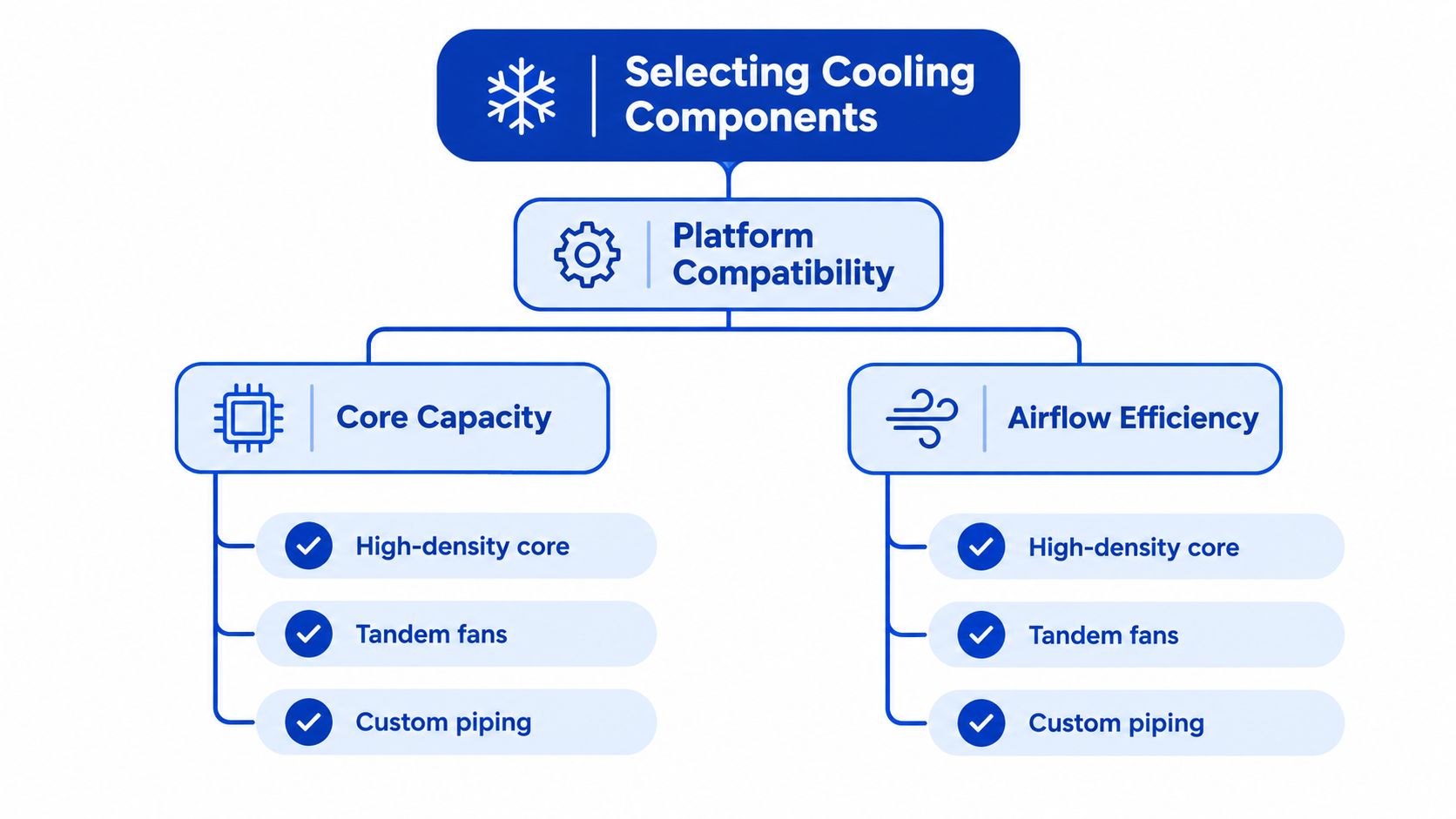
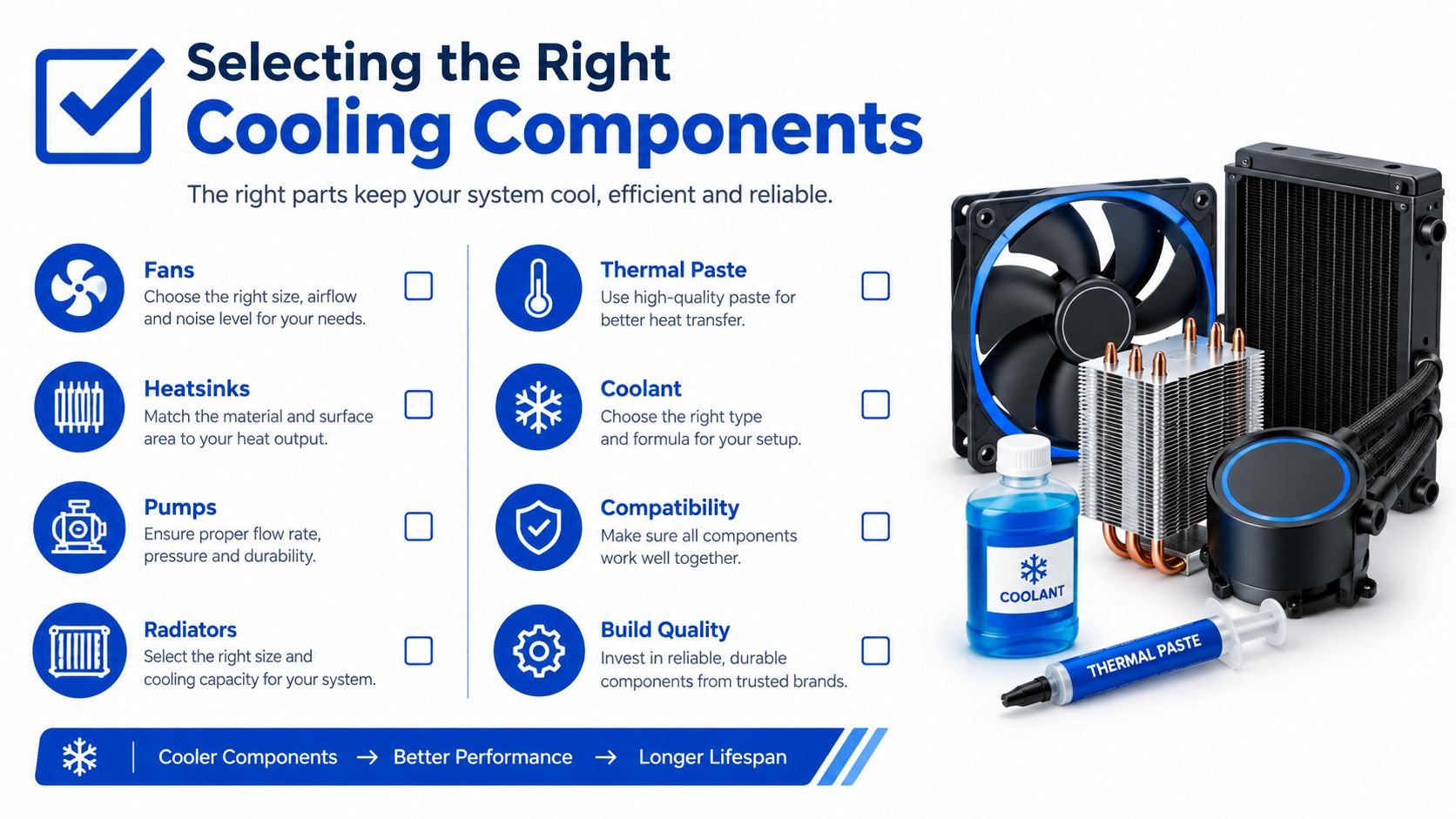
Choose cooling hardware according to the failure you can document, not the largest core listed in a catalogue. A daily-driven Audi with stable intake temperatures may need less capacity than a tuned car used for mountain pulls or track sessions. Platform, calibration, ambient temperature, front-end airflow, packaging, and time under boost all affect the right choice.
Build the decision around evidence
Check the system before replacing parts:
- Log intake temperature. Compare similar pulls and record whether temperatures continue climbing as the car repeats the test.
- Pressure-test the charge-air system. A leaking coupler, clamp, pipe, or seal can look like an intercooler problem.
- Inspect coolant flow. Confirm pump operation, hose condition, fluid level, and any sign of restriction.
- Define the use case. Road driving allows more recovery between accelerations. Track use keeps the system under load for longer.
- Match the calibration. Evaluate the complete hardware and tune combination after installation, rather than attributing every change to the intercooler.
EA837 cars need the brick, heat exchangers, and pump capacity assessed together. A properly selected heat exchanger upgrade can support the coolant circuit, but it cannot correct a restricted line, weak pump, or poor airflow elsewhere. The EA825 demands the same system-level approach, with attention to its packaging and charge-air layout. A larger component only helps when the rest of the circuit can use its capacity.
Simplify the path where possible
Pipework deserves the same scrutiny as the core. Each joiner, abrupt transition, misaligned connection, and unnecessary bend can add pressure drop or create another leak point. An intercooler development report describes lower charge-air temperatures after pipework was simplified and silicone joiners were removed. The practical lesson is to balance cooling capacity against restriction and sealing quality.
Parts selection should follow the car's use:
- Street-focused build: Prioritize reliable fitment, leak-free connections, stable temperatures, and compatibility with the current tune.
- High-output street car: Assess the brick and heat exchanger as a pair, then verify pump and airflow capacity.
- Track car: Favor repeatability, recovery between sessions, serviceability, and clear airflow through the front stack.
- Future power increase: Leave thermal headroom for the planned combination without adding volume that creates unnecessary restriction.
Vorsprung Autowerk offers Audi-focused components including ÜberBrick and Großartig intercooler bricks, GP Ice heat exchangers, and the VWA-100 water pump. Compare those options with equivalent platform-specific parts, then confirm fitment and use measured temperatures to guide the final decision.
Final Verdict on Thermal Management
An intercooler isn't just a power accessory. On the Audi EA837 3.0T and EA825 4.0T, it's part of the system that determines whether the engine can repeat its performance after heat builds.
Peak horsepower gets the attention, but repeatable charge density is what makes a performance car feel fast more than once. A capable intercooler, correctly sized heat exchanger, healthy pump, sealed charge-air path, and calibration that suits the hardware work together to protect that consistency. Oversizing one part while ignoring pressure drop or front-end airflow can create a new limitation instead of removing the old one.
The best intercooler benefits show up in the drive home from the track, the third acceleration run, and the hot-weather pull where the car still responds like it did when cold. For a serious Audi build, thermal management belongs near the beginning of the modification plan, not at the end after timing has already been pulled and the car has started disappointing you.
Vorsprung Autowerk supplies Audi-focused cooling, engine, drivetrain, and performance components for EA837 and EA825 applications, including intercooler bricks, heat exchangers, and water pump solutions. Review the available platform-specific options at Vorsprung Autowerk and build your cooling system around the way you drive.


