

A cylinder-specific misfire appears on your S4's scan report, the engine feels uneven under acceleration, and you're looking at a choice that seems simple: replace the coil identified by the code or order a complete ignition coil kit. Neither is automatically right. On EA837 and EA825 engines, a careful diagnosis and a confirmed fitment match matter more than replacing parts by guesswork.
Table of Contents
- What an Ignition Coil Kit Actually Includes
- How Ignition Coils Actually Work
- Symptoms of Failing Coils on EA837 and EA825 Engines
- When to Replace One Coil Versus Buy a Full Kit
- OEM Versus Aftermarket Coil Kits
- Fitment Notes for S4, S5, SQ5, RS6, and RS7
- Putting It All Together for Your Audi
What an Ignition Coil Kit Actually Includes
A misfiring S4 or SQ5 can make a full set of coils seem like the cleanest fix. But before ordering, check what the kit contains. Depending on the application, it may include coil-on-plug units, boots, and associated hardware or wiring. Those items aren't universal, and a box for an EA837 3.0T V6 won't necessarily resemble one intended for an EA825 4.0T V8.
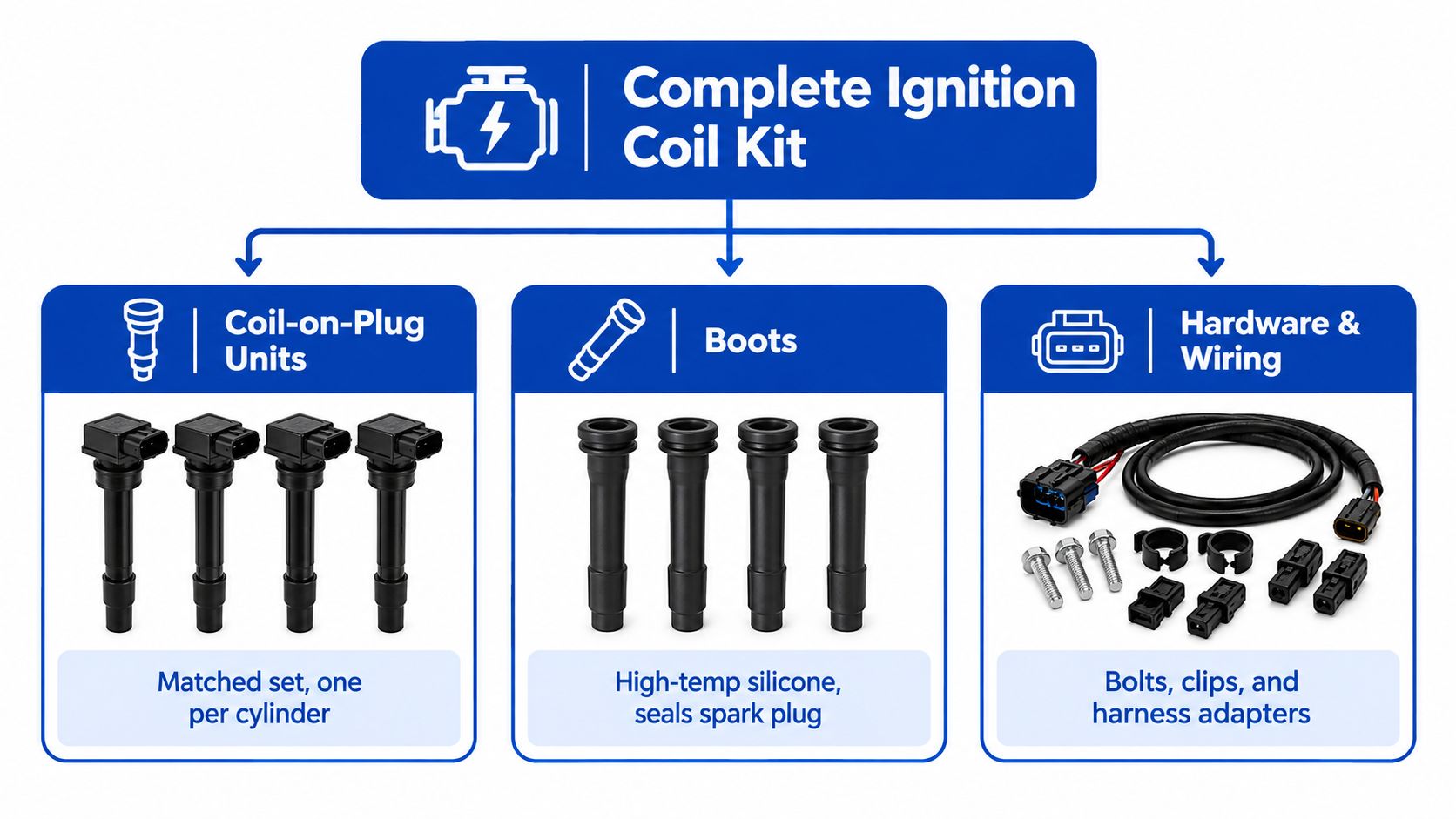
The coils are the central components. In a modern coil-on-plug arrangement, each unit sits over a spark plug and connects to the engine wiring. Boots help insulate the connection and seal around the plug; some kits include them with the coils, while others treat them as part of the coil assembly. Hardware and wiring can mean clips, fasteners, or application-specific connector pieces, but don't assume they're included. Read the listing and confirm the contents before buying.
The difference between a V6 and V8 kit isn't just the number of coils. Engine layout, coil shape, electrical connector, boot length, and mounting details can vary by application. Even vehicles carrying the same model badge can have different engine configurations across years and trims. Use the engine code and vehicle details to verify fitment, rather than relying on a broad description such as “fits Audi V6.”
Before checkout: Confirm whether the listing is for coils alone or also includes boots, connectors, and installation hardware. If a connector is the actual problem, a coil kit may not be the part you need. This guide to Audi ignition-coil connector issues can help you distinguish a connection fault from a coil fault.
Ignition-coil technology became foundational to mass-produced petrol vehicles in the early twentieth century. The electrical job remains the same today: convert low-voltage vehicle power into the high-voltage pulse needed at the spark plug, although modern Audi systems control each cylinder electronically (Denso's overview of ignition-coil principles). That history is useful context, but for a buyer, the practical point is fitment: Audi coil kits are platform-specific assemblies, not interchangeable collections of electrical parts.
How Ignition Coils Actually Work
An Audi ignition coil takes vehicle electrical power and turns it into the high-voltage pulse that fires a spark plug. The process starts with current flowing through the coil's primary winding. The engine control module controls when that current is interrupted; the interruption causes the magnetic field to collapse and induces a much higher voltage in the secondary winding. That voltage travels to the plug, where it must jump the electrode gap.
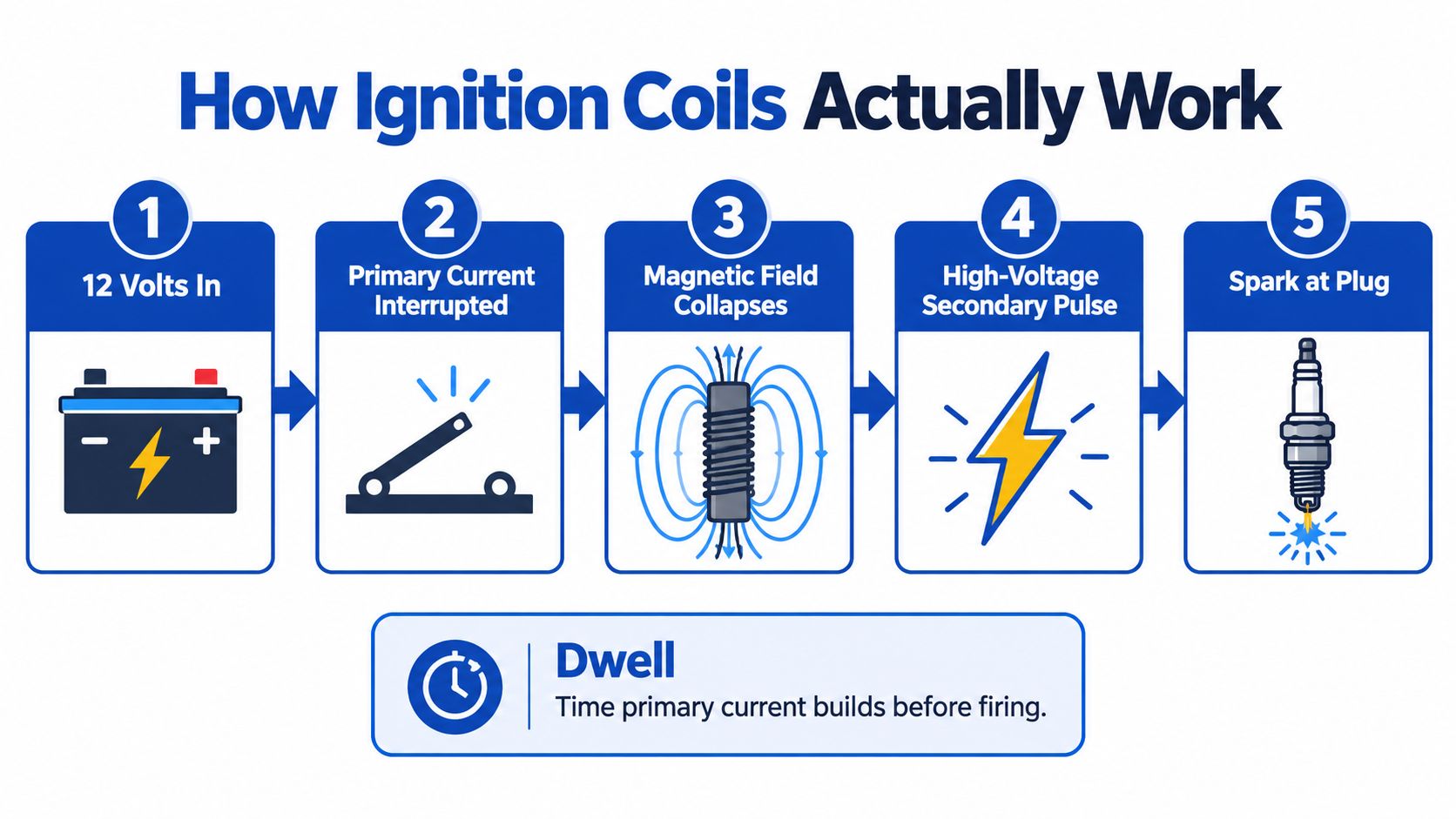
The timing before the interruption matters, too. Dwell is the time current flows through the primary winding before the coil fires. It gives the coil time to build magnetic energy. If dwell is too short, the coil may not build enough energy for a reliable spark. If it's too long, current and heat rise, increasing stress on the coil and its electrical driver. The engine controller's dwell strategy is therefore part of the compatibility picture, not an incidental detail.
That explains why a coil that looks fine on a multimeter can still misfire when the engine is under load. A static resistance reading checks only one aspect of the coil, and resistance alone doesn't show whether the coil supplies enough energy in the cylinder's operating conditions. Modern coils can also include electronics that make a simple resistance test less revealing. On a boosted Audi, a symptom that appears during acceleration deserves diagnosis under the conditions that trigger it, not just a quick check at idle.
Modern ignition coils convert approximately 12 volts into high-voltage pulses that commonly reach up to about 40,000 volts, according to Road & Track's history of ignition systems. That figure isn't a shopping target. A bigger advertised voltage number, by itself, doesn't prove a coil will suit a particular engine or deliver better real-world operation.
A short visual explanation can help make the sequence easier to picture:
Symptoms of Failing Coils on EA837 and EA825 Engines
A rough idle or stumble under acceleration can point to an ignition problem, but it doesn't identify the failed part on its own. Owners may notice hesitation, uneven running, a cold-start stumble, or a warning light accompanied by a cylinder-specific misfire. A fault that appears intermittently can be especially frustrating: the engine may feel normal during an easy drive, then falter when load rises.
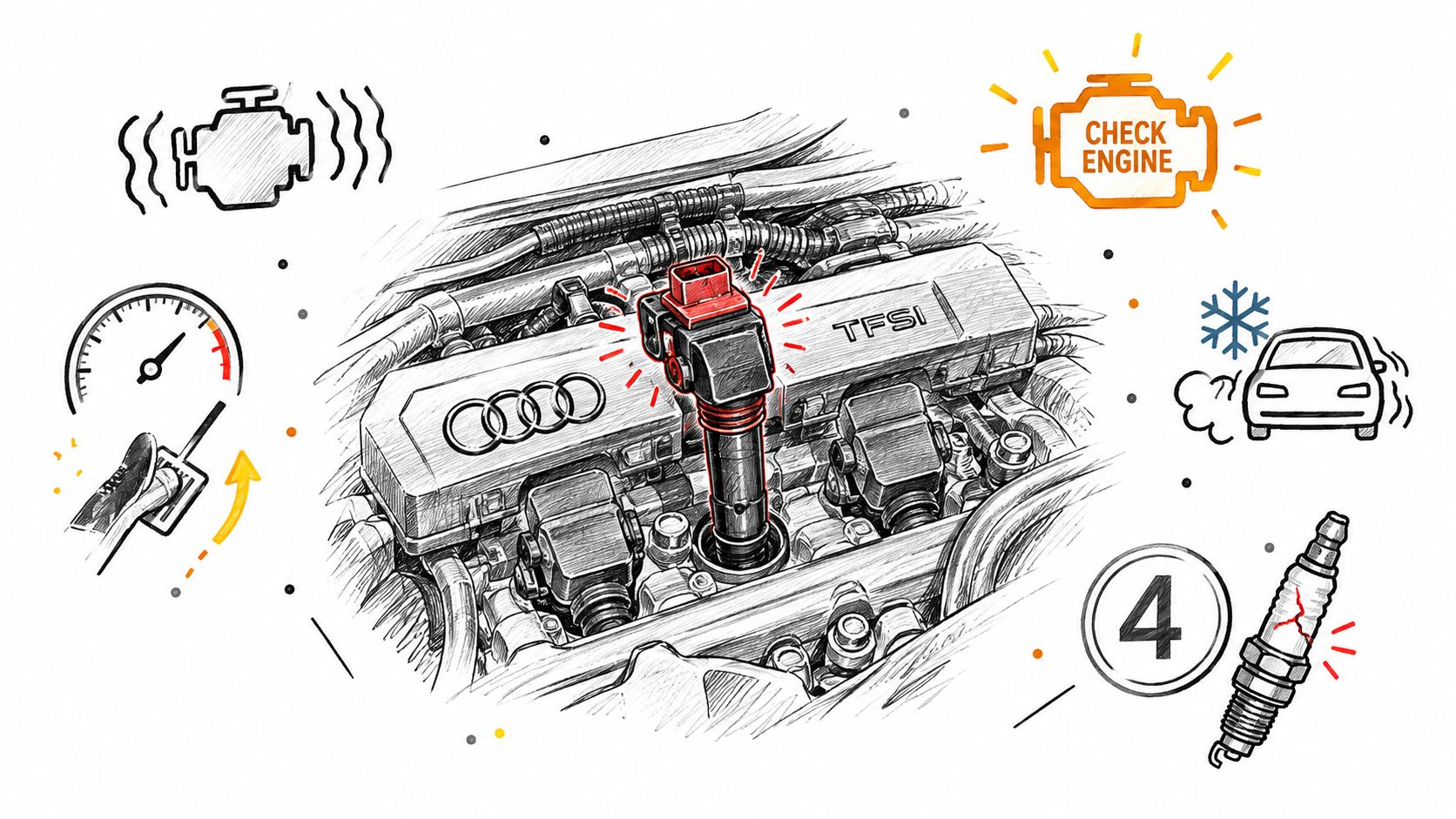
A scan tool can show which cylinder has recorded a misfire, but that doesn't prove its coil is defective. The plug may be worn or fouled, the connector may have poor contact, or the cause may lie elsewhere in the engine. On a boosted engine, investigate the wider picture rather than treating every misfire code as a parts order.
Separate a coil fault from a similar symptom
A useful diagnostic is to move the suspect coil to another cylinder, clear the relevant fault information, and see whether the misfire follows the coil. If it does, the coil becomes a stronger suspect. If the fault stays on the original cylinder, inspect the plug and connection, and continue diagnosis rather than automatically buying a complete kit. A coil swap is a clue, not a reason to skip checks of power supply, grounds, and connector condition.
Other possible causes include a faulty plug, an injector problem, a compression issue, a boost leak, a fueling concern, or an intercooler coolant leak. For either the EA837 3.0T or EA825 4.0T, the right next step depends on the car's symptoms and test results. Recording when the fault occurs, and whether it's limited to cold starts, idle, or higher load, gives the technician useful context.
Look for conditions that can damage a replacement
Coils can fail through winding opens or shorts, excessive resistance, heat, vibration, and corroded connections. Replacing a coil without addressing the condition that stressed it can invite the same problem again (AA1Car's ignition-coil reference). Inspect for contamination around the plug wells, deteriorated boots, loose or corroded terminals, and wiring damage.
A fouled plug or an issue elsewhere can produce symptoms that look like a coil fault. An Audi check-engine-light diagnosis guide offers broader context, but the engine's diagnostic evidence should lead the repair. Don't condemn a full set solely because the warning light came on.
When to Replace One Coil Versus Buy a Full Kit
A full ignition coil kit isn't automatically the right repair when one cylinder misfires. The decision should follow evidence: whether the fault moves with the coil, whether more than one coil is showing trouble, and whether the car's service history or use gives you a reason to replace a matched set together.
Start by saving the diagnostic information, including the conditions recorded when the fault occurred. Then inspect the plug and connector, and perform a controlled coil swap with a different cylinder. After clearing the fault information, run the car under comparable conditions and check whether the misfire has moved. This established workshop technique can help identify a coil fault, but power supply, grounds, connector tension, and plug condition still need attention (Pico Technology's ignition testing guidance).
| Scenario | Recommended action | Evidence to collect | Risk if wrong |
|---|---|---|---|
| A single coil appears faulty | Replace the confirmed coil, then retest | Misfire follows the swapped coil; connector and plug checked | Replacing an unfailed part, or missing the true cause |
| More than one coil has recurring faults | Consider a matched full kit after diagnosis | Repeat misfires, service history, coil and plug condition | Spending on a full set without correcting a shared wiring or engine issue |
| Preventive replacement during major maintenance | Decide based on condition and planned use | Inspection findings, past faults, access and service plans | Replacing serviceable coils, or leaving a known weak component in place |
| Tuned or track-driven car with repeat load-related misfires | Investigate the ignition system under the conditions that trigger the fault | Misfire data under load, plugs, gap, connector and heat-related condition | Blaming coils for a plug, fueling, boost, or calibration issue |
A complete set may be reasonable when several coils have documented problems or when preventive replacement fits a planned maintenance job. But replacing all coils just because one failed can add cost without fixing a cylinder-specific plug, wiring, injector, or mechanical fault. For a tuned car, establish whether the misfire repeats under the same operating conditions and check related ignition components before deciding that every coil needs replacement.
Practical rule: Replace the part your tests identify. Choose a full set when the condition of multiple coils or a considered maintenance plan supports it, not because “replace them all” sounds simpler.
An ignition diagnosis also shouldn't be confused with a cooling-system upgrade. For example, the Wagner Tuning Audi RS4 B9 / RS5 B9 Competition Intercooler Kit is a separate catalog item, not a substitute for finding the cause of an ignition misfire. If you're weighing a single replacement against a set, review this Audi ignition-coil replacement guide alongside the diagnostic results.
OEM Versus Aftermarket Coil Kits
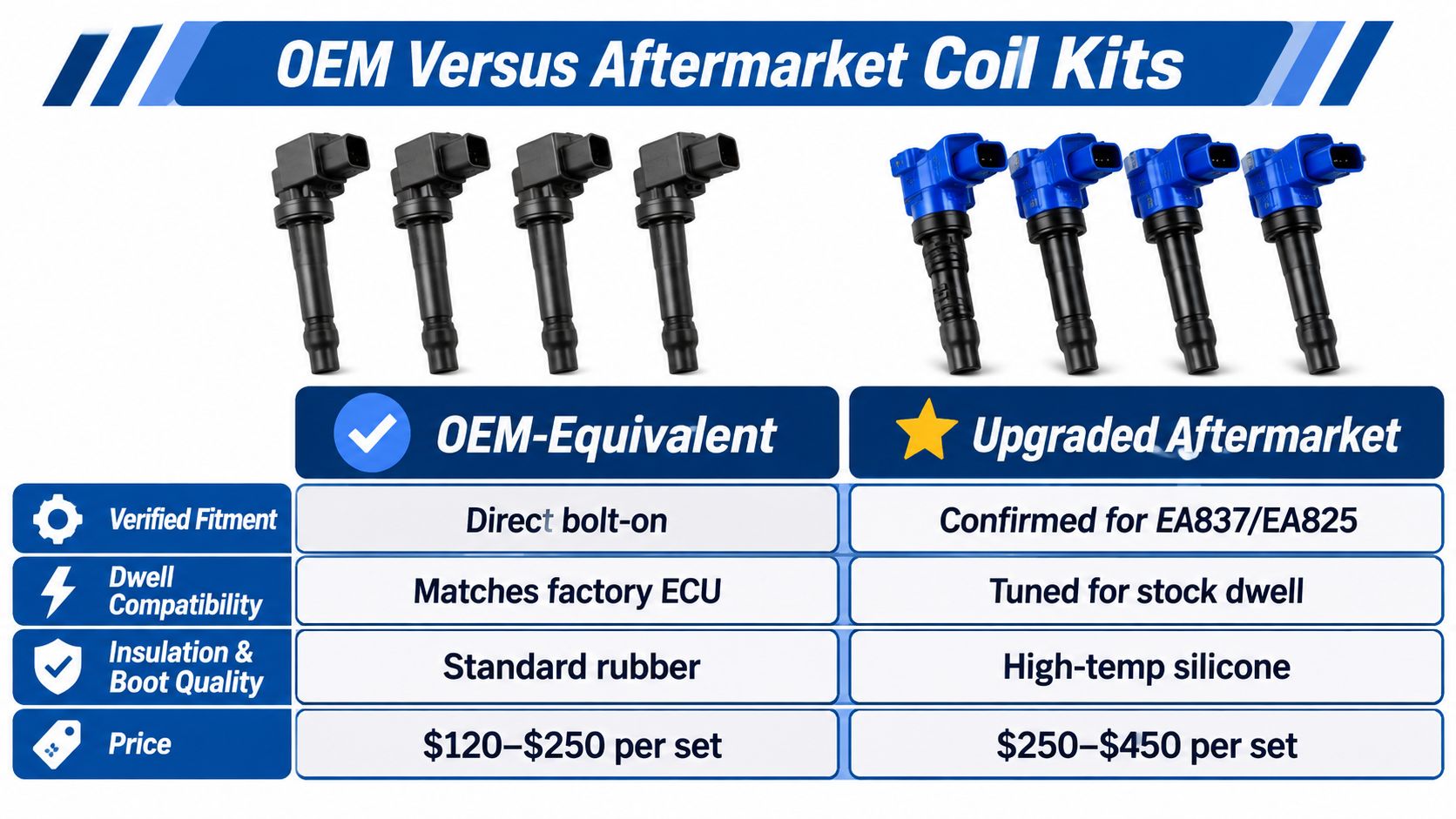
An OEM-equivalent kit is often the straightforward choice when the car is stock and the original ignition setup has been operating as intended. Its appeal is predictable fitment and compatibility with the factory engine management. An aftermarket kit can make sense when the application is clearly specified and the manufacturer provides meaningful information about construction and operating compatibility.
The trade-off isn't "standard versus stronger." A coil must work with the controller's dwell strategy, connector polarity, plug, and the conditions in which the car is driven. On a tuned or frequently hard-driven Audi, the relevant question is whether the replacement maintains reliable ignition under the owner's actual load and temperature conditions, not whether the box promises a bigger spark.
Compare evidence, not labels
Before choosing, check whether the kit is confirmed for the exact engine application, whether its connector and boot match the original, and whether it's designed to operate with the factory ECU. Ask what testing supports performance claims. Useful observations include whether misfires recur under sustained load, whether the car starts and idles consistently, and whether boots and connectors remain in good condition after heat exposure.
Coil-on-plug systems represented 51.07% of automotive ignition-coil revenue in 2025 and were forecast to grow at a 6.08% CAGR through 2031, according to Mordor Intelligence's market report. That market projection helps describe the prominence of the design, but it doesn't establish that an aftermarket coil will make a particular Audi more powerful. Treat sales trends and marketing language as separate from vehicle-specific test evidence.
For a stock engine without repeat ignition issues, an application-verified OEM-equivalent kit may be the more sensible fit. For a modified car, an upgraded option deserves consideration only if the manufacturer documents compatibility and the owner can compare operation under relevant conditions. Changing coil type without checking plugs, gap, and ECU compatibility can complicate diagnosis instead of solving it.
Fitment Notes for S4, S5, SQ5, RS6, and RS7
Model badges aren't enough to identify the correct coil kit. S4, S5, and SQ5 applications can use the EA837 3.0T, while RS6 and RS7 applications may be associated with the EA825 4.0T, but model year, market, and engine configuration affect parts selection. Confirm the engine code and vehicle details against the catalog application or parts information before ordering.
For supercharged V6 and twin-turbo V8 engines, pay attention to the connector shape, coil body, boot length, and plug-well condition. Heat and contamination can affect the parts around the coil as well as the coil itself. A set that appears to fit by cylinder count may still have the wrong connector or boot for the vehicle.
Verify before installing
Use the vehicle selector as a starting point, then confirm the result against the VIN or engine code when there's any uncertainty. Check whether the kit includes the parts you need, especially boots or connector pieces. If the listing doesn't make that clear, ask before placing the order.
Owners working on a supercharged V6 can use this Audi supercharged V6 overview as platform context, but it doesn't replace application-specific fitment confirmation. During installation, inspect the plugs and plug wells, make sure connectors seat securely, and follow the specified torque procedure for the vehicle. If the plugs are due for service, treating them as part of the same diagnostic job can help prevent a repeat misfire.
Putting It All Together for Your Audi
When a misfire appears, preserve the fault information, inspect the plug and connector, and use a cylinder swap to test whether the fault follows the coil. Replace one coil when the evidence isolates one; consider a full kit when repeat failures, condition, or planned maintenance justify it. Confirm fitment by engine code and vehicle details, not model badge alone.
For tuned or hard-driven cars, judge a kit by compatibility and repeatable operation under the conditions that trigger the fault, rather than an unsupported voltage claim. If your application is a supercharged V8, this Audi supercharged V8 overview provides additional platform context.
Before ordering, write down the engine code, the misfiring cylinder, the swap-test result, and whether the kit includes the boots and connectors you need. That short checklist can prevent a plausible-looking but incorrect purchase.
Vorsprung Autowerk offers Audi-focused performance parts and maintenance components, with catalog support for platforms including EA837 and EA825 applications. Check your vehicle details and current fitment options, then visit Vorsprung Autowerk to find parts suited to your Audi.


