

You're standing beside your Audi in the workshop, planning the exhaust changes before its next track day. Someone has suggested that the factory catalysts are restrictive, and the largest replacement looks tempting. Before you order, though, you need to know whether it'll improve the car you really drive, not just produce an attractive flow claim.
A high flow cat exhaust system needs to work when the engine is cold, fully warm, and under sustained load. The useful question isn't just whether exhaust can pass through it more easily. It's whether the complete installation balances performance, emissions conversion, heat, sound, and service life.
Table of Contents
- Why High Flow Matters on Audi Performance Cars
- How a High Flow Catalyst Creates Its Effect
- What Flow and Backpressure Data Really Show
- Cold Start Light-Off and Durability Trade-Offs
- Compare High Flow Cats and Catless Options
- Match Installation to EA837 and EA825 Platforms
- How to Choose the Right High Flow Cat
- Make a Durable Choice for Your Audi
Why High Flow Matters on Audi Performance Cars
Consider an owner preparing a supercharged Audi for track use. The proposed upgrade sounds straightforward: replace a restrictive catalyst and let the engine breathe. A careful workshop would first ask whether anyone has measured that restriction, whether the existing converter is healthy, and what conditions the replacement must survive.
That distinction matters because a catalytic converter isn't just an obstruction. It's emissions-control hardware with a flow requirement, rather than a flow component with an optional emissions function.
Catalysts became established in vehicle exhausts during the 1970s, and three-way converters were used in most new United States vehicles by 1981. Their importance came from treating hydrocarbons, carbon monoxide, and nitrogen oxides together, as documented in California's history of vehicle emissions-control development.
Start with the actual Audi platform
The main contexts here are the EA837 supercharged V6 and EA825 V8. Owners shopping across S4, S5, Q5, SQ5, RS6, RS7, and Q7 listings need to distinguish the vehicle badge from the specific engine and exhaust application. A model name alone isn't a fitment specification.
For example, an owner comparing generations can use the Audi S4 B9 exhaust guide as platform-specific reading, not as evidence that parts interchange with a supercharged application.
Workshop rule: Diagnose the restriction before choosing the replacement. A bigger opening isn't evidence that the original component was the limiting factor.
A sensible assessment separates the owner's priorities:
- Performance: Establish whether catalyst restriction matters at the intended operating load.
- Daily use: Decide how much change in cold-start noise and cruising character is acceptable.
- Reliability: Consider maintenance condition, calibration, and repeated heat exposure.
- Road use: Confirm the applicable replacement and emissions requirements before purchasing.
The result may still be a high-flow catalyst. It may also be a conventional replacement, repair of an underlying engine problem, or no catalyst change at all. An engineer's job is to identify the appropriate solution, not automatically specify the most open component.
How a High Flow Catalyst Creates Its Effect
Think of breathing through a smooth tube compared with breathing through a tube containing a narrow, uneven insert. Both allow air through, but one requires more effort. The exhaust analogy is useful, provided we remember that a catalyst must also perform chemical conversion.
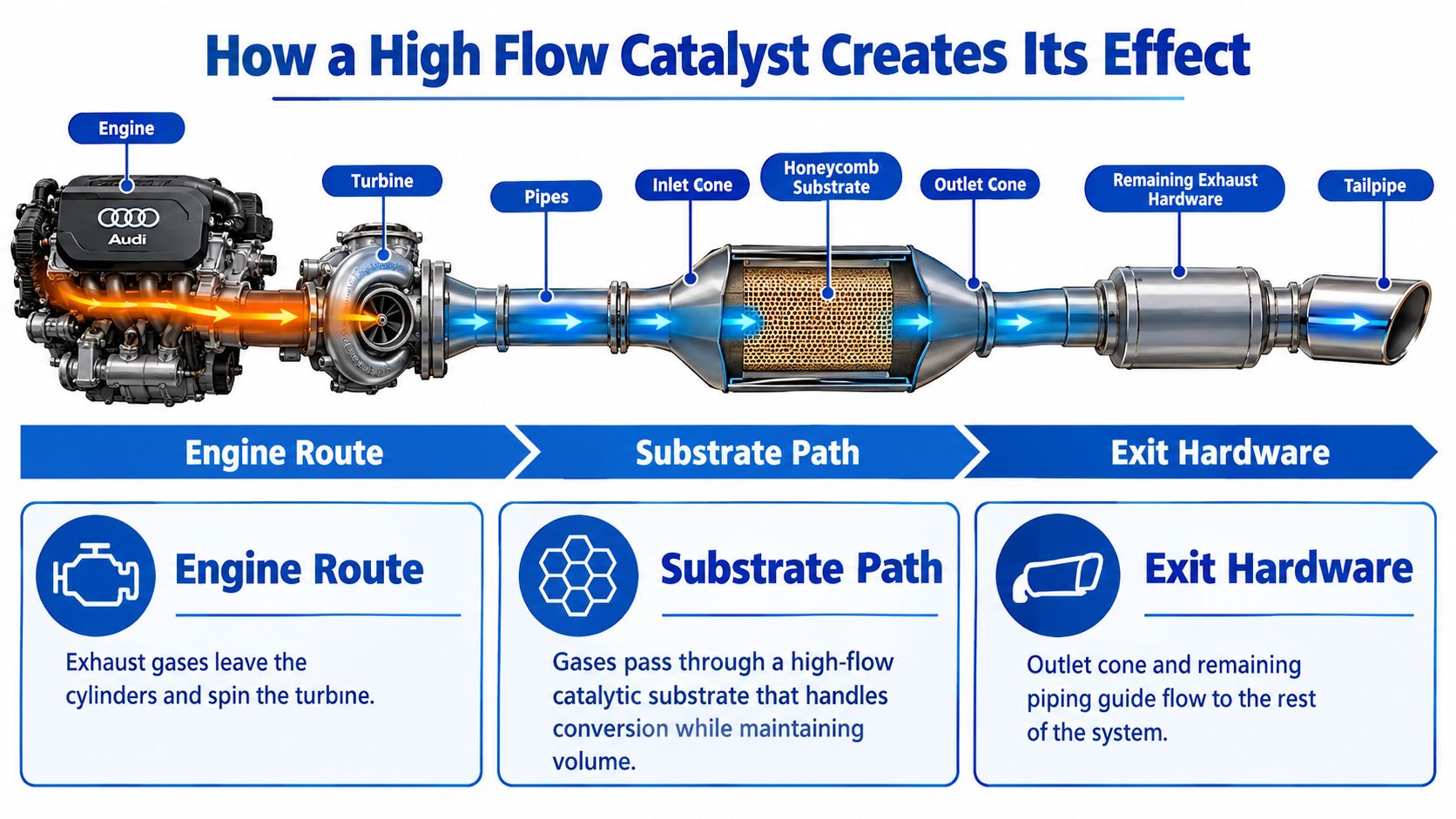
Exhaust leaves the cylinders and travels through the upstream hardware toward the converter. On a turbocharged application, that route includes the turbine. The supercharged EA837 doesn't have an exhaust-driven turbine, so the illustrated route below needs that distinction.
The diagram shows the major features to inspect along the gas path.
Separate flow from conversion
Inside the converter, gases pass through a honeycomb-like substrate, often called the brick. The inlet cone distributes gas into it, and the outlet cone collects gas leaving it. Connecting pipes and downstream exhaust hardware complete the route.
Several terms describe different aspects of that process:
- Pressure drop: The difference between pressure measured immediately before and after a component.
- Backpressure: Pressure upstream associated with resistance farther along the exhaust.
- Exhaust mass flow: How much exhaust mass passes through the system over time, rather than just how fast gas moves.
- Pumping loss: The work the engine expends moving gases against resistance.
- Light-off: The temperature region where the catalyst begins achieving effective conversion.
- Conversion efficiency: The proportion of a particular pollutant the catalyst converts under defined conditions.
These aren't interchangeable measurements. Low pressure drop doesn't establish good conversion, and effective conversion during a warm test doesn't establish good cold-start performance.
Why the complete passage matters
A wide pipe can still feed gas poorly into the brick. Abrupt transitions, offset connections, or intrusive welds can undermine an otherwise promising component. Conversely, an intelligently shaped assembly can improve flow without relying solely on a larger outside diameter.
The practical engineering target is less unnecessary resistance while retaining effective catalyst operation. That requires evaluating the passage, substrate, coating, temperature behavior, and control-system compatibility together.
A product description that discusses only pipe size has described the housing. It hasn't yet demonstrated how well the catalytic converter works.
What Flow and Backpressure Data Really Show
A flow claim becomes useful when the seller explains how it was measured. Temperature, engine load, measurement locations, and exhaust mass flow determine whether a comparison means anything for your Audi.
The engineering evidence illustrates why. Reported examples include catalyst pressure drops of approximately 2–10 kPa between 2,000 and 5,000 rpm on a 3.8 L V6; separate dynamometer results associated 10.4 kPa of added backpressure with about 4% less peak torque and 5% less peak power, while 17.3 kPa reduced peak power by approximately 7%, as summarized in engineering literature on exhaust backpressure.
Those results aren't horsepower promises for an EA837 or EA825. Different engines, operating conditions, and complete exhaust systems prevent that shortcut. They demonstrate that restriction can have a measurable cost, not that reversing a published restriction test guarantees an identical gain.
Read geometry alongside the measurements
Pressure loss increases approximately with the square of flow velocity in the engineering context described above. Consequently, a component that looks acceptable at modest flow may behave differently during a high-load pull.
Substrate geometry also matters. A modeled converter comparison reduced backpressure from 10.3 kPa to 9.0 kPa through internal design changes; the same research discusses inlet-cone length, flow distribution, cell density, material, and coating thickness in its analysis of catalytic-converter resistance.
Hydraulic diameter describes the effective size of each gas passage. It helps explain why nominal cell count alone can't describe resistance: wall thickness and coating also affect the space available for flow.
What Exhaust Flow Evidence Means
| Measure or claim | What it tells you | What to verify |
|---|---|---|
| Differential pressure | Resistance across the measured assembly | Sensor locations, temperature, load, and mass flow |
| Cell-density claim | A feature of substrate layout | Passage size, coating, material, and conversion evidence |
| Pipe diameter | Available passage size in that pipe | Cones, flanges, alignment, and internal weld intrusion |
| Peak-power comparison | Output under the test conditions | Same calibration, fuel, temperatures, and supporting hardware |
| Flow-bench figure | Behavior in that particular bench setup | Gas conditions and relevance to engine operation |
For validation, ask a suitably equipped workshop to measure pressure before and after each catalyst during controlled testing, alongside exhaust temperature, lambda, and boost. Comparing several relevant operating points is more informative than selecting a single favorable result.
A meaningful performance claim includes the conditions that produced it. Without those conditions, you can't reliably compare products.
Cold Start Light-Off and Durability Trade-Offs
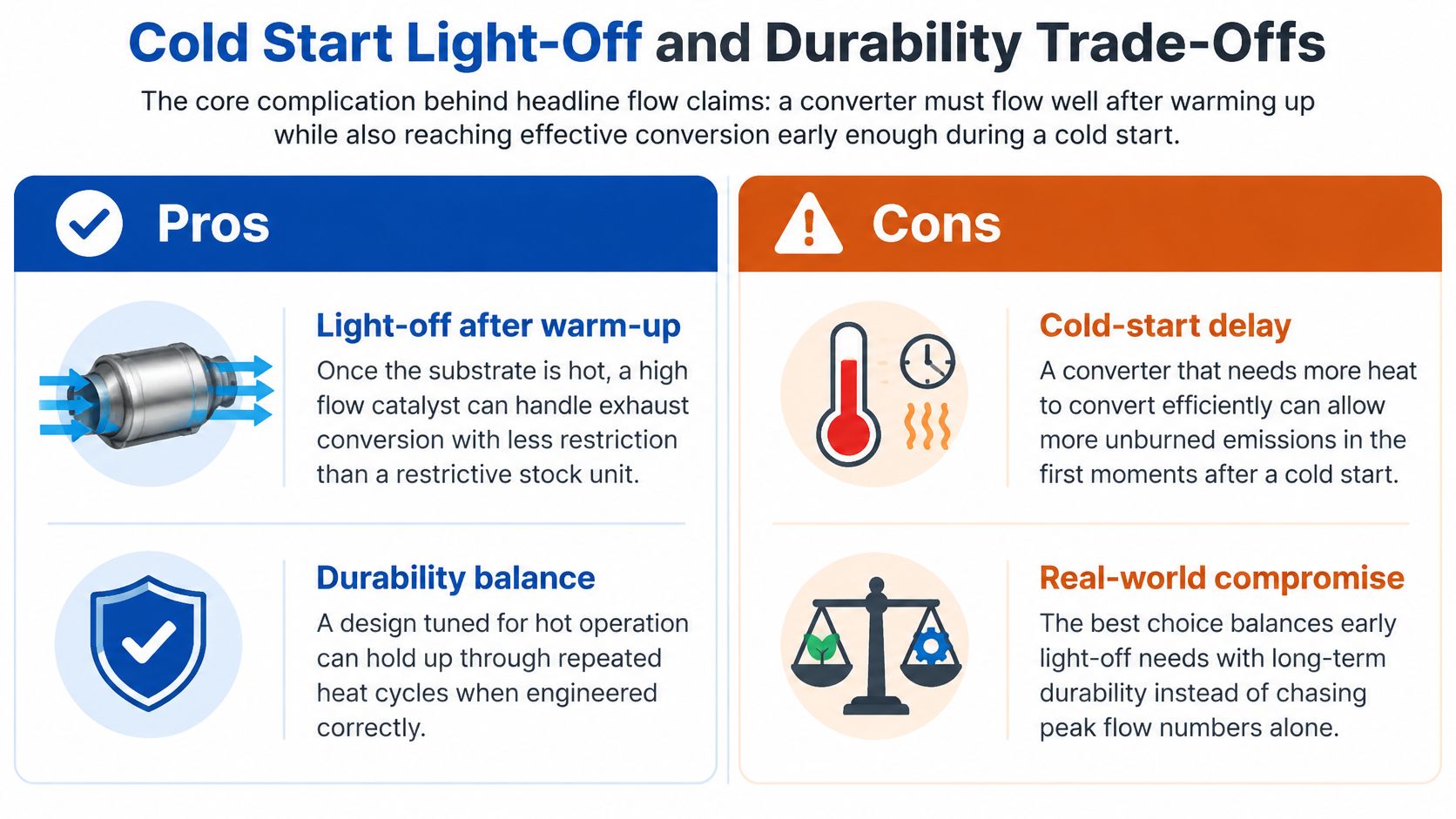
A catalyst resembles a furnace in one important respect: it needs sufficient heat before it works effectively. Excellent warm-flow performance doesn't answer how much untreated exhaust passes through during warm-up.
Typical three-way-catalyst light-off is around 250–300°C. Cold-start research reports exhaust remaining below light-off for more than 200 seconds in a driving cycle and findings that more than 60% of hydrocarbons in an FTP cycle can occur before light-off, discussed in this review of cold-start catalyst heating and emissions.pdf).
For a short-trip Audi, that makes warm-up behavior a serious buying criterion, not a secondary detail. The comparison below highlights the balance between hot operation and early conversion.
Faster flow isn't automatically better cold performance
Substrate volume, thermal mass, catalyst position, insulation, and heat retention all deserve attention. A design change can improve warm restriction while creating a different warm-up compromise. You can't infer the outcome from a photograph or assume that every larger converter warms more slowly.
Ask for inlet and outlet temperature traces from a cold start, pollutant-conversion measurements, and the ambient and driving conditions used. Temperature alone isn't a direct measurement of conversion efficiency.
Sensor behavior matters too. The Audi oxygen-sensor guide provides relevant background for discussing feedback and monitoring with your workshop.
Excessive heat creates a different problem
Repeated hard use, rich operation, ignition misfires, oil consumption, and calibration errors can age or damage the substrate and coating. The broader relationship between temperature and catalyst effectiveness is discussed in research on catalytic-converter performance and operating temperature.
Before blaming a recurring catalyst-efficiency fault on the replacement part, investigate:
- Combustion condition: Review misfire counters, fuel trims, and lambda readings.
- Thermal exposure: Compare available temperature data with the manufacturer's documented operating limits.
- Mechanical condition: Inspect for leaks, damaged shielding, rattles, and visible substrate damage where accessible.
- Restriction changes: Compare current pressure readings with the installation baseline.
A warm inspection result doesn't fully describe cold or transient performance. Likewise, a fault code doesn't identify the root cause by itself. Treat the catalyst as part of the engine's operating system, not an isolated consumable to replace repeatedly without diagnosis.
Compare High Flow Cats and Catless Options
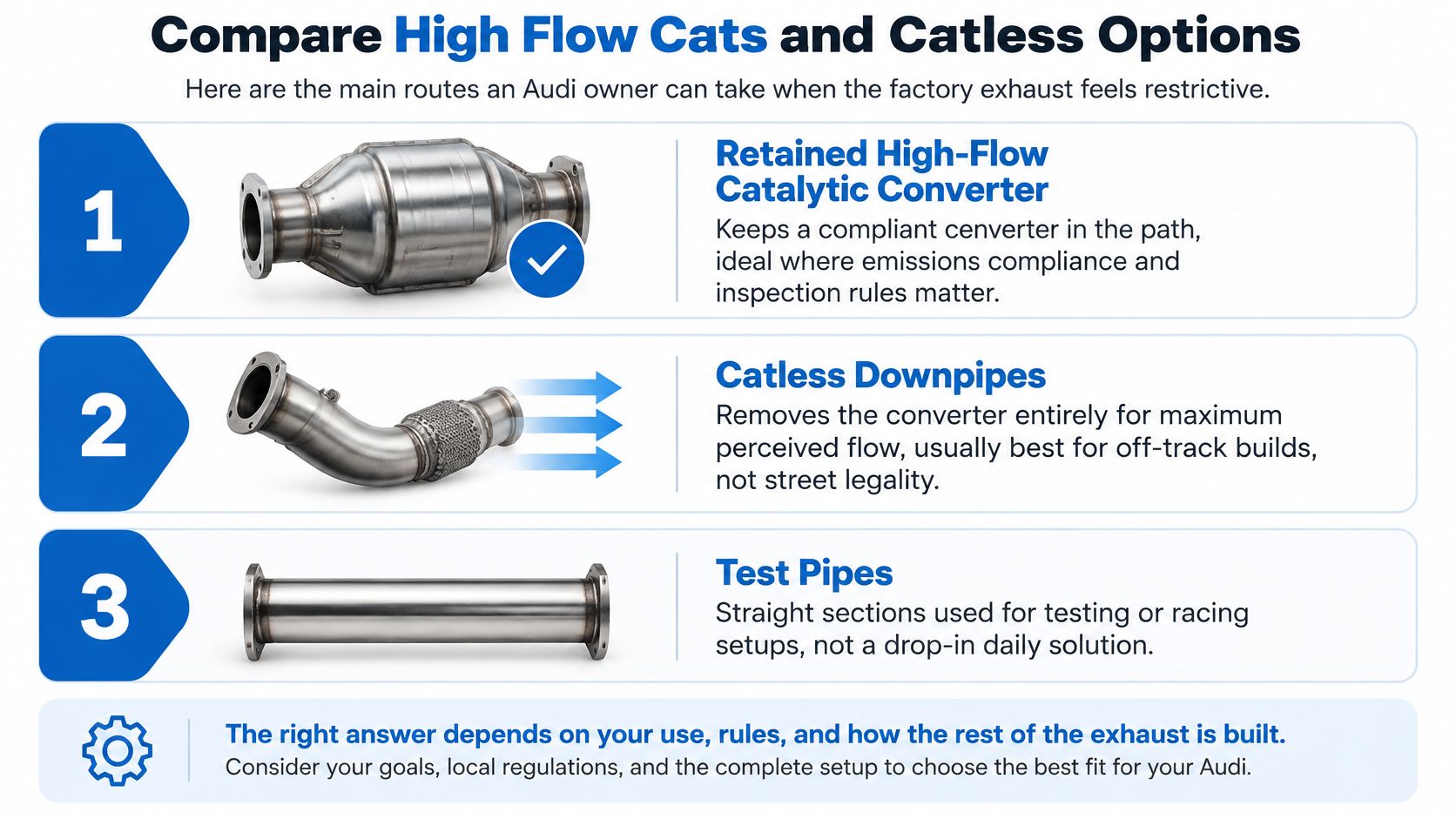
Removing a catalyst and improving a catalyst are different engineering choices. A catless assembly removes the conversion element; a high-flow converter attempts to retain that function while managing restriction.
Neither a catless downpipe nor a test pipe should be treated as an automatically suitable road-car upgrade. The labels describe hardware configurations, not legal exemptions or proof of better overall performance.
The visual comparison identifies the main alternatives, but application documents must determine their permitted use.
Compare the complete ownership trade-off
For sound, request recordings from the same engine and comparable downstream exhaust, including cold start and steady cruising. Don't assume an acceleration clip establishes acceptable cabin noise, and don't equate loudness with measured performance.
Compare High Flow and Catless Exhaust Routes
| Option | Emissions hardware | Primary strength | Primary trade-off |
|---|---|---|---|
| Application-approved high-flow catalyst | Retains catalytic conversion | Balances conversion and lower restriction | Needs supporting flow, durability, and approval evidence |
| Catless downpipe | Removes the converter in the replaced section | Removes catalyst restriction there | Loses that conversion function and raises legal-use concerns |
| Test pipe | Bypasses the replaced catalyst | Simple catalyst-free passage | Same conversion concern, with fitment dependent on the assembly |
| Conventional factory-style replacement | Retains catalytic hardware | Replacement-focused approach | May not address a documented high-load restriction |
One available option is Vorsprung High Flow Cats, Audi 3.0T V6 Supercharged Q5/SQ5/S4/S5. The listing describes a metallic substrate, revised flanges and mounting points, refined mating surfaces, and included heat shielding. Those disclosed features provide useful questions for comparison, but they don't independently establish approval for every vehicle or jurisdiction.
For a failed-catalyst replacement, prioritize finding the cause of failure and confirming the lawful replacement specification. For a daily driver, include serviceability and inspection requirements in the decision. For a dedicated competition build, confirm the governing rules before treating any catalyst-free option as appropriate.
The decision shouldn't end at the component's purchase price or advertised flow. Consider installation access, future inspection, sensor compatibility, maintenance, and the consequences of having to remove the assembly again.
Match Installation to EA837 and EA825 Platforms
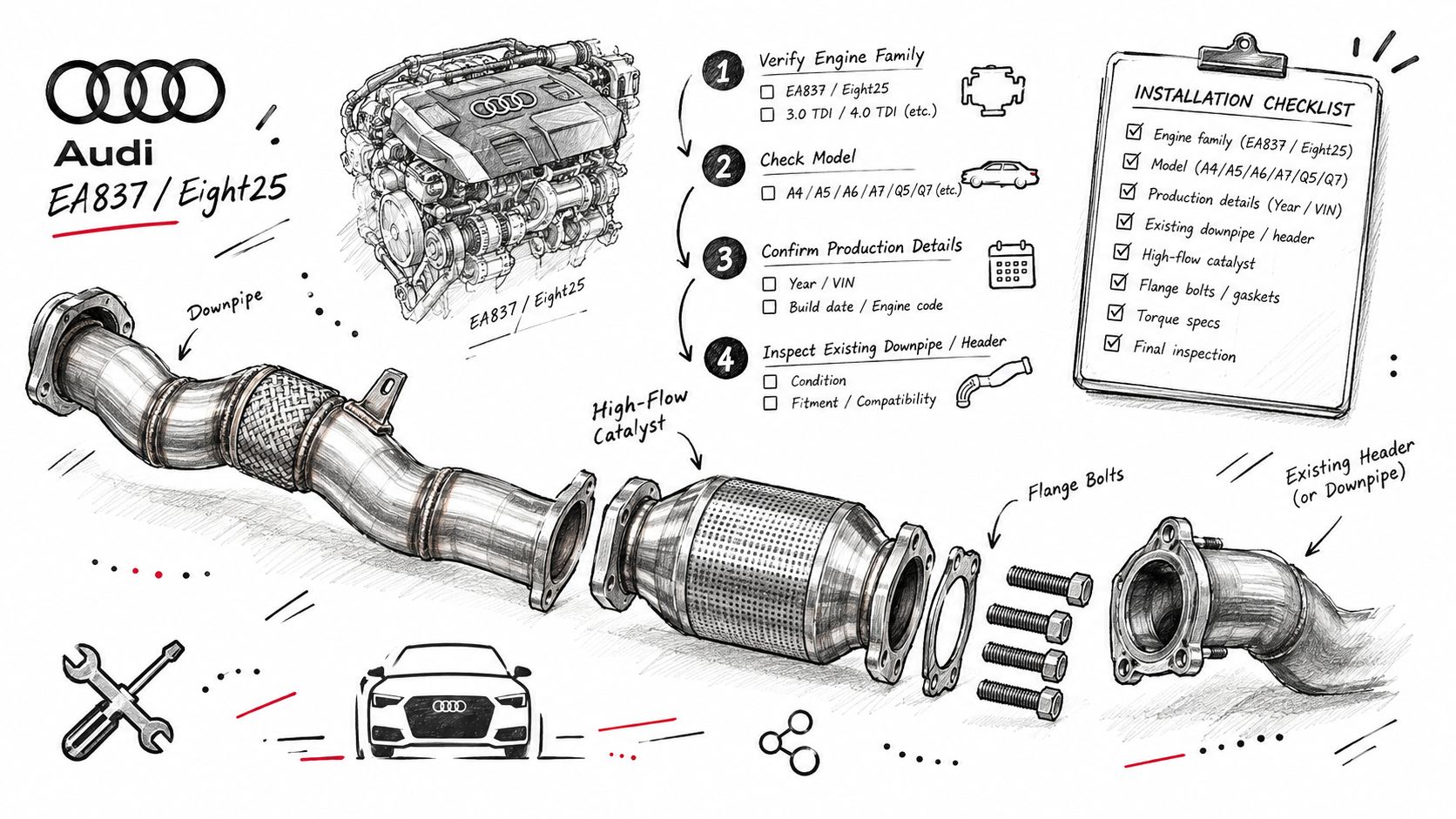
Fitment begins with vehicle identification, not the listing's headline. Confirm the engine code, production details, existing upstream arrangement, sensor provisions, and downstream connection before dismantling anything.
Use the illustration as a checklist prompt, rather than a substitute for vehicle-specific workshop information.
Establish the mechanical match
An EA837 assembly shouldn't be assumed to suit an EA825, and shared engine branding doesn't guarantee identical installation details across vehicles. Ask for written application confirmation when an existing exhaust has already been modified.
- Check connections: Confirm flange patterns, mating surfaces, brackets, and the relationship to the remaining exhaust.
- Inspect the passage: Look for offset transitions and weld intrusion before installation.
- Preserve protection: Confirm shielding coverage and clearance around wiring and nearby components.
- Plan access: Identify sensor-removal requirements and follow the applicable workshop procedure.
Disclosed fabrication cues such as TIG welding, back-purging, and integrated heat shielding are worth examining. None guarantees correct alignment or durability by itself. A well-made assembly still needs to mount without being forced into position.
The header-installation guide can support preparation where headers are involved, but it doesn't replace instructions for the specific catalyst assembly.
The accompanying installation video provides another reference to assess against your own application.
Verify before applying full load
Keep sensors in their specified positions and protect their wiring from heat, tension, and contact. Use the prescribed fasteners, tightening procedure, and leak-check method rather than improvising around a poor fit.
After installation, inspect joints and brackets, scan for faults, and review sensor operation and any required adaptation procedure. Record a baseline under controlled conditions before evaluating performance. Don't use calibration changes that suppress diagnostics as evidence that the installation is functioning correctly.
How to Choose the Right High Flow Cat
Start by describing the vehicle's actual work. A short-trip commuter, a road car used for occasional spirited driving, and a competition vehicle don't need to prioritize the same evidence.
For the commuter, cold behavior and lawful road use deserve particular attention. For repeated high-load operation, request credible thermal and aging information alongside pressure measurements. In either case, the manufacturer should explain the conditions behind its claims.
Build a documentary shortlist
Ask each supplier for a compact evidence package rather than a collection of marketing terms:
- Vehicle application: Written confirmation covering the engine, chassis, production details, and connecting hardware.
- Measured performance: Differential-pressure results with relevant flow and temperature conditions.
- Conversion behavior: Cold and warm emissions evidence, including the test procedure.
- Durability: Aging methods, post-test condition, operating limits, and warranty exclusions.
- Control compatibility: Sensor provisions and any legitimate calibration requirements.
- Legal documentation: Applicable certification or approval tied to the particular vehicle.
Regulatory history explains the importance of aged testing. The EPA's 1986 aftermarket policy specified minimum conversion efficiencies of 70% for hydrocarbons and carbon monoxide and 30% for nitrogen oxides; California's revised requirements applied to relevant new aftermarket converters after January 1, 2009, requiring demonstration that an aged converter could meet the vehicle's original standards, as detailed in CARB's aftermarket-converter regulatory analysis.
Reject incomplete comparisons
A road-compliance claim should identify the relevant application and jurisdiction. A statement that a converter contains emissions-control material isn't the same thing as approval to install it on your car.
Likewise, a temperature rating needs context. Ask whether it describes continuous operation, a defined exposure, or a specific validation procedure rather than assuming the number answers every durability question.
If you're changing more than the catalyst, establish the full project scope using the turbo-back exhaust explanation. Otherwise, you may compare a standalone converter with a complete assembly and misattribute the differences.
Buying standard: Prefer a supplier who explains the test limitations over one who offers a universal gain without application-specific evidence.
Make a Durable Choice for Your Audi
The right high flow cat exhaust system is the one whose documentation and installation match your Audi's needs. The biggest opening, lowest cell-count claim, or most dramatic dyno graph can't make that decision alone.
Use a written comparison sheet before ordering. Record what each supplier has demonstrated, what remains unverified, and which questions require an answer from the installer. Missing evidence shouldn't become an assumption in the product's favor.
Choose the appropriate decision path
- Road-driven EA837 or EA825: Confirm lawful application first, then evaluate the operating evidence, installation requirements, and sound expectations.
- Dedicated competition vehicle: Check the applicable rules, then choose hardware supported by the intended load profile and maintenance plan.
- Vehicle with an existing fault: Diagnose the engine and exhaust before selecting replacement hardware.
For road use, the high-flow catalytic-converter legality guide is a starting point for identifying the questions to verify in your market, not a substitute for application-specific approval.
Before authorizing the job, ask the workshop to document the vehicle's condition, confirm the proposed component, and agree on post-installation checks. That turns an exhaust purchase into an engineering decision with a clear basis, rather than an experiment you assess only after the parts are fitted.
Vorsprung Autowerk offers Audi-focused exhaust components and model-specific fitment information, including high-flow catalyst options for defined applications. Visit Vorsprung Autowerk with your engine code, vehicle details, existing exhaust configuration, and intended use to discuss the relevant hardware and documentation before ordering.


