

You're standing over the engine bay with the reservoir below its proper level, the steering feels heavier than usual, and a bottle of generic power steering fluid is within reach. It's an easy mistake to make, especially on an Audi EA837 or EA825 where different model years and steering architectures can sit under the same broad “power steering oil” search.
The correct fluid isn't chosen by color, bottle shape, or brand familiarity. It's chosen by the steering system, production era, and approved specification. A careful top-up can protect a hydraulic pump, while an uncertain mixture can create noise, poor assist, seal problems, and a repair bill that far exceeds the cost of the fluid.
Table of Contents
- Why the Wrong Audi Power Steering Oil Ruins a Good Pump
- Audi Power Steering Fluid Generations Explained
- CHF 11S vs CHF 202 Which Spec Fits Your Audi
- Matching Fluid to Audi Platform and Steering Type
- How to Top Up, Bleed, and Flush Safely
- Contamination Signs and When to Replace the Fluid
Why the Wrong Audi Power Steering Oil Ruins a Good Pump
Low fluid pushes the system to show its weakness fast. The pump may whine at parking speeds, the steering may feel heavy, or the reservoir may be low because a hose, seal, pump, or rack is leaking. The easy mistake is to top it off with whatever bottle is on the shelf.
That small shortcut turns a service issue into a hydraulic problem. Audi steering fluid works inside the pump, valves, seals, and rack, so it has to hold the right viscosity, lubricate moving parts, and stay predictable as temperatures change. ATF and hydraulic steering fluid belong to different fluid categories, even if both are sold for automotive use.
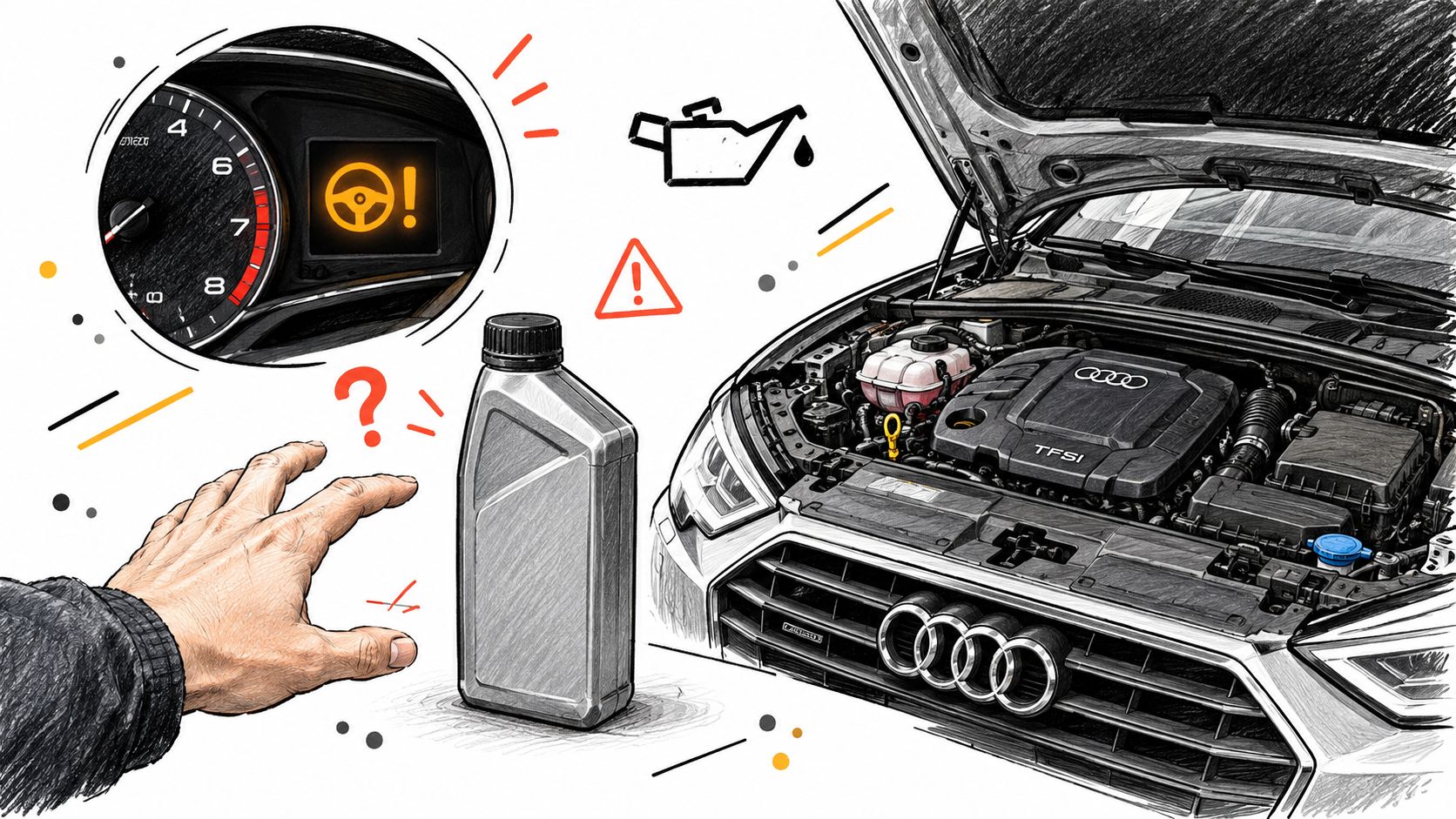
Why chemistry matters more than the label
A hydraulic pump does not care whether the bottle says “premium” or “synthetic blend.” It responds to viscosity and additive package. Wrong chemistry can change pump loading, seal compatibility, and valve response, and the result may be groaning, uneven assist, or a steering wheel that feels different once the fluid warms up. The technical information for Pentosin CHF 11S draws that line clearly, separating it from ATF and showing where this fluid belongs in hydraulic steering and related central hydraulic systems.
I have seen owners add fluid to a noisy pump when the noise was really air in the system or the wrong fluid already circulating. More fluid does not correct contamination. It only raises the level of the same mix moving through the pump.
Practical rule: If you cannot identify the specification already in the reservoir, do not use a convenient substitute. Identify the system first, then decide whether a top-up is safe.
Audi's fluid specifications changed across generations, detailed in the next section. That shift is why forum advice often conflicts, and why model-year-aware service matters. The Audi power steering fluid application timeline helps explain why the same “power steering oil” label can point to very different fluids. The same mindset applies when choosing braided oil lines for an Audi build.
Audi Power Steering Fluid Generations Explained
Audi power steering fluid follows the steering system's era and hydraulic architecture. A bottle that suits an early mineral-fluid system can be wrong for a later low-viscosity circuit, even when both are sold as power steering oil. That mismatch can increase pump noise, affect valve response, and leave incompatible additives circulating through seals.
The three eras
| Audi steering fluid era | Common specification family | Practical meaning |
|---|---|---|
| Early 1980s to 1989 | CHF 7.1 | Mineral-based hydraulic fluid used by many early Audi applications |
| 1990s through 2005 | TL 52 146.00, G 002 000 A2, commonly associated with CHF 11S-type fluid | Synthetic hydraulic chemistry for a later generation of systems |
| 2006 onward | TL 52 146.01, G 004 000 A2, CHF 202-type fluid | Fully synthetic hydraulic fluid used in later applications |
The documented Audi fluid application history places many Audi applications from 1984 to 1989 in the CHF 7.1 era, 1990 to 2005 with CHF 11S-type fluids, and 2006 onward with CHF 202-type fluids. Treat those ranges as orientation points. Confirm the specification on the reservoir cap, service documentation, or the replacement part before opening the bottle.
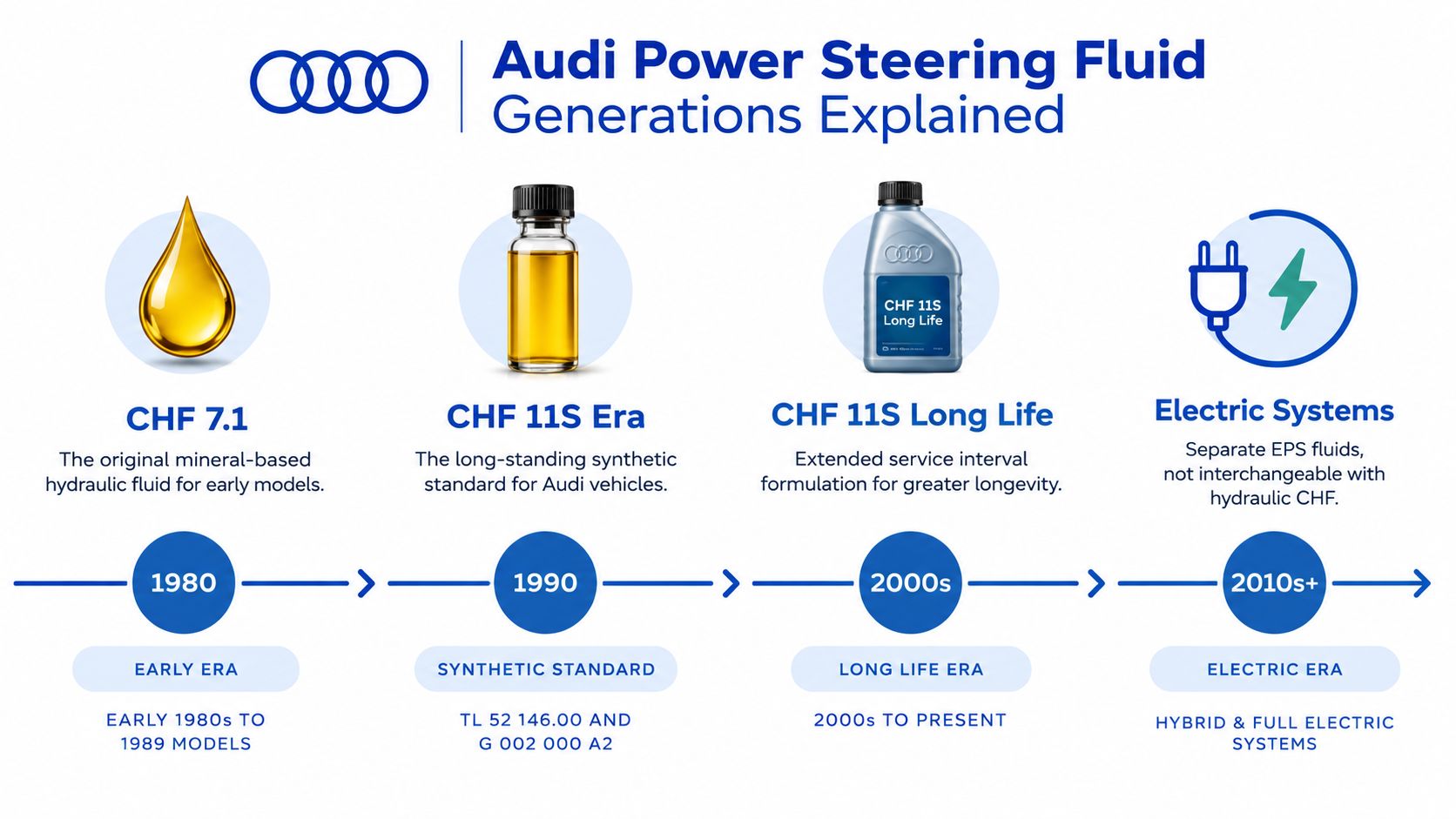
How to use the timeline in the workshop
The model year narrows the search, but it does not identify the fluid by itself. Check the steering architecture first. A conventional hydraulic rack and pump need the specified hydraulic fluid. An electro-hydraulic system still has a fluid circuit, but its pump, reservoir, and operating demands differ. A fully electric steering system has no hydraulic fluid reservoir to service.
Read every marking on the cap and bottle. You may see G 002 000, G 004 000, CHF 11S, CHF 202, TL 52 146.00, or TL 52 146.01. Do not use color as a specification, and do not treat ATF as a substitute for a hydraulic fluid just because the fluid looks similar.
A fitment reference such as this Audi A4 fluid application can help confirm which products are listed for a particular platform, but it does not replace the vehicle's own specification.
A partial top-up is risky when the existing fluid is unknown, dark, aerated, or contaminated. Adding the correct fluid to an incorrect mixture leaves the pump moving both chemistries. If the system has already received the wrong oil, drain and flush it rather than relying on a cross-system bleed. A clean flush removes more of the old mixture and gives the replacement fluid a better chance to protect the pump, seals, and steering valves.
CHF 11S vs CHF 202 Which Spec Fits Your Audi
A low fluid level does not tell you which bottle to buy. A dark reservoir, noisy pump, or recent steering repair can leave the system filled with an unknown mixture. Identify the fluid specification and steering circuit before adding anything.
CHF 11S and CHF 202 are both low-viscosity synthetic hydraulic fluids used in Audi and Volkswagen hydraulic applications. They are not automatic transmission fluids. Their friction and additive packages are intended for hydraulic steering, level control, and related central hydraulic circuits, so similar appearance or color is not enough to establish compatibility.
Audi references commonly associate CHF 11S with the G 002 000 family and CHF 202 with G 004 000. Check the reservoir cap stamp before ordering. G 002 000 points to a CHF 11S-type specification, while G 004 000 M2 points to a CHF 202-type specification. Photograph the cap and the old fluid label before buying. Those details are more useful than relying on a generic “Audi power steering oil” search result.
The practical comparison
| Question | CHF 11S | CHF 202 |
|---|---|---|
| Fluid type | Low-viscosity synthetic hydraulic fluid | Later low-viscosity synthetic hydraulic fluid |
| Common Audi reference | G 002 000 | G 004 000 family |
| Correct use | Match the vehicle's CHF 11S or G 002 000 specification | Match the vehicle's CHF 202 or G 004 000 specification |
| ATF substitute | No | No |
| Ordering check | Confirm the cap, manual, and vehicle-specific parts data | Confirm the cap, manual, and vehicle-specific parts data |
The published operating envelope for Pentosin CHF 11S is approximately -40°C to +130°C, according to this Pentosin fluid comparison document. That range reflects the demands placed on the fluid during cold starts, repeated parking maneuvers, and sustained heat. Low-temperature flow helps the pump build assistance without excessive strain, while high-temperature stability helps limit viscosity loss and aeration.
Why a partial top-up can fail
A top-up is appropriate only when the existing fluid is identified, clean, and low for a known reason, such as work on the system. Add the same approved specification, then inspect for the leak that caused the level to fall.
Suspected ATF exposure, foam, unexplained discoloration, or an unknown fluid changes the repair. Adding CHF 11S or CHF 202 may lower the concentration of the wrong fluid without removing it. The pump, seals, and steering valves still see the contaminated mixture.
Drain and flush the circuit instead of relying on a cross-system bleed. A proper flush removes more of the old chemistry and gives the replacement fluid a consistent working environment. The same discipline applies when servicing a supercharged Audi V6, where fluid identification and contamination control matter before the system is returned to service.
Matching Fluid to Audi Platform and Steering Type
The model badge alone isn't enough. First establish whether the car has hydraulic power steering, electrohydraulic power steering, or an electric steering system with no hydraulic steering reservoir. The refill procedure and fluid requirement change with the architecture.
Audi's own power steering technology overview identifies hydraulic power steering across the A4, A5, A8, Q5, Q7, and R8 families, while the A1 is identified with electrohydraulic power steering. Parts catalogs often compress these distinctions into a single “Audi power steering fluid” category, which is where many incorrect purchases begin.
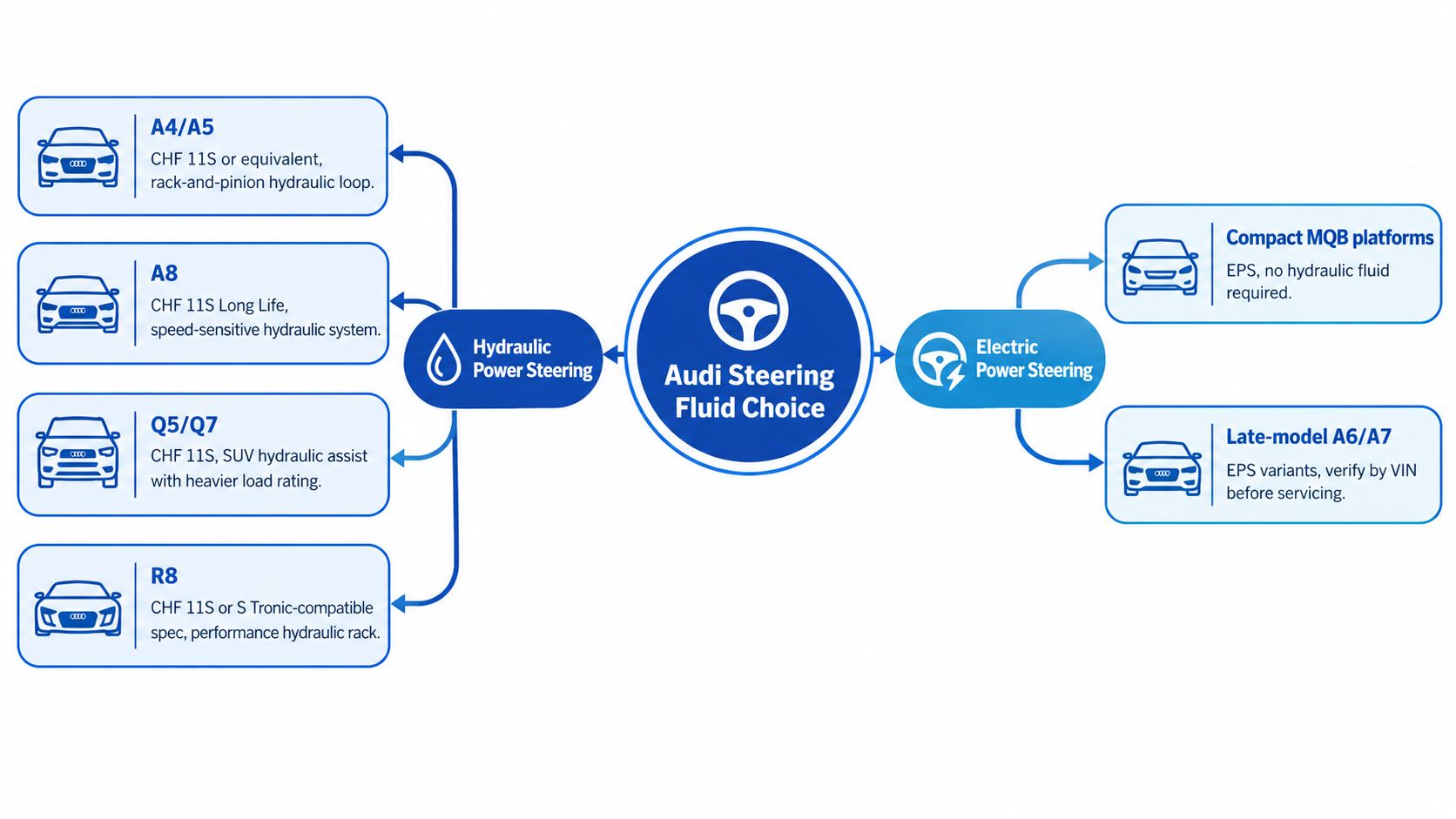
A platform-aware inspection
Open the hood and locate the reservoir before ordering fluid. A marked hydraulic reservoir, pump, and fluid lines indicate a serviceable hydraulic circuit. If you can't find a reservoir, don't pour fluid into a nearby tank just because its cap looks accessible. Confirm the system using the owner's manual, factory information, or VIN-specific parts data.
Use this decision path:
- Identify the steering architecture. Confirm hydraulic, electrohydraulic, or electric assistance.
- Read the reservoir cap. Look for a fluid family or OE reference such as G 002 000 or G 004 000.
- Check the manual or VIN-specific data. A model family can contain different steering arrangements across production periods and markets.
- Match the specification. VW TL 521 46-type requirements can help identify suitable products, but the exact vehicle requirement still takes priority.
- Assess the existing fluid. Clean, known fluid may support a controlled top-up. Unknown or contaminated fluid calls for a flush decision.
The distinction is especially important for owners who move between older hydraulic Audi platforms and newer electrically assisted cars. A bottle marketed for “Audi power steering” doesn't prove that your car uses it. It may be a catalog shortcut, a cross-fitment listing, or a product intended for a different steering circuit.
The right question isn't “Which fluid fits an Audi?” It's “Which fluid does this steering architecture and specification require?”
Treat an electrohydraulic system carefully too. It may still use hydraulic fluid, but the pump arrangement and bleeding process aren't necessarily identical to a belt-driven hydraulic system. Don't copy a refill method from another Audi just because the badge and engine family look familiar. The same caution applies when planning maintenance around an Audi V8 supercharged platform.
How to Top Up, Bleed, and Flush Safely
Start with a clean reservoir cap, the correct fluid, and a reason for the low level. A low reservoir isn't a service specification. It's evidence that fluid has leaked, been removed during a repair, or moved out of the normal range because air entered the circuit.
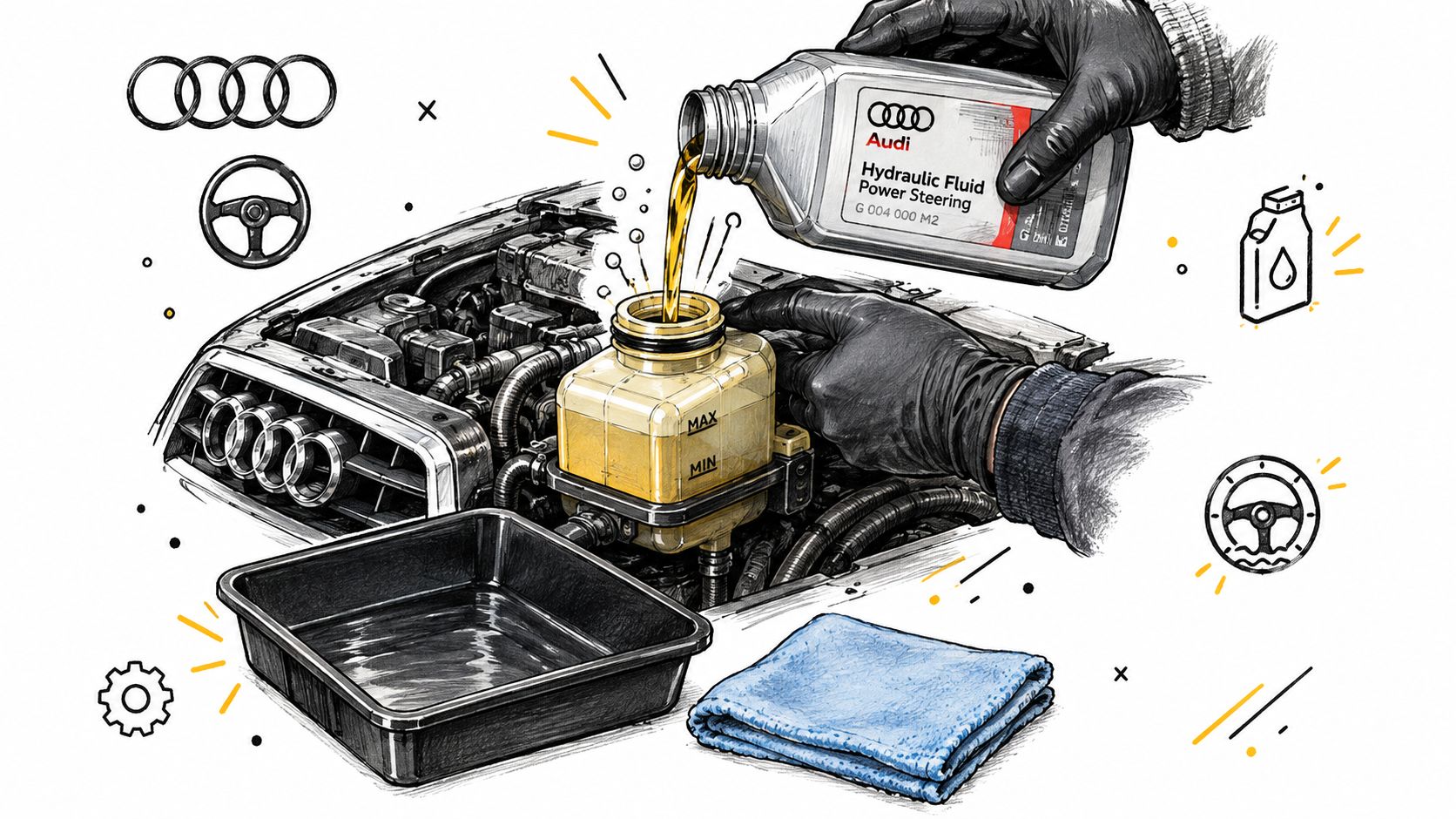
Topping up without creating a second problem
Clean the cap and the area around it before opening the reservoir. Dirt entering the circuit can damage valves and accelerate wear. Add the verified fluid slowly, keep the container and funnel clean, and stop at the specified level rather than filling by guesswork.
Don't top up if the fluid is visibly cloudy, foamy, heavily discolored, or suspected to be ATF. Don't use a different specification to get the car through the day unless the vehicle documentation explicitly supports it. A low level caused by a leak also needs diagnosis, because repeated topping-up leaves the pump operating with an unresolved fault.
Bleeding air from the circuit
Air usually announces itself through foaming, whining, jerky assistance, or a steering feel that changes as the pump runs. After the correct fluid is installed, the system may need careful cycling to move trapped air back to the reservoir. Follow the vehicle-specific procedure, keep the reservoir from running dry, and recheck the level as the fluid settles.
Avoid holding the steering at full lock while the pump is working. That creates unnecessary hydraulic load, especially during repeated maneuvers. If the fluid continues to foam or the pump remains noisy after proper bleeding, inspect the suction hose, reservoir connection, pump, and rack for leaks or air ingress rather than continuing to add fluid.
This video can help visualize the general maintenance process, but it doesn't replace the bleeding procedure for your exact Audi system.
When flushing is the better repair
Flush when the wrong fluid has entered the reservoir, when the specification is unknown, or when contamination is visible. The objective is to remove the old chemistry from the reservoir, pump, lines, and rack rather than leave a diluted mixture circulating through expensive components.
A workshop should also check for the cause of the low level before returning the car to service. Replacing fluid without repairing a leaking hose or seal only resets the symptom. If the work involves other hydraulic maintenance, keep the fluid task separate from unrelated systems and follow the correct procedure for Audi brake fluid service.
Contamination Signs and When to Replace the Fluid
Healthy-looking fluid isn't a guarantee, but poor-looking fluid is a clear reason to investigate. Cloudiness, foam, unusual discoloration, and visible particles indicate that the fluid may contain air, debris, wear material, or an incompatible formulation. A pump that whines more during cold starts or after the system heats up deserves the same attention.
Mixed specifications can change how seals behave and how much work the pump has to do. Accidental ATF exposure is particularly serious because its additive and friction package wasn't designed for Audi's low-viscosity hydraulic steering circuits. A top-up may hide the color change temporarily, but it won't remove the chemistry already circulating in the system.
Use condition and history together
Replace the fluid when contamination is likely, even if the service interval hasn't arrived. The practical benchmark of 50,000 km or 24 months remains a useful maintenance reference for Audi hydraulic steering systems, as shown in this Audi 80 hydraulic fluid fitment information, but contamination, pump noise, leakage, or an undocumented repair can justify earlier service.
The old and newer names can overlap in the aftermarket. VW G 002 000, VW G 004 000 M2, CHF 11S, and CHF 202 may appear together in product listings, and suppliers can describe products as meeting VW TL 521 46-type requirements. That doesn't turn every bottle into a universal Audi fluid. Compatibility still depends on the steering system, the specified chemistry, and whether the existing fluid is clean enough for a controlled top-up.
Use this final decision rule:
- No hydraulic reservoir: Don't add power steering fluid. Verify the electric system and its service requirements.
- Hydraulic reservoir with a clear matching specification: Use the approved fluid and correct the reason for any low level.
- Unknown, mixed, foamy, or contaminated fluid: Flush the system instead of layering another product on top.
- Persistent noise or heavy steering: Diagnose the pump, hoses, rack, belt drive, and air ingress rather than blaming the fluid alone.
Fluid choice protects the pump before pressure, noise, or steering effort tells you something has gone wrong. For related Audi maintenance decisions, the same habit applies as it does when checking an Audi PCV valve. Identify the system, match the specification, and treat contamination as a repair trigger.
Vorsprung Autowerk offers Audi-focused maintenance components, platform-specific parts, and mobile oil and filter service for owners who want practical support around EA837 and EA825 vehicles. Visit Vorsprung Autowerk to match maintenance parts to your Audi and get help before an uncertain fluid top-up becomes pump damage.


