

The most popular advice about high-flow catalytic converters is too simple: fit a freer-flowing part and your Audi will make more power. Louder isn't proof of faster, and a catalyst inside the pipe isn't proof of road legality. A worthwhile upgrade needs to solve a measured restriction without creating an inspection problem or an expensive replacement cycle.
Table of Contents
- When More Flow Is Not Automatically Worth It
- What a High Flow Cat Changes Under the Car
- Stock Cats Versus High Flow and Catless
- Emissions Rules That Can Erase the Gain
- What the Converter Really Costs to Own
- Street Track and Modified Audi Use Cases
- How to Choose and What to Do Next
When More Flow Is Not Automatically Worth It
A high-flow catalytic converter earns its place when it reduces a restriction measured under high load and its benefits justify the cost of ownership. A bigger outlet, louder note, or horsepower claim alone is a poor reason to buy one.
For an EA837 3.0T or EA825 4.0T, base the decision on the car's condition and intended use. A cracked or failed converter is a compliance and repair purchase, so judge its quote against a healthy factory unit. A healthy converter on a tuned car is a performance purchase, so judge its quote against a measured restriction.
Judge the result, not the opening diameter
Compare parts using evidence that matters after installation:
| Decision check | Evidence worth paying for | Reason to wait |
|---|---|---|
| High-load restriction | Lower measured pressure drop under comparable conditions | Only a larger outlet or louder exhaust |
| Diagnostic readiness | Catalyst and oxygen-sensor monitors can complete | Persistent faults or disabled monitoring |
| Ownership value | Documented fitment, durability, and service costs | An attractive purchase price with unresolved follow-up work |
A high-flow converter does not create extra airflow demand. If the engine is not near the original converter's restriction limit, replacing it may achieve little. Engine-control software also does not guarantee that extra flow capacity will produce more output.
That leaves the healthy, lightly modified street Audi as the hardest case to justify. Keep the factory catalysts unless testing shows a restriction or planned engine changes create a credible need. Check OBD readiness as part of the decision, since a flow gain that leaves catalyst monitors incomplete can create ongoing ownership problems.
Buying rule: Pay for a restriction you can measure. Do not pay for a restriction you have only assumed.
A failed catalyst can make its replacement feel transformational. That improvement restores normal operation; it does not prove the replacement outperforms a healthy factory unit. Keep the repair decision and performance decision separate when reviewing the estimate. If the shop bundles them into an unsupported power promise, do not order yet.
Repeated pulls after heat soak need the same evidence-based judgment. Poor performance alone does not identify the converter as the cause. Ask for a high-load pressure-drop measurement before choosing exhaust hardware. Judge the result by the restriction removed, OBD readiness, and the cost of owning the part, not by outlet size or sound.
What a High Flow Cat Changes Under the Car
Exhaust gas must pass through a catalytic converter's substrate, which creates a pressure drop. The outlet diameter alone tells you little about how much restriction the assembly creates. Substrate design, catalyst volume, cell density, and transitions all affect flow and emissions performance.
The diagram shows how the converter changes exhaust gases.
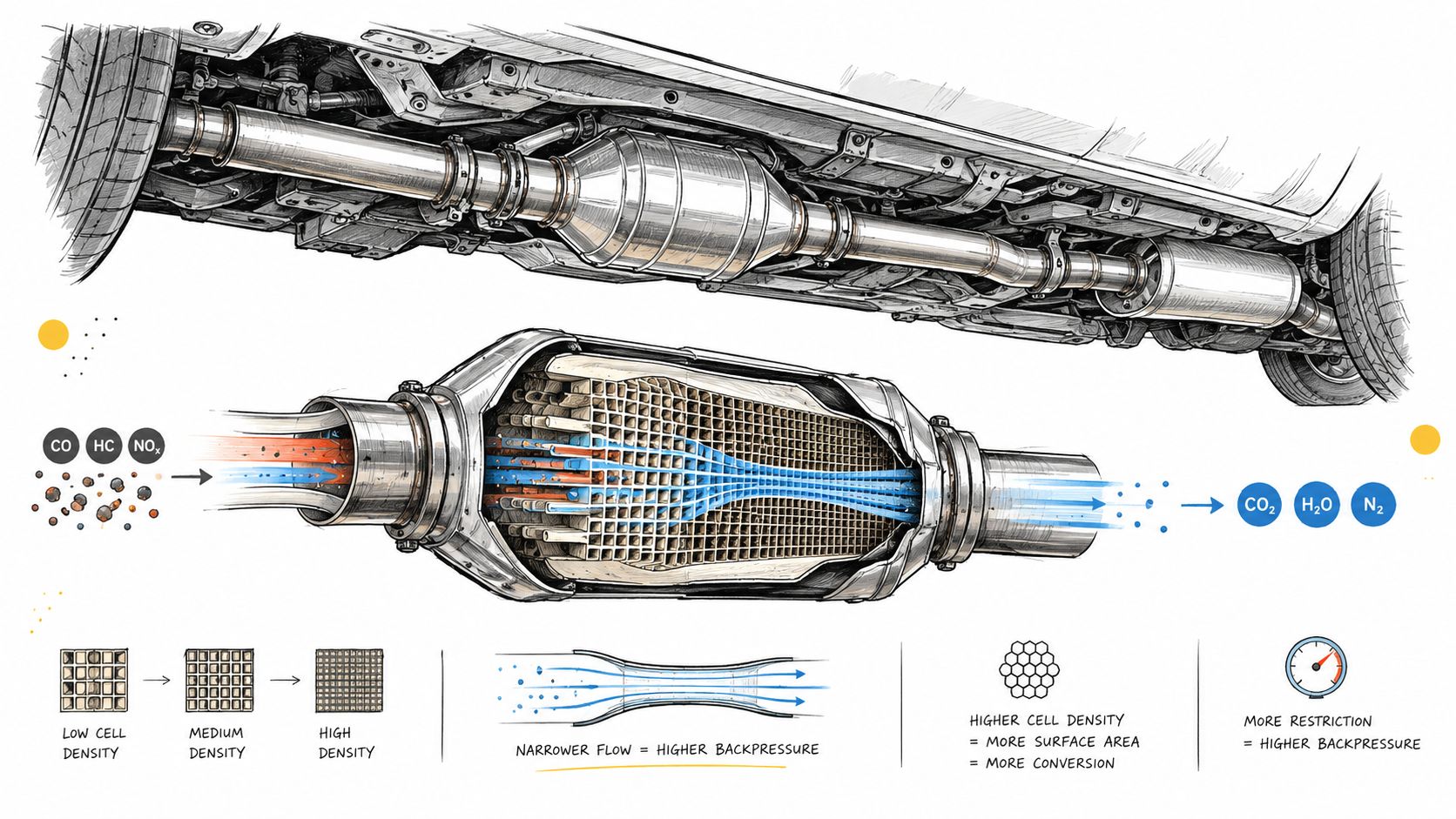
A useful comparison must account for both exhaust flow and pollutant conversion. A lower pressure drop alone does not establish that the replacement performs well as a catalyst.
Temperature matters as much as passage size
The linked three-way catalyst engine study found that hydrocarbon conversion depended primarily on catalyst temperature. Once the catalyst reached operating temperature, pressure, space velocity, and near-stoichiometric mixture conditions had comparatively little direct influence on conversion (three-way catalyst engine testing).
The same study reported that raising backpressure from 1.02 to 1.51 bar increased cold fast-idle exhaust mass flow from 34.7 to 39.8 kg/h, a 14.7% change. The result shows that backpressure interacts with exhaust flow and thermal behavior.
Specify catalyst volume, sensor placement, and thermal management alongside any claim of lower backpressure. For EA837 and EA825 cars, judge the setup using measured pressure drop under high load, catalyst operating behavior, and OBD readiness. A larger outlet or peak-horsepower claim does not answer those questions.
For buyers comparing complete assemblies, what a turbo-back exhaust includes clarifies which parts of the system a converter change affects.
The video shows a catalytic converter and the exhaust components around it.
Demand a controlled comparison
An EA837 or EA825 before-and-after test should isolate the converter's effect:
- Hold conditions steady. Match boost, ignition timing, fuel, and intake temperature.
- Measure the change. Record manifold or turbine pressure, lambda, catalyst temperature, and wheel torque.
- Check the whole result. Look for reduced high-rpm pressure without losing catalyst light-off or diagnostic function.
Reject a peak number without test conditions. If the installer changes the tune and converter together, the dyno result cannot show what the converter contributed. Factor in OBD readiness and ownership costs before approving the hardware.
Stock Cats Versus High Flow and Catless
Stock, high-flow, and catless differ in what they remove, what they keep, and what they expose you to. Compare them on the same criteria: measured pressure drop, catalyst volume, sensor and monitor function, temperature, sound, and intended use.
Stock, High-Flow, and Catless on the Same Criteria
| Criteria | Stock cat | High-flow cat | Catless test pipe or downpipe |
|---|---|---|---|
| Restriction | Establish a healthy baseline before replacing | Require pressure-drop evidence | Removes substrate restriction |
| Catalyst volume and cell density | Original vehicle specification | Ask for disclosed specifications | No catalyst substrate |
| Oxygen sensors and monitors | Baseline for the original system | Verify compatibility and monitor completion | Removing catalyst function creates diagnostic concerns |
| Thermal evaluation | Record baseline temperatures | Assess shielding and catalyst operating temperature | Don't assume removal solves every heat problem |
| Smell and sound | Original reference point | Sound isn't proof of conversion quality | Odor and louder sound can accompany removal |
| Public-road suitability | Retain a healthy, compliant original system | Requires application-specific legal verification | Not a lawful street shortcut |
What the performance research supports
The catalyst pressure-loss review cited below estimates approximately 300 watts of power loss per 1,000 pascals of pressure loss. Separate experimental results reported a 40% reduction in catalyst backpressure with a 5.5 Nm torque increase, while a 10-kPa pressure reduction was associated with roughly 1.5%–3% lower fuel consumption under the tested conditions (catalyst pressure-loss and engine-performance review).
These engineering results describe specific test conditions, not a promised Audi dyno result. They do not establish a guaranteed EA837 torque gain or an EA825 fuel-saving figure. The practical test is whether the converter produces a meaningful pressure drop at the exhaust mass flow your engine reaches under high load.
For a standard road car, the factory catalyst may remain the sensible choice if it is healthy and not the dominant restriction. On a modified, high-output EA837 or EA825, consider a high-flow replacement only when pressure-drop measurements support it and the cost of preserving OBD readiness makes sense. If the catalyst has failed, compare compliant replacements with the original specification, not with a damaged part.
A catted-versus-catless downpipe comparison clarifies what each setup retains, but it does not replace checking whether the part is suitable for your intended use.
A test pipe removes the catalyst. Calling it a performance component doesn't change what was removed.
Serviceability also belongs in the comparison. For tubing that matches its listed fitment, the Vibrant SS Accuseal Exhaust Seal Clamp for 4in OD Tubing (1.25in wide band) provides a clamp connection that can be disassembled for later service. It does not show that a converter performs better.
Emissions Rules That Can Erase the Gain
Treat compliance as a purchase gate. Confirm road-use approval before paying or scheduling installation. A converter can contain catalyst material and still be unsuitable for legal road use.
Catalytic converters have been installed on most passenger cars and light-duty trucks since the 1975 model year. EPA guidance identifies installing non-complying converters and removing, bypassing, or otherwise tampering with emissions controls as potential Clean Air Act violations (EPA converter and tampering guidance).
Put the potential exposure beside the parts invoice
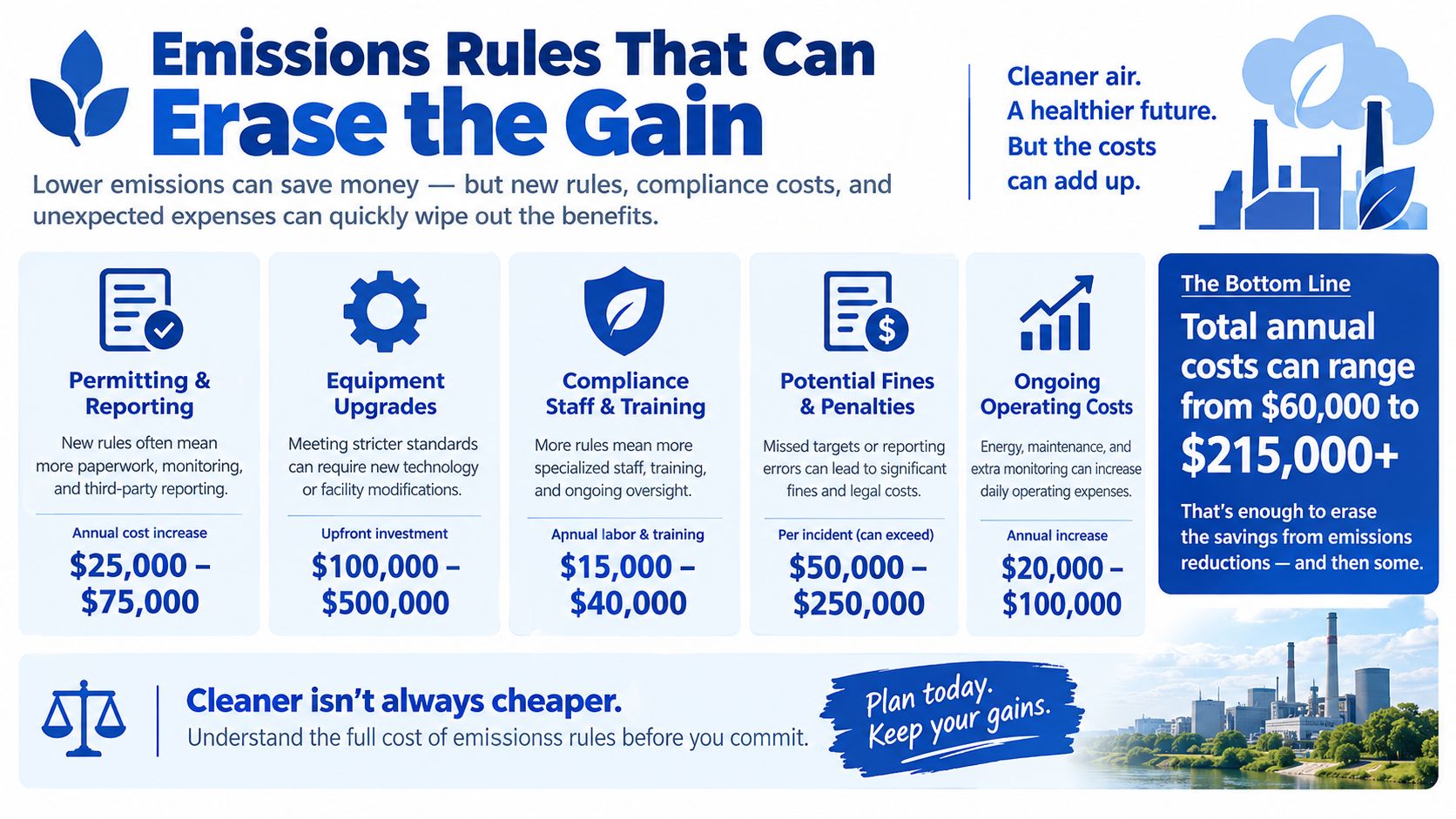
The same guidance describes penalties and replacement-converter requirements. The figures below are specific to that guidance, so check the applicable rules and penalty schedule before relying on them.
- Tampering exposure. The cited civil penalties reach $4,819 per act for individuals and $48,192 for manufacturers and dealers. The guidance also cites a defeat-device penalty of up to $4,819.
- Replacement installation exposure. The guidance cites penalties of up to $2,500 per violation for individuals, repair shops, or fleet operators, with higher exposure for dealers.
- Durability requirements. The cited aftermarket framework specifies 25,000 miles or five years, with minimum end-of-life reductions of 70% for hydrocarbons, 70% for carbon monoxide, and 30% for nitrogen oxides.
These are figures cited in the guidance, not confirmation of the current penalty schedule. The cited material does not establish that these amounts remain current, so verify them with the relevant authority before making a decision.
The infographic shows how compliance and operational costs can add to the ownership calculation.
Check the exact Audi application
A high-flow label does not establish emissions equivalence. Check the model year, engine family, approved application, and jurisdiction, including stricter state or regional requirements. EPA's emissions-control replacement and tampering provisions outline requirements for replacement equipment.
Get the seller's approval documentation before paying, then keep it with the invoice and installation record. A completed readiness scan confirms diagnostic status; it does not prove legal certification. Use this high-flow catalytic converter legality guide to prepare specific questions about your Audi's application.
If the seller describes the part only as racing or off-road hardware, do not treat a clear warning light as proof of road approval. A track booking does not exempt a car used on public roads from road-use requirements.
What the Converter Really Costs to Own
Judge a high-flow converter by the full installed cost and the evidence it delivers, not by the size of its outlet or a peak-horsepower claim. For EA837 and EA825 cars, ask whether it reduces measured high-load pressure drop while preserving OBD readiness, and whether that benefit justifies the ownership cost.
On an EA837, have the workshop price access and removal for the exact vehicle rather than assuming a simple under-car swap. For either engine family, include connection inspection, sensor checks, and a documented post-install result.
Build a complete estimate
The quote should separate these items:
- Hardware and installation. Converter assembly, joining components, and labor for the exact vehicle.
- Verification. Exhaust-leak inspection, oxygen-sensor checks, and a post-install diagnostic scan.
- Follow-up responsibility. Who investigates an efficiency fault, what the warranty covers, and whether correcting the configuration adds labor.
- Replacement compatibility. Whether a failed unit can be replaced without changing the calibration or repeating custom fabrication.
Don't accept “we'll tune the light out” as a repair plan. If a fault appears, diagnose catalyst suitability, leaks, sensor behavior, and calibration compatibility rather than disabling emissions monitoring.
Use this Audi oxygen-sensor guide to discuss which sensor checks the estimate includes.
Account for replacement risk
Catalytic converters typically contain roughly 2–15 grams of platinum-group metals, and scrap value varies with converter design and metal prices. That makes theft and replacement a line item of roughly the converter's scrap-value risk, and it belongs on the same estimate as the installation labor (catalytic-converter materials and theft background).
A substantial-looking housing does not establish adequate material loading. Ask what the supplier discloses about the substrate, thermal protection, and warranty, and whether the welds and substrate are intended for repeated heat cycling in your application.
Record temperatures, fault codes, and inspection status before the flange is cut. A modified car whose logs show repeated high-load pulls with catalyst-side restriction can justify a proven flow improvement. A stock or lightly tuned car usually cannot.
Ask the workshop to price the leak repair as a separate line so you can see what the converter itself costs.
Street Track and Modified Audi Use Cases
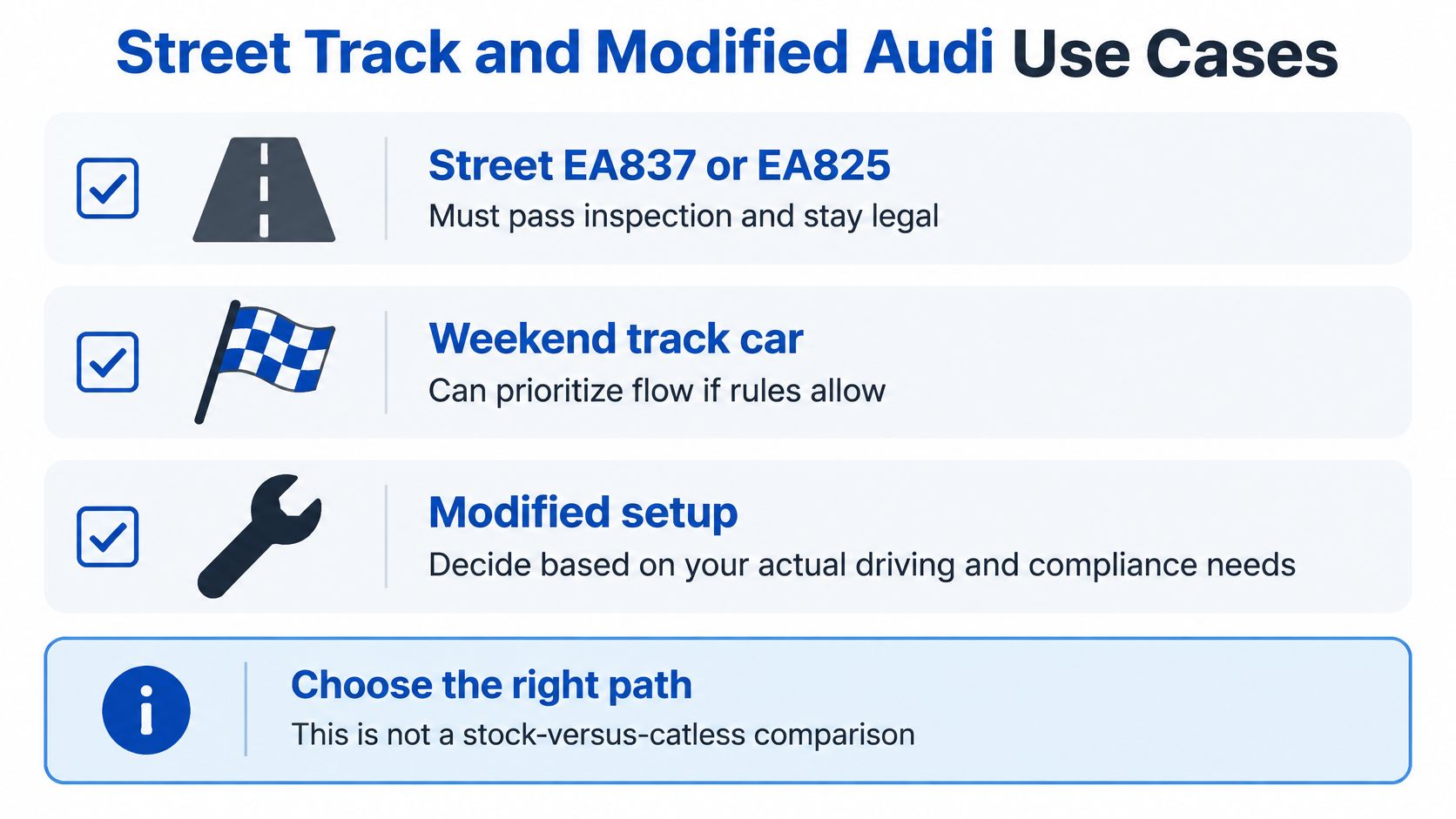
Match the part to how the car is driven today. Do not match it to a build you might assemble later. A street EA837, a repeatedly pulled modified car, and a dedicated competition Audi need different recommendations.
The street car that must remain inspection-ready
Your EA837 or EA825 is primarily road transport, even if you enjoy spirited driving. Choose the least restrictive legally approved catalyst for the exact application, not the highest-flow item in the catalog.
If the existing converters are healthy and the car is lightly tuned, waiting is a sound choice. Spend only when baseline checks identify a reason to change the system.
For an EA825 owner planning broader modifications, the Audi RS 7 tuning guide can help frame the build as a system. Coordinate the exhaust choice with the intended calibration and road-use requirements.
The modified car with a demonstrated limit
Consider a modified supercharged EA837 with logs showing catalyst restriction during repeated high-load operation. That car is a credible candidate for a high-flow assembly, provided the supplier supports the application and the installer can verify the result.
This recommendation depends on your car's logs. Without a documented high-load restriction, it does not apply. Judge the change by measured pressure drop under load, OBD readiness, and ownership cost, not a peak-horsepower claim or a larger outlet.
For comparison, Vorsprung Autowerk offers high-flow converters, catless downpipes, and test pipes for defined Audi applications across S4, S5, Q5, SQ5, RS6, RS7, and Q7 platforms. Check each listing for fitment, Euro 6 catalyst details where applicable, and fabrication information such as TIG welding, back-purging, and integrated heat shielding. Those details alone do not establish approval in your jurisdiction.
The dedicated competition car
A less restrictive configuration can suit a genuine off-road or competition vehicle when the applicable rules allow it. Confirm the vehicle's status before choosing test pipes or catless downpipes.
- Road-driven weekend car. Keep road compliance in the buying criteria.
- Dedicated competition vehicle. Check event rules, operating requirements, and how the proposed modification is treated.
- Undecided build. Settle the use case before ordering hardware intended for competition-only use.
Track use alone does not exempt a car from road requirements unless the event rules and the vehicle's status allow it. A louder exhaust is not automatically faster, and a competition part will not become street-compliant just because an installer fits it.
How to Choose and What to Do Next
Start with the workshop's written diagnosis of the fault or measured restriction, then compare it against the acceptance criteria in step 3. If neither a fault nor a restriction is documented, hold off on buying parts.
A replacement should address a specific problem. Damaged substrate, recurring efficiency codes, and measured high-load restriction each call for different diagnostic work. A different exhaust sound is a separate goal. Do not justify it as a power gain.
Follow a buy-or-wait sequence
- Confirm the problem. Have the workshop document the failure or performance limit rather than guessing from sound or a disappointing pull.
- Confirm the application against the approval documents described in the emissions section above.
- Agree on acceptance evidence. Put the planned pressure measurements, controlled performance comparison, diagnostic checks, and warranty terms on the work order.
Judge the installation using the agreed measurements. Keep the test conditions and results with the invoice, so another workshop can see what changed. For EA837 and EA825 cars, prioritize measured high-load pressure drop, OBD readiness, and ownership cost over peak-horsepower claims or a larger outlet.
Research on aged three-way catalysts found that stronger air-fuel-ratio swings shifted light-off toward higher temperatures, stretched the conversion curve, and pushed full conversion to higher temperatures (three-way catalyst aging research). Ask the supplier for the substrate cell density and catalyst loading in writing before accepting a quote. These details help you compare catalyst specifications rather than shopping by diameter alone.
For fabrication, discuss whether the assembly needs a suitable flex joint with an interlock liner. The joint supports the exhaust assembly, but it does not establish that the catalyst is correctly specified.
Keep the approval paperwork, baseline scan, installation invoice, and verification results together. They document the system you bought more accurately than a product headline.
Before ordering, use the retailer's vehicle selector to compare high-flow catalysts and off-road test pipes for your Audi. Get clarification if the listing leaves fitment or approval uncertain.
If the stock catalysts are healthy and no restriction is measured, wait. If the evidence supports replacement, choose the appropriate assembly and verify the result. Keep competition-only parts off any car that must meet public-road requirements.
Vorsprung Autowerk offers Audi-specific high-flow catalytic converters, catless downpipes, and test pipes for defined platform applications. Select your exact vehicle and compare hardware before confirming fitment, compliance documentation, and installation requirements: Vorsprung Autowerk.


