

“Fit the biggest exhaust you can” is poor advice for a daily-driven GTI. A louder car isn't necessarily a faster car, and changing the rear silencer isn't the same decision as replacing emissions-control hardware. The right Mk7 GTI exhaust system starts with a clear goal: better sound, supported performance, lower weight, or some combination that remains comfortable and legal where you drive.
Table of Contents
- Why a Bigger Mk7 GTI Exhaust System Is Not Automatically Faster
- How the Mk7 GTI Exhaust Works From Turbo to Tip
- Catless, High-Flow Cat, and Cat-Back Options Compared
- Where the Power Actually Comes From
- Sound, Drone, and What Daily Driving Really Feels Like
- Fitment, Materials, and Tuning Considerations
- Emissions and Noise Legality by Market
- Choosing Your Setup and Your Next Step
Why a Bigger Mk7 GTI Exhaust System Is Not Automatically Faster
A large outlet and an aggressive cold start don't prove that an exhaust produces useful power. Before comparing systems, separate what you're buying from what you expect it to accomplish. Sound, flow, and measured acceleration are different outcomes.
The useful distinction is between the downpipe, connected to the turbocharger and containing the primary catalytic converter, and the cat-back, comprising the downstream pipework and sound-control components. With the factory downpipe and catalyst retained, changing the rear section is primarily an acoustic decision. The need to distinguish sound changes from demonstrated wheel-power gains is central to the Mk7 GTI cat-back performance discussion.
The illustration below provides a starting point for thinking about the whole system rather than outlet size alone.
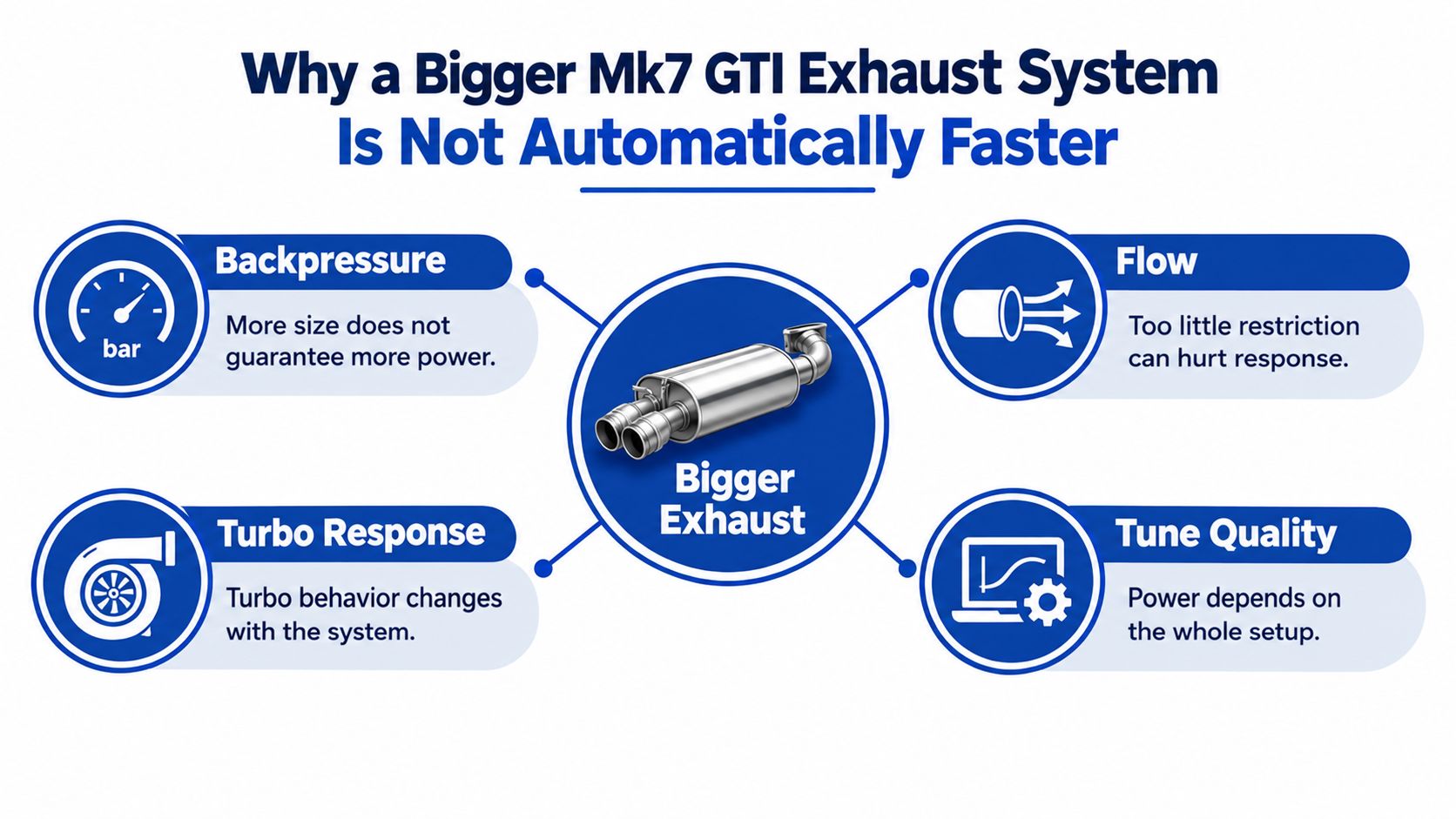
Buy the outcome, not the diameter
Don't turn that distinction into another shortcut, such as assuming the engine needs extra exhaust restriction. The purchasing question is whether the proposed system removes a meaningful restriction for your combination, not whether it looks larger than stock.
Ask a seller to separate its claims:
- Sound: Does the comparison demonstrate cabin behavior, or just an exterior acceleration clip?
- Performance: Was the exhaust tested independently, or alongside an ECU calibration and other hardware?
- Weight: Is the claimed benefit based on measured component mass?
- Compliance: Does the documentation cover emissions, noise, or both?
Practical rule: If the evidence demonstrates a different sound, buy it as a sound upgrade. Don't pay for an unproven horsepower promise.
For a daily driver, prioritize the sound and legality criteria below. For a tuned car, focus on system restriction, fitment, and calibration compatibility. For a competition build, establish the operating requirements before choosing hardware. None of those decisions improves just because a tailpipe is bigger.
How the Mk7 GTI Exhaust Works From Turbo to Tip
Follow the exhaust forward from the tips and the shopping categories become easier to understand. The tips are the final outlets. Ahead of them, the muffler and resonator shape the sound, while the midpipe carries exhaust rearward from the downpipe.
At the front, the downpipe receives exhaust leaving the turbocharger and contains the primary catalyst. That location makes an upstream change more consequential than replacing the rear section. The Integrated Engineering Mk7 GTI exhaust guide explains this functional split and the thermal considerations around the engine's exhaust arrangement.
The component path is easier to follow in a diagram.
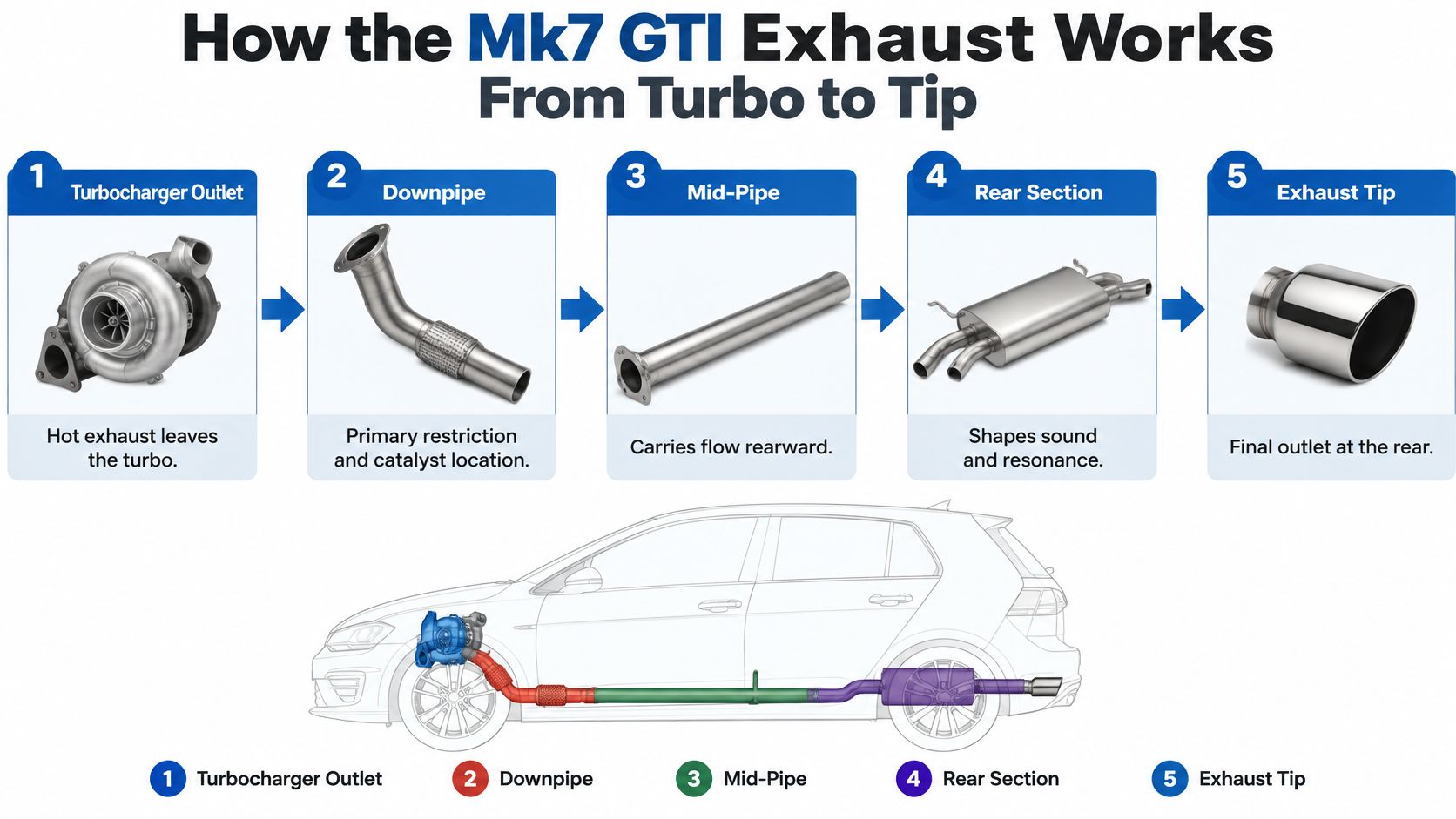
Heat management matters upstream
The EA888 Gen 3 uses an integrated water-cooled exhaust manifold. Its thermal behavior helps accelerate catalyst light-off during warm-up while controlling temperatures under sustained load.
Think of a pizza oven's retained heat as an analogy, not a literal description of the hardware. Gas flow isn't the only consideration. The temperature of the surrounding system affects how effectively the next component can do its job.
Replacing upstream exhaust hardware can therefore affect catalyst temperature, oxygen-sensor behavior, and calibration requirements. A downpipe shouldn't be treated as a pipe that happens to fit between existing connections.
Know where the replacement starts
A turbo-back exhaust covers a different scope from a cat-back. Ask for a component diagram rather than relying on a product title, especially when buying separate sections from different manufacturers.
At the opposite end, the Vibrant 3.5in Round SS Exhaust Tip (Double Wall Angle Cut Beveled Outlet) is a weld-on finishing component manufactured from 304 stainless steel. Its appearance and connection requirements belong in the finishing discussion, not the downpipe-performance discussion.
For road use, establish whether you can meet your goal without disturbing upstream hardware. That's the more conservative starting point when the objective is a sportier sound.
Catless, High-Flow Cat, and Cat-Back Options Compared
These aren't interchangeable versions of the same upgrade. A catless downpipe removes the catalytic converter from that assembly. A high-flow catted downpipe changes the catalyst and associated pipework. A cat-back changes the downstream section while generally retaining the factory catalyst and oxygen-sensor arrangement.
That difference determines the questions you should ask before discussing tone or finish. The catless-versus-catted downpipe comparison is a useful starting point for separating those hardware choices.
Mk7 GTI Exhaust Paths at a Glance
| Option | What It Changes | Flow Impact | Sound Impact | Legality Risk | Tuning Demand |
|---|---|---|---|---|---|
| Catless downpipe | Removes the catalyst from the downpipe assembly | Removes catalyst-related restriction | Requires evaluation of the complete system | Major emissions-compliance concern | Confirm hardware and ECU compatibility before purchase |
| High-flow catted downpipe | Replaces the original catalyst and upstream pipework | Can reduce catalyst restriction | Can increase sound and odor | A fitted catalyst doesn't establish approval | Evaluate catalyst behavior and calibration requirements |
| Cat-back | Replaces downstream pipework and acoustic components | Changes downstream flow without removing the upstream catalyst | Primary reason to choose this route | Noise and certification still matter | Usually an acoustic rather than calibration-led purchase |
Choose by operating requirements
For a daily car, the cat-back route keeps the decision focused on sound control and downstream construction. It doesn't eliminate legal checks, but it avoids changing the primary emissions-control component.
A high-flow catalyst belongs in a performance plan that accounts for the engine's airflow requirements, the ECU configuration, and the actual approval status of the replacement. “Catted” isn't a synonym for compliant. Nor does it establish how the car will behave during cold start or inspection.
Catless hardware demands the clearest boundary between public-road use and competition use. Don't buy it on the assumption that resolving a dashboard warning would resolve its legal status. Those are separate questions.
A component can fit mechanically, work with a calibration, and still be unsuitable for the roads where you intend to use it.
For a stock daily driver, start with the least invasive configuration that meets the sound brief. For a performance-focused build, decide what restriction needs addressing before selecting a catalyst or downpipe. For a competition-only car, document that use and confirm the applicable requirements rather than treating unrestricted flow as the entire specification.
Where the Power Actually Comes From
Pressure loss through the complete exhaust path matters more than advertised diameter. Common Mk7 GTI aftermarket systems use approximately 3-inch (76 mm) tubing, typically in 304 stainless steel, while many high-flow catalysts are marketed around 200 cells per square inch, compared with approximately 500–600 cells per square inch for the original catalyst, as described in the Mk7 GTI exhaust-system technical reference.
A larger cross-section reduces gas velocity and can lower pressure loss at high mass flow. But bends, transitions, catalyst construction, muffler design, and turbocharger demand all influence the result. A large pipe connected through poorly considered transitions isn't automatically an effective system.
Match the hardware to airflow demand
For the stock IS20 turbocharger, the common diameter described above is generally regarded as sufficient for street-level airflow. Going larger should follow a substantially upgraded turbocharger and a defined requirement, not a preference for the largest specification on the product page.
Catalyst cell density also needs context. Lower density can reduce restriction, but the trade-offs can include greater cold-start emissions, odor, noise, and regulatory exposure. Use the high-flow catalytic converter guide to frame questions about the complete converter, rather than choosing by cell count alone.
The graphic below illustrates the distinction between exhaust-only changes and a combined package. Its numerical cat-back range shouldn't be treated as a guaranteed result for your car.
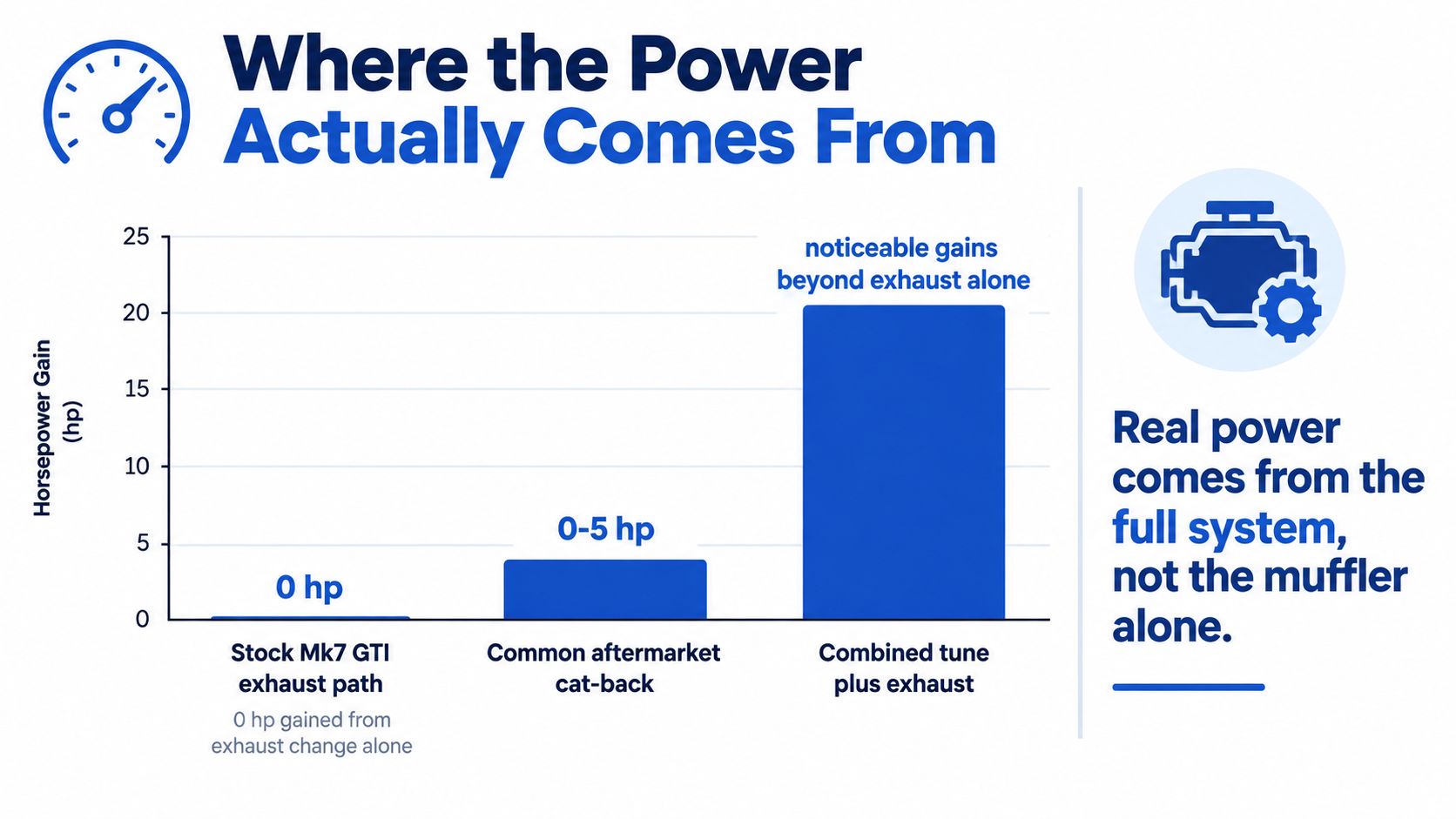
Demand a comparison that isolates the change
A useful performance test separates the hardware from the calibration. If both change together, you can't assign the entire improvement to the exhaust.
Ask for evidence that distinguishes:
- Wheel-power change: Comparable baseline and modified tests with the configuration disclosed.
- Boost response: Logs that let you evaluate response, not just the final peak.
- Thermal behavior: Relevant temperature information rather than a claim that freer flow solves everything.
- Component mass: Actual measurements if reduced weight is part of the sales argument.
For a stock car whose owner wants more character, choose the rear section on acoustic merit. For a power build, ask the tuner which component limits the intended combination before ordering. The right first purchase is the one supported by the build plan, not necessarily an exhaust.
Sound, Drone, and What Daily Driving Really Feels Like
A full-throttle clip answers only part of the ownership question. You also need to hear the car starting cold, holding a steady cruising speed, and lifting off the accelerator. These conditions expose different aspects of the system.
Use the illustration as a checklist for the sounds you need to evaluate.
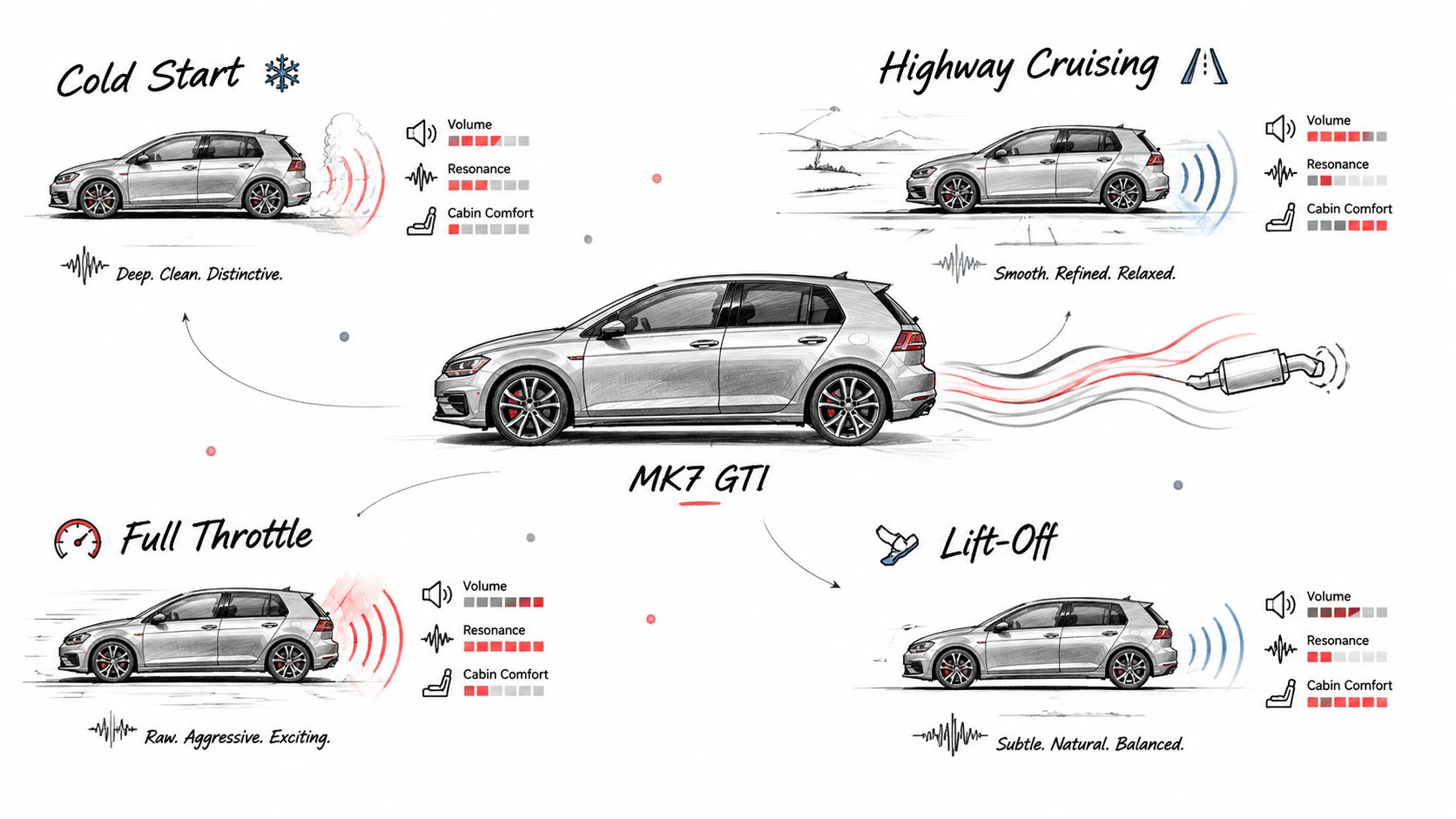
Assess the cabin, not just the roadside recording
Drone is the persistent cabin boom that makes an otherwise appealing exhaust tiring at steady load. Peak exterior loudness doesn't tell you whether that sound will dominate your commute. The daily-driver concerns in Mk7 GTI owner discussions include this exact tension between a sportier note and acceptable comfort.
A resonated system is the safer starting point when low-frequency boom is unacceptable. The resonator attenuates that boom without materially changing the system's basic flow path. Muffler design also belongs in the comparison, and any valved system should be evaluated in each operating state rather than judged only with its loudest setting selected.
Ask for recordings that match your intended use:
- Cold start: Hear the initial start and the subsequent settling behavior.
- Highway cruise: Request an in-cabin recording under steady load, with the operating conditions identified.
- Full throttle: Evaluate the tone without mistaking loudness for performance.
- Overrun: Decide whether the lift-off character suits your neighborhood and driving preferences.
A video can help assess character, but it isn't a calibrated sound measurement or proof of compliance.
Write a usable sound brief
Tell the installer what you won't tolerate. “No sustained cabin boom at my normal cruising speed” is more useful than “deep but not too loud.”
The quietest compliant system may deliver greater usable value than the highest-flow system on a daily car.
For repeatable comparisons, request the same recording position, operating conditions, and measurement method. Without that consistency, comparisons between different clips remain subjective, however convincing the soundtrack sounds.
Fitment, Materials, and Tuning Considerations
A material label isn't a complete fabrication specification. Before ordering, establish exactly what connects to what, which hardware is included, and whether the proposed configuration matches your existing turbocharger, downpipe, and rear section.
Treat the following as inspection questions, not assumptions about a manufacturer's product. Ask for drawings, installation instructions, and close-up photographs where the listing leaves details unclear.
Inspect the connections and installed position
Check the flange arrangement before buying separate components. The exhaust flange fitment guide provides context for evaluating a connection rather than assuming nominal pipe size establishes compatibility.
Ask the seller or installer to confirm:
- Material specification: Identify the tubing alloy and ask for wall-thickness information.
- Flanges and V-bands: Confirm the mating arrangement, included hardware, and intended sealing method.
- Hanger placement: Request confirmation that the assembled system sits correctly without being forced into position.
- Heat management: Identify retained shielding and any shielding required by the installation instructions.
- Service access: Establish how the system separates for future work and which joints require welding.
Clamps deserve the same attention as the visible tubing. Ask whether the specified clamp suits the joint and can be released for later service. Don't accept a promise of easy disassembly without checking the actual connection design.
Confirm ECU compatibility before ordering
The upstream thermal and sensor considerations described earlier make a downpipe purchase a coordination task between the parts supplier and tuner. Ask the tuner to approve the exact hardware configuration, not merely the category “high-flow downpipe.”
A cat-back is normally an acoustic purchase rather than a reason to change calibration. A downpipe requires a more careful review of catalyst behavior, sensor compatibility, and calibration requirements. Don't assume every replacement needs identical software work, or that software compatibility establishes emissions approval.
Before installation: Agree on the finished configuration, included hardware, calibration requirements, and responsibility for resolving fitment issues.
Finish with a written checklist: Does it match this car? Does it mate to the retained components? What's included? What requires fabrication? Who has confirmed ECU compatibility? What documentation supports road use?
That process isn't glamorous, but it gives you something more useful than a confident product description: a defined installation scope.
Emissions and Noise Legality by Market
Emissions legality and noise legality are separate approvals. Retaining the catalytic converter doesn't establish that an exhaust meets local sound rules. Equally, a quiet system doesn't establish that replacement emissions hardware is approved.
Don't use an exhaust's appearance, a seller's location, or an absence of warning lights as your legal test. Ask what evidence applies to your vehicle, your configuration, and the jurisdiction where it will be used. The high-flow catalytic converter legality guide is a starting point for forming those questions, not a substitute for checking local requirements.
Request evidence for your market
| Market or use | Emissions questions | Noise and certification questions |
|---|---|---|
| United States | What requirements apply where the car is registered, and is the exact replacement acceptable there? | Which local sound rules apply to the installed configuration? |
| European markets | Does the replacement preserve the required emissions compliance? | Is applicable E-mark or type-approval documentation available for the exact vehicle and system? |
| Other road markets | Which authority determines acceptable replacement emissions hardware? | Are local approval documents or sound tests required? |
| Competition-only use | Is the part explicitly designated for that use? | What requirements apply at the intended venue? |
European buyers should be particularly careful about the distinction between a favorable sound measurement and the required E-mark or type-approval documentation. A claim that a system is quiet doesn't answer the certification question.
Check the exact configuration
Approval evidence should identify what was assessed. Ask whether it covers the resonated or non-resonated version, the relevant valve arrangement, and the retained upstream hardware. Don't assume documentation for a similar product covers the one in your basket.
Before paying, request:
- Approval documents: Applicable certification and type-approval references.
- Use restrictions: Written clarification of any off-road or competition-only designation.
- Configuration details: Confirmation of the components covered by the documentation.
- Local verification: Advice from the relevant inspection authority where uncertainty remains.
Catless parts remove emissions-control hardware and may not be legal on public roads where you live. A high-flow catalyst also needs scrutiny. Check before buying, because an installed part isn't automatically an acceptable part.
Choosing Your Setup and Your Next Step
For a road-focused daily driver, keep the OEM downpipe and choose a resonated cat-back if you want more character without making cabin comfort an afterthought. Verify the system's noise compliance rather than assuming the retained catalyst settles every legal question.
For a tuned car, have the tuner define the exhaust requirement before selecting a high-flow catted downpipe. Confirm the complete hardware combination, ECU compatibility, and approval status together. A tuning-stage label alone isn't a sufficiently detailed specification.
For a competition-only build, choose components around the intended operating requirements and venue rules. Don't assume catless hardware is necessary just because public-road use isn't planned.
Answer these before spending
- What am I improving? Identify sound, supported power, weight, or a clearly defined combination.
- What must remain acceptable? Set limits for cabin boom, cold-start behavior, and legal exposure.
- Who has confirmed compatibility? Obtain fitment and calibration confirmation for the actual car.
The sensible purchase is the least disruptive configuration that achieves your goal. Start with a component list, get the unanswered fitment and compliance questions resolved, and only then compare finishes and outlet styles.
Vorsprung Autowerk offers exhaust components and fabrication hardware, with platform-specific product information to help define a build. Visit Vorsprung Autowerk to review the available hardware, then confirm Mk7 GTI compatibility, connection dimensions, and intended use before ordering.


