

You're sitting at a light, foot off the brake, and the car doesn't feel right. It pulls cleanly to midrange, then goes flat up top. Or the dash is lit, a catalyst efficiency code is stored, and you're searching for an Audi cat converter while results mix stock replacements, high-flow cats, and plain pipes as if they're interchangeable. They're not. The right pick depends first on whether the catalyst failed and whether the car has to keep an approved emissions device, not on pipe diameter or a claimed horsepower number.
Table of Contents
- Three Audi Cat Converter Paths Side by Side
- Failed Cat or an Upstream Engine Fault
- When Backpressure Actually Changes the Pull
- Which Paths Stay Legal on the Road
- Sound Fitment and Heat on These Engines
- Match the Path and Retire the Old Cat
Three Audi Cat Converter Paths Side by Side
Choose the converter path based on how the car is used. An inspected road car, a tuned street car that still needs a catalyst, and a competition car used off public roads call for different hardware.
| Option | Intended use | Restriction vs healthy OEM | Catalyst in stream | Sound and heat | Who should choose it |
|---|---|---|---|---|---|
| OEM or OEM-equivalent | Public-road and inspected cars | Baseline; rises if the substrate clogs or breaks up | Yes | Quietest, with the most thermal mass near the manifold | Commuters replacing a failed cat after the engine checks out |
| Euro-6 high-flow cat | Street cars that still need a catalyst and want less restriction | Lower than a loaded or damaged OEM brick when loading is correct | Yes | Mildly louder; heat stays manageable with proper shielding | Tuned EA837 or EA825 cars that must keep a catalyst |
| Catless downpipe or test pipes | Off-road and competition only | Lowest restriction | No | Loudest, with more engine-bay and tunnel heat | Track or off-road builds on an off-road calibration |
Reading the three rows plainly
OEM or OEM-equivalent is the repair path. It restores a healthy baseline, keeps a substrate in the exhaust stream for the efficiency monitor, and keeps sound and heat closest to stock. For a daily driver with a sound engine, this is the straightforward replacement choice.
Euro-6 high-flow suits a tuned street car that still needs a catalyst. Its more open substrate can reduce restriction compared with a loaded or damaged stock brick, provided the catalyst has the correct loading. It retains a catalyst for the efficiency monitor to assess.
Catless is for off-road and competition builds only. With no substrate, it has the lowest restriction and highest volume, while heat that the brick would have held moves into the bay and tunnel. It belongs on a car used off public roads with an off-road calibration.
Choose the row by how the car is used first. Flow, sound, and price sort the options within that row.
One layout note that drives everything else
Packaging differs between these engines. On the EA837 3.0T, the cats sit just behind the manifolds, low between the engine and subframe, leaving tight access and placing the brick in a high-heat area. On the EA825 4.0T, twin-turbo packaging varies by model year, so the replacement must match the car's sensor count. Similar pipe diameter alone does not establish fitment.
Failed Cat or an Upstream Engine Fault
A P0420 or P0430 code feels like a verdict. It isn't. It's the efficiency monitor telling you the rear oxygen sensor no longer sees the pattern it expects after the brick, and several faults can produce that pattern. The EU regulation on replacement pollution-control devices published in 2025 specifies that replacement pollution-control devices for covered type-approved vehicles must be separately emission-type-approved and carry an approval mark, which makes diagnostic compatibility part of the decision, not just flow.
The flowchart below frames the code as a question to work through, not a parts order.
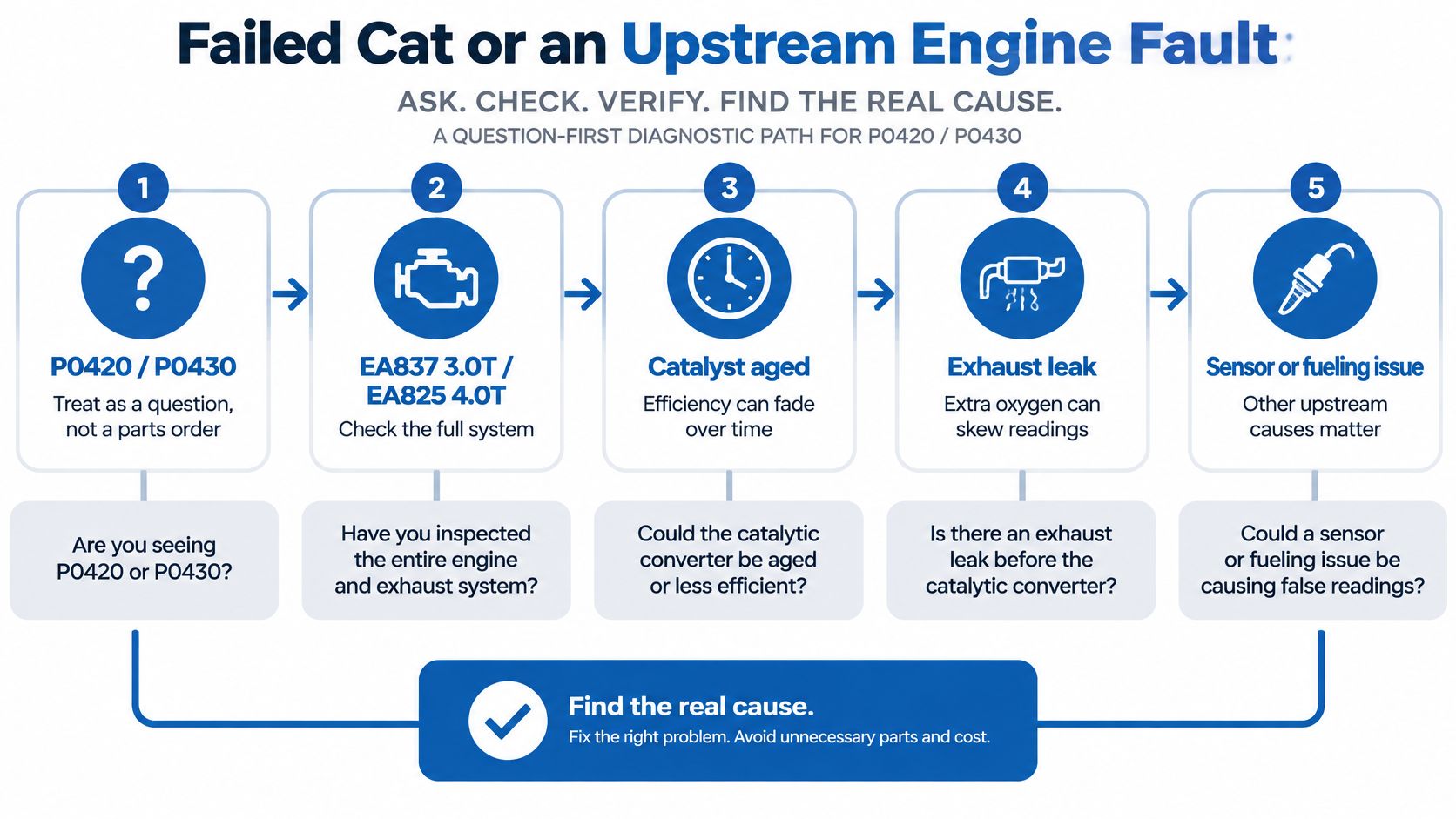
Five checks before you condemn the brick
Work these in order, because each one can change the answer.
- Read misfire counts and fuel trims first. Pull stored misfire history plus short-term and long-term fuel trims before you price a converter. Active misfires send unburned fuel into the exhaust, and rich trims overheat the substrate. Either one means the engine gets fixed first.
- Compare front and rear sensor traces on a fully hot drive. A healthy cat makes the downstream sensor switch differently from the upstream one. If the rear trace starts mirroring the front, the brick may be aged, or the rear sensor itself may be lazy. Cold readings don't count, since the monitor runs hot.
- Inspect for leaks ahead of the rear sensor. Check flanges, gaskets, and flex joints. A small leak pulls in extra oxygen and can fail the efficiency test on a brick that's still doing its job.
- Confirm the engine isn't consuming oil. Check consumption and inspect the PCV system for feeding oil into the intake. Oil ash glazes catalyst surfaces, and it'll glaze the new one the same way.
- Only then call the substrate done. If misfires are absent, trims are sane, sensors respond properly, there are no leaks, and oil use is normal, the catalyst itself has aged out. Now a replacement makes sense.
| Clue | What it may actually be | Check before replacing the cat |
|---|---|---|
| P0420 or P0430 | Aged catalyst, exhaust leak, or lazy rear sensor | Upstream versus downstream traces on a hot drive |
| Stored misfires | Unburned fuel overheating the substrate | Coils, plugs, and fuel trims repaired first |
| Rising oil consumption | Oil ash glazing a new catalyst | PCV, leaks, and consumption on the EA837 or EA825 |
| Leak ahead of the rear sensor | Extra oxygen that fails the efficiency test | Flanges, flex joints, and gaskets |
| Rich fuel trims | Overfueling that cooks the brick | Trim direction and sensor plausibility |
If you're sorting the light itself before you touch hardware, the guide to common check engine light causes covers the faults that most often sit upstream of a converter code.
Why a high-flow cat isn't an automatic cure
A repeating efficiency code doesn't disappear just because the new brick flows better. Catalyst loading, light-off temperature, calibration, and monitor thresholds decide whether readiness completes and stays complete. A lightly loaded brick can flow well and still fail the monitor, while a correctly loaded one passes.
The expensive mistake is bolting on the cheapest converter while the original cause is still active. Unburned fuel overheats the new substrate and oil ash poisons it, so the same code returns and you've bought the job twice. End this step with a clear yes or no. Either the engine needs repair first, or the engine side is clean and the catalyst is finished.
When Backpressure Actually Changes the Pull
A healthy catalytic converter creates some exhaust restriction, but that alone does not make it the engine's limiting point. Its substrate provides the heat and residence time needed to convert hydrocarbons, carbon monoxide, and NOx.
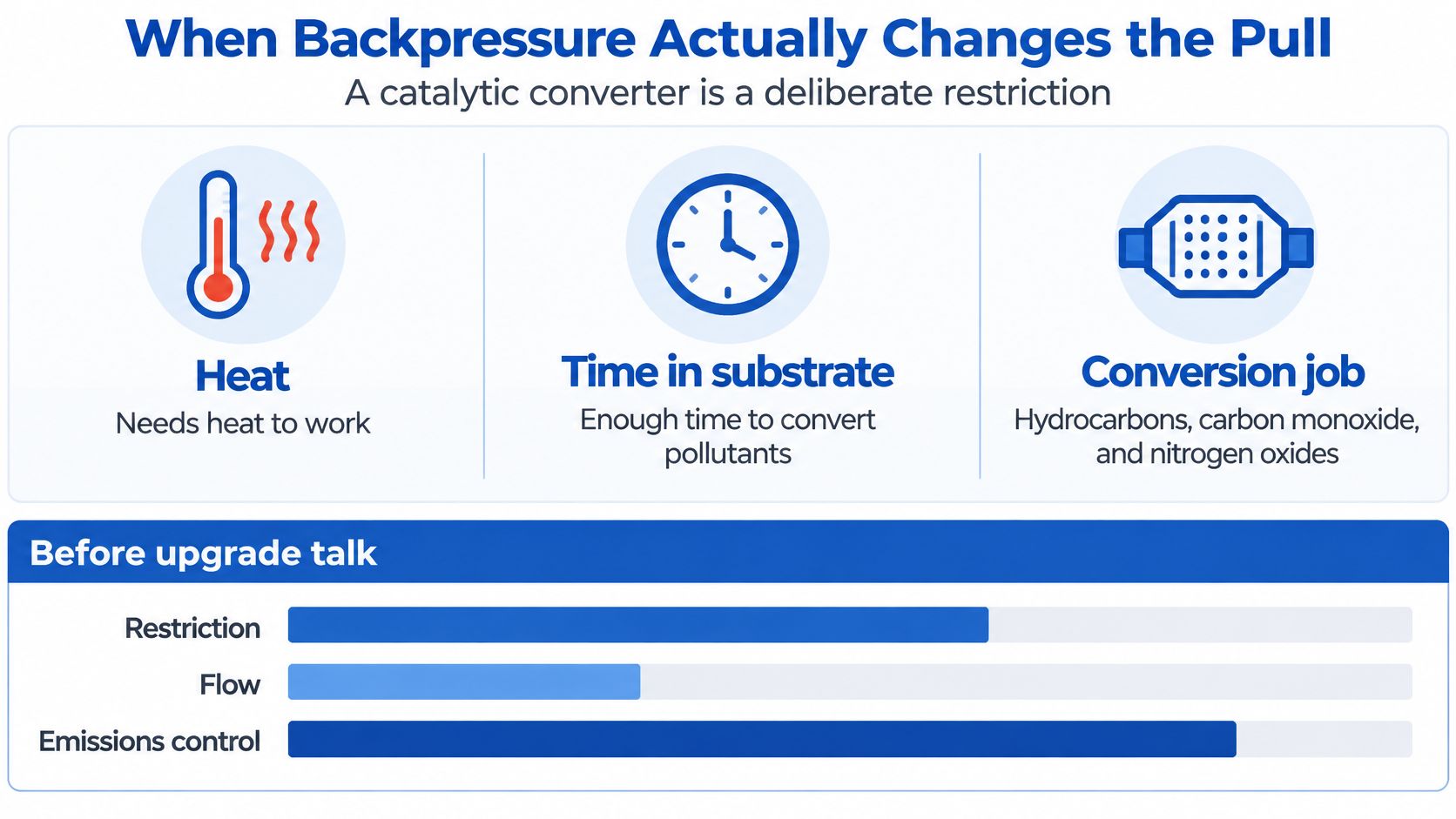
The healthy cat usually isn't the limiter
On a stock or mildly tuned EA837 3.0T, intake temperature and the supercharger typically limit performance before a healthy cat does. Replacing a sound converter for flow alone is unlikely to be the best use of a mild build's budget.
A damaged substrate changes the equation. A melted, broken, or oil-loaded brick raises upstream pressure, making it harder for the engine to empty its cylinders. The car can feel flat above the midrange even though the tune has not changed. Once the brick is damaged, it stops being a designed restriction and becomes a blockage; replacing it restores the pull rather than adding a new performance feature.
The Audi oxygen sensor guide explains how front and rear sensor readings relate to catalyst operation.
The video below shows how exhaust restriction can affect performance.
Where High-Flow and Catless Fit
A high-flow cat keeps a catalyst in the exhaust while aiming to reduce pressure drop. It may suit a 3.0T build that asks for more exhaust flow through a pulley, intake, or tune. On an EA825, the choice also depends on how the converter fits the engine's exhaust layout. A flow claim alone does not establish that a part suits the car.
For an EA837, ask the maker about heat tolerance and substrate construction, especially with converters close to the manifolds. The Vorsprung High Flow Cats for Audi 3.0T supercharged Q5, SQ5, S4, and S5 are listed with four variants. The maker says they are not designed for crackle or burble tunes. Check whether the maker specifies the substrate and its temperature rating before choosing a replacement.
Catless pipes remove the substrate pressure drop, but they also change what the rear sensors see and generally suit off-road or competition use rather than a street car. If the catalyst is healthy and the build is mild, a flow upgrade may bring little benefit. If the substrate has failed, replace the failed part; if the car is competition-only, weigh the flow trade-off against the loss of the catalyst.
Which Paths Stay Legal on the Road
A flow claim tells you nothing about whether a part belongs on a public road. On an EA837 or EA825, the converter is matched to engine generation, fueling, oxygen-sensor strategy, turbocharging, and the emissions standard for that model year. Treat approval as a fitment requirement, same as a flange pattern.
The checklist below sets out what has to match before a street part is even a candidate.
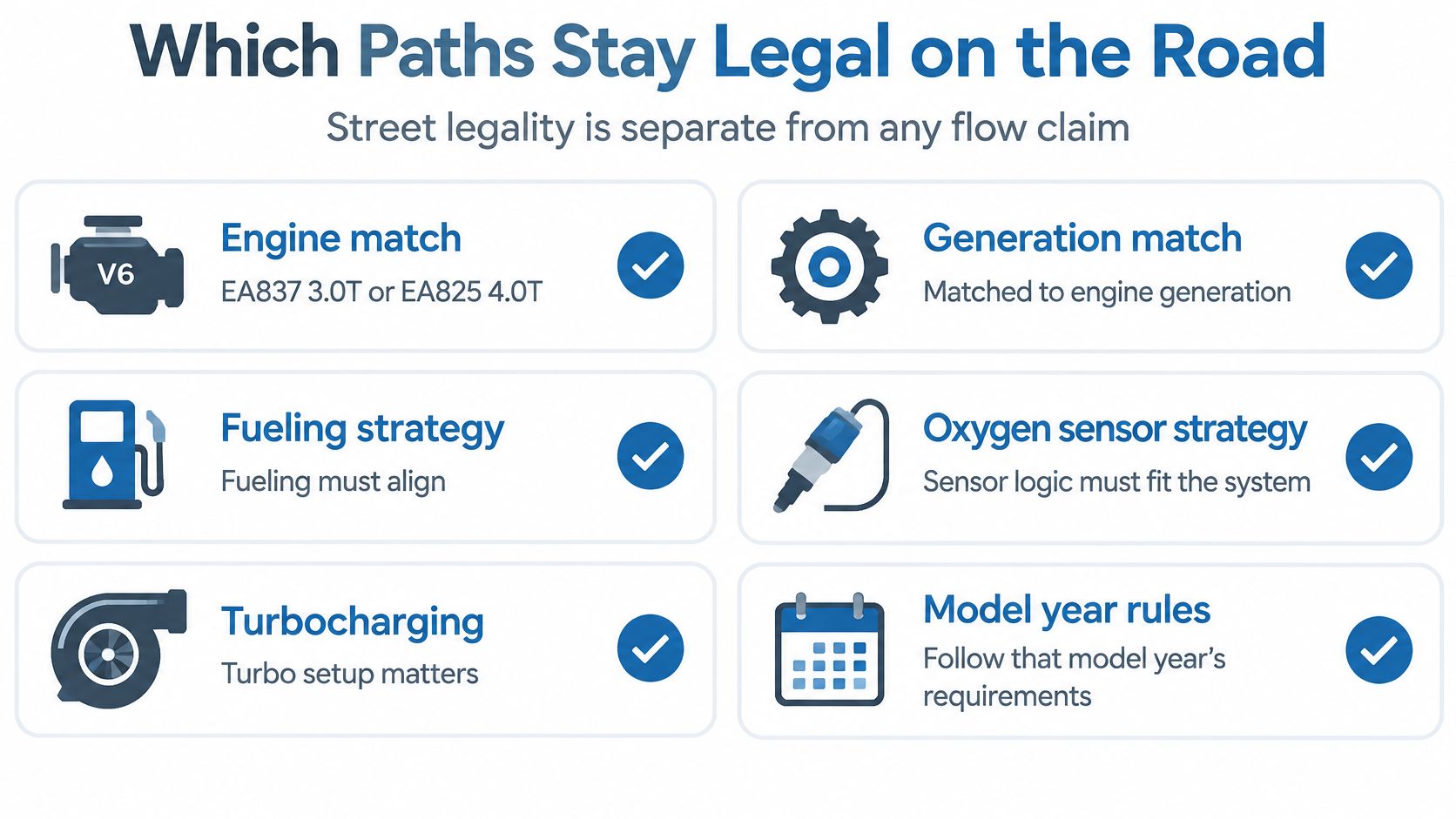
What keeps a street car legal
- Public-road and inspected cars stay on an OEM or OEM-equivalent converter, or on a replacement catalyst that's emission-type-approved for that specific vehicle.
- EU rules published in 2025 require replacement pollution-control devices for covered type-approved vehicles to be separately emission-type-approved and carry an approval mark, so a Euro-6 label on a box doesn't prove the part is approved for every EA837 or EA825 market.
- In the United States, removing or bypassing a catalytic converter on a public-road vehicle is generally illegal under federal tampering rules, and many states add inspection or readiness checks on top.
- Catless downpipes, test pipes, and cat-delete headers are off-road and competition parts. That classification doesn't change because they bolt to a street chassis.
The deeper question of whether a high-flow catalytic converter is legal depends on approval for the car and market, which is why two parts with similar cell counts can land on opposite sides of the line.
Why model year matters more than owners expect
Audi has tied converters to engine control for decades. According to Audi's five-cylinder engine history, the 1984 Audi Sport quattro was the first Audi the company identifies as using a fully electronic map-controlled ignition system together with a catalytic converter as standard equipment, and the EU began using WLTP for type approvals of certain new vehicles on September 1, 2017, with WLTP progressively replacing NEDC from September 1, 2018.
That timeline is the practical point. A later Audi was certified under a different test regime with different diagnostics, so it isn't a universal pipe swap. Before you order, match engine code, model year, and sensor count, and confirm the listing describes a replacement catalyst rather than an off-road pipe wearing street language.
Shop rule: If the listing can't state the approval basis for your exact car, treat it as an off-road part until proven otherwise.
Sound Fitment and Heat on These Engines
Cold-start sound is one of the clearest differences between converter paths. Factory cats quiet the exhaust noticeably, while a Euro-6 high-flow cat usually adds a sharper edge and a little more volume. On overrun, you hear more engine texture, but the substrate still smooths much of the rasp and odor. For a tuned street car, that can be a more livable balance than a catless setup.
Catless hardware brings a more pronounced change: cold starts get loud, and overrun sounds raw. Consider the whole system layout when choosing a downpipe. This turbo-back exhaust guide explains how the primary section fits into the rest of the exhaust.
Construction decides whether it survives
On budget catless parts, thin tubing, rough welds, and poor shielding can lead to cracks at the flange or heat damage to nearby components. A competition pipe driven hard needs heavier stainless, clean mandrel bends, and integrated heat shielding.
Fitment matters just as much. Flanges, oxygen-sensor bungs, and any flex or decoupler must match the factory layout, so the pipe does not load the manifold studs through repeated heat cycles. Even a slight mismatch can cause a leak or ticking after installation.
Platform checks before the order
EA837 and EA825 applications do not share all their hardware. B8 and B8.5 S4, S5, SQ5, A6, and A7 models on the EA837 need different downpipe fitment from C8 RS6, RS7, and other EA825 applications. Confirm left and right primary length, sensor-bung orientation, wiring reach, and clearance to the subframe and tunnel as the engine moves.
A merge collector is a fabrication piece for building a custom collector, not a catalyst substitute.
Before ordering, record the engine code, left and right sensor count, and whether the car still has its factory primary pipes. If the car has already been modified, match the replacement to the hardware currently fitted.
Match the Path and Retire the Old Cat
A commuter, a tuned street car, and a track build do not need the same converter setup. The right choice depends on whether the catalyst failed, what caused the failure, and whether the car must retain an approved emissions device.
The image below maps converter options against different builds and driving styles.
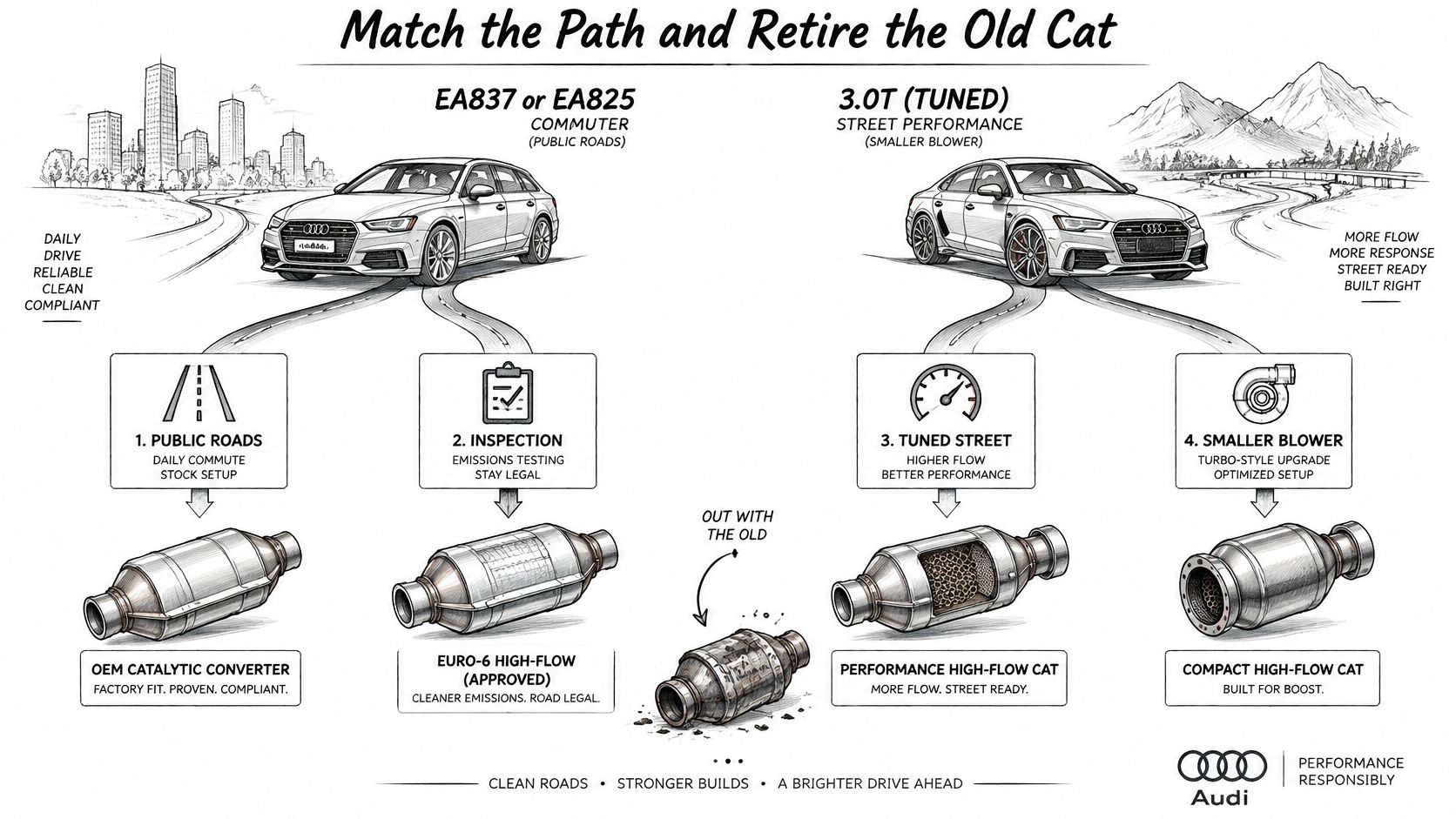
Four uses, one path each
1. Commuter EA837 or EA825 on public roads. Use an OEM converter or a type-approved Euro-6 high-flow replacement. Approval and monitor behavior matter more than a claimed flow gain when the car faces inspections and readiness checks.
2. Tuned street 3.0T that must keep a catalyst. A smaller blower pulley and revised calibration increase the demands on an aging stock brick. A Euro-6 high-flow cat with a disclosed heat rating and proper shielding retains a catalyst substrate while reducing restriction. It also avoids the rasp and odor associated with a catless setup.
3. Track, hill-climb, or off-road car. Catless downpipes or test pipes with heat shielding suit builds that do not need to meet street emissions requirements. Store the original cats if the car may return to road use. Replacing the correct parts later can cost more than keeping the ones already removed.
4. High oil consumption, whatever the build. Address the PCV system, rings, or leaks before replacing the converter. Oil ash can damage the new substrate, so installing a cat before correcting the consumption risks repeating the failure.
The pre-order sequence
Use the earlier diagnosis and fitment checks to confirm the replacement matches the car as it sits now. Record the engine code, model year, sensor layout, and whether the factory primary pipes remain. If adjacent exhaust work is planned, the guide to installing headers covers flange and fastener practices that help keep primary joints sealed.
Vorsprung Autowerk lists Euro-6 high-flow cats and shielded T304 competition test pipes by platform for EA837 and EA825 applications.
Retiring the old converter properly
The old cat still holds recoverable platinum-group metals. Ecotrade Group's autocatalyst recycling market summary reports that in 2017, approximately 1.2 million troy ounces (37 metric tons) of platinum and 2.2 million troy ounces (67 metric tons) of palladium were recycled globally from spent autocatalysts. Europe accounted for roughly 0.424 million troy ounces of the platinum and 0.477 million troy ounces of the palladium.
The summary also describes research estimating that only about 50–60% of automotive-catalyst platinum was recycled, with approximately 15 metric tons leaking outside the European market in 2017. Sending the removed converter through a documented recycling channel helps keep its recoverable metals in the recycling stream.
A scrap return is not guaranteed to be substantial. Daily Platinum's converter value guide cites World Platinum Investment Council 2024 estimates of an average platinum price of approximately $957 per troy ounce and palladium at about $982 per troy ounce. What a particular converter returns depends on its metal loading and condition.
Remove the old Audi cat converter intact rather than cutting out the brick. Keep the recycler's documentation and use a certified recycler rather than a cash buyer with no paper trail.
If you have identified the failed part and confirmed the car's emissions requirements, Vorsprung Autowerk lists Euro-6 high-flow cats and shielded competition test pipes by platform. Match the engine code, model year, and sensor count before ordering.


