

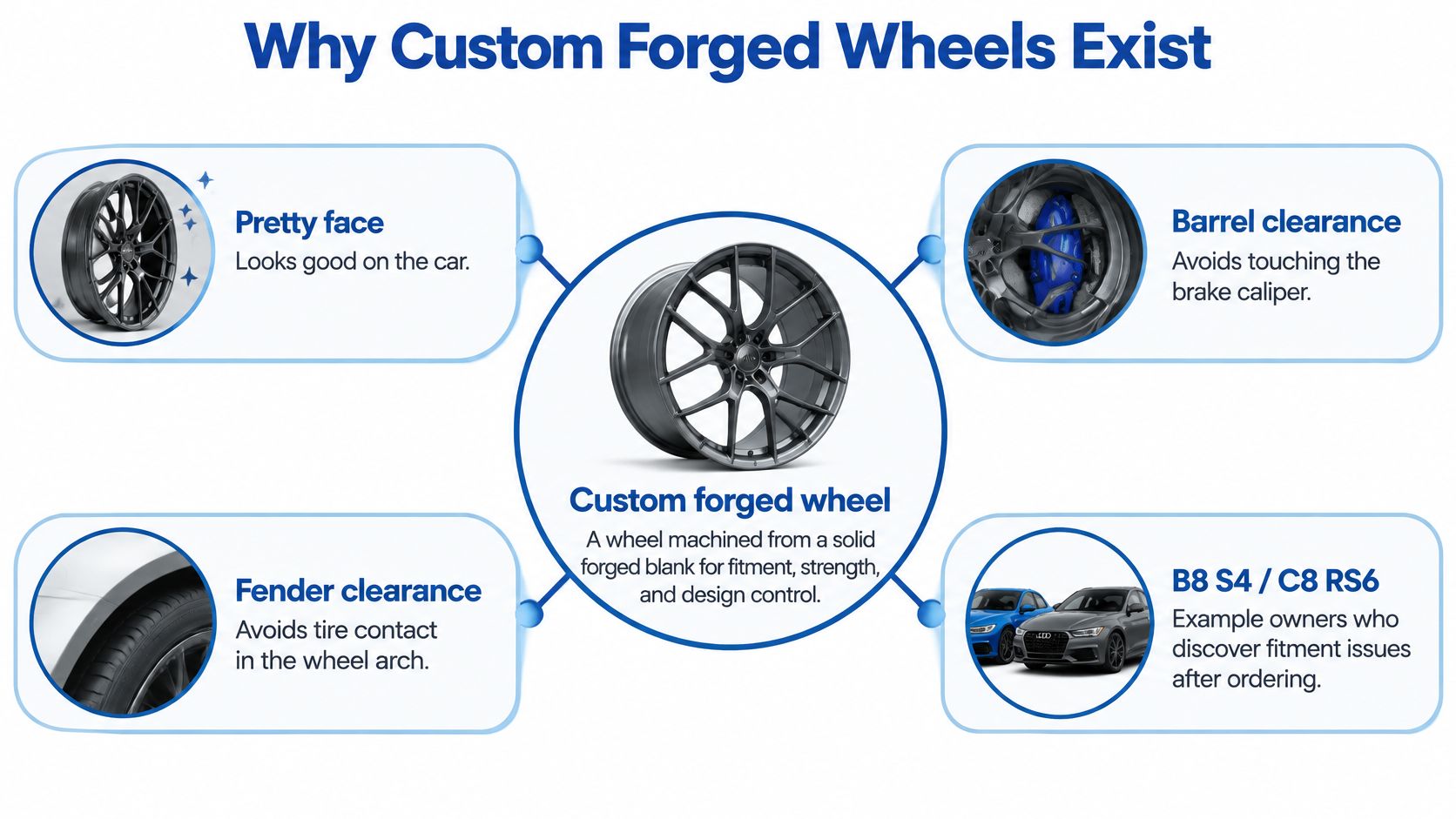
You ordered the face you liked, a B8 S4 or a C8 RS6, and the wheels arrived looking exactly like the photo. Then the barrel kissed the caliper, or the tire found the fender liner on the first driveway. That is the usual way a pretty wheel becomes a fitment job. Custom forged wheels only earn their weight savings when diameter, width, offset, brake clearance, and a load rating for that exact axle all agree.
Table of Contents
- Why Custom Forged Wheels Exist
- The Specs That Decide Fitment
- Monoblock and Multi-Piece Forging
- Brake and Suspension Clearance Checks
- Load Ratings for Real Audi Axles
- Finishes Coatings and Upkeep
- Platform Fitment and Order Decision
Why Custom Forged Wheels Exist
A forged wheel starts as a solid aluminum blank, which is pressed into shape and then machined for a specific diameter, width, offset, bolt pattern, and center bore. That process gives designers room to tailor the wheel to the car rather than just change the face of a cast design.
Casting pours molten metal into a mold; forging compresses the blank. On 6061 aluminum, that structure can support a thinner design while retaining impact and fatigue resistance. The common temper is 6061-T6, heat-treated for strength and precise machining.
The alloy was adopted for measurable strength-to-weight reasons. TMS records that Alcoa introduced what it describes as the first forged aluminum wheel in 1948, using an aerospace alloy, and introduced 6061 for forged aluminum wheels in 1968. The Aluminum Association's history in that account places 6061's introduction in 1935, with composition and processing limits broadened in 1963.
Less wheel mass gives the suspension less unsprung weight to control. That can sharpen turn-in and help the tire stay planted under braking, though the benefit depends on the complete wheel-and-tire setup. A thinner spoke or more concave face still has to leave room for the brake package and carry the loads its design will see. The manufacturing differences are covered in this forged versus cast wheel comparison.
The Specs That Decide Fitment
A wheel can match the bolt pattern and still fail at the caliper or strut. Start with the dimensions for the exact Audi, then confirm brake and suspension clearance against the wheel's spoke design. Most performance Audis share a 5x112 bolt pattern and a 66.56 mm hub bore, but those measurements alone do not prove fitment.
| Spec | What it controls | If it is wrong |
|---|---|---|
| Diameter | Tire sidewall and radial brake room | Too small can hit the caliper radially; too large raises unsprung mass |
| Width | Tire section and possible concavity | Too wide can rub the fender or liner; too narrow limits tire choice and face shape |
| Offset (ET) | Inboard versus outboard position | Low ET can push the wheel outward; high ET can bring it into the strut or liner |
| Bolt pattern | Stud circle match | A pattern other than 5x112, including 5x120, will not bolt on |
| Center bore | Hub-centric seating | Under 66.56 mm will not seat; oversize needs a hub-centric ring |
| Load rating | Axle capacity of that exact wheel | An under-rated wheel may not support the axle load |
Diameter, width, and offset
Diameter sets sidewall height and radial room over the rotor. 19 and 20 inch wheels are common street choices on an S4, S5, or SQ5. 21 and 22 inch wheels also appear on an RS6, RS7, or Q7, where the spoke window must clear the larger brake package. A wheel can clear the fender and still contact the caliper.
Width, often 9.0 to 11.0 inches in a custom set, affects tire section and how much concavity the face can have. A wider wheel may bring a 275 or 305 section tire into the liner. More concavity is not automatically better: the face still has to clear the brakes and fit within the fender and suspension envelope.
Offset (ET) is the distance in millimeters between the wheel centerline and mounting pad. Lower ET moves the wheel outward; higher ET tucks it inward toward the strut. Even a 5 mm change can alter clearance. Record the existing ET from the wheel or spec card, then compare it with the proposed wheel using this guide to measuring wheel offset.
Pattern, bore, and the line you write first
Write the specification for each corner before choosing a spoke style. A typical rear specification for a staggered street set is 20x10 ET35, 5x112, 66.56 mm. Fronts are often narrower and use a higher ET to keep the tire clear of the fender.
Bolt pattern must be 5x112. A 5x120 wheel will not match the stud circle, and elongating the holes is not a fitment solution. Center bore must match 66.56 mm, or be larger with a hub-centric ring. A smaller bore will not seat on the hub.
A spacer changes the wheel's position, moves the load path, and reduces available stud engagement. It cannot substitute for a correctly chosen ET, particularly when the wheel needs to clear a caliper.
The material used for a wheel and the tubing used for intake or charge piping are separate specifications. The Vibrant 2in O.D. Universal Aluminum Tubing with a 30 degree bend is a tubing product, not a wheel blank. Wheel alloy alone does not establish fitment or safety. The wheel must clear the brakes and suspension, and its load rating must match the exact Audi axle, spoke design, and test method.
Monoblock and Multi-Piece Forging
Start with the blank. A forged 6061 puck is pressed, then the face, spokes, and barrel are CNC machined. A monoblock is that one piece. A multi-piece wheel is a center bolted or welded to barrel parts so width or lip depth can change without a new face. One-piece versus bolted-together is the whole split.
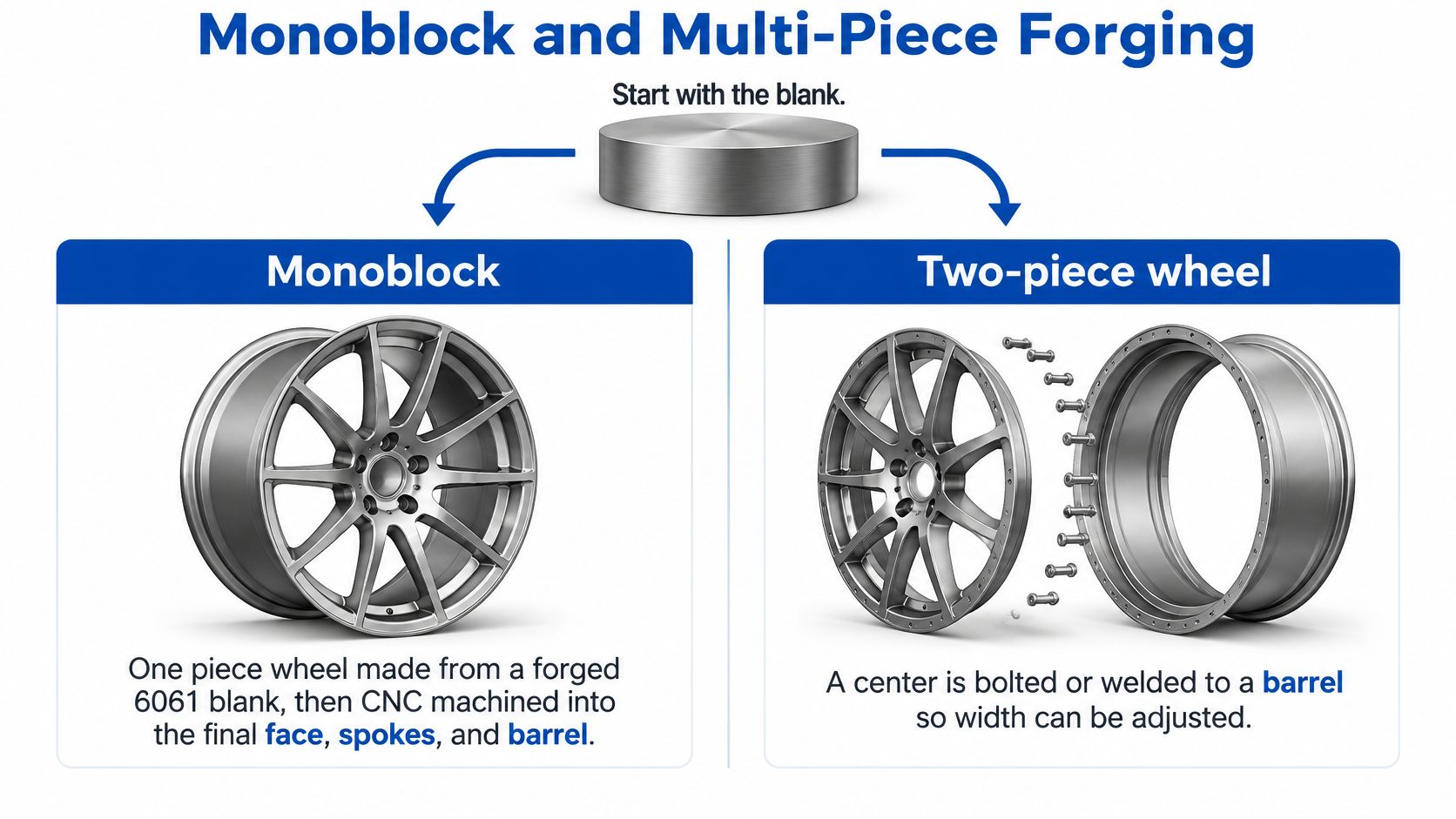
| Construction | How it is built | Weight and hardware | Best use |
|---|---|---|---|
| Monoblock | One forged blank, fully machined | Usually lightest; no assembly bolts | Daily and track Audis where mass and simplicity matter |
| Two-piece | Forged center plus a separate barrel | Tunable width; barrel can be serviced | Staggered widths without a new face design |
| Three-piece | Center plus inner and outer barrel lips | Most hardware; lips are replaceable | Deep-lip looks and curb-rash repair |
What each build is actually for
A monoblock has no ring of assembly bolts to torque, so it suits street and track use on an EA837 S4 or S5 where you want the least hardware and the least mass. Spoke shape is locked once the blank is cut. If the front brake needs a different barrel than the rear, you order two widths, not one adjustable shell. How that one-piece cut is specified is covered in this monoblock forged wheel breakdown.
A two-piece wheel is the practical custom-width tool. The center stays, and the barrel changes so a staggered set doesn't need a second face design. You gain a joint, and that joint is something you inspect.
A three-piece wheel splits the barrel into inner and outer lips. That is how deep lips and replaceable curb-rash barrels are made. You pay in hardware and in rotating mass out at the lip, which is the worst place to carry extra weight. I would pick it when a replaceable lip is the point, not when the goal is the lightest corner.
Back-milling removes non-structural metal from the rear of the spokes. A knurled bead seat helps the tire stay put under torque instead of spinning on the rim. Both are machining choices. Neither replaces a stress check.
This short cut shows the blank-to-spoke sequence better than a still photo.
The alloy name is not the load path
SAE testing of aluminum wheels used service-like variable-amplitude biaxial loading with wheel rotation and found fatigue life to initial cracking could be predicted across cast, age-hardened, and forged materials when cumulative damage was limited to 0.5 rather than the conventional 1.0. Durability depended on stress in critical regions, not on the process name.
A thin, sharp-fillet 6061-T6 monoblock can be weaker than a slightly heavier design with a better path through the spoke roots, hub, and bolt seats. Ask for finite-element review of the actual spoke, plus documented radial and cornering-fatigue validation and the design loads behind them. Match the build to the job. Monoblock for a driven S or RS car. Multi-piece when width, concavity, or lip service matters more than minimum mass.
Brake and Suspension Clearance Checks
Diameter, width, offset, 5x112, and a 66.56 mm bore do not prove the wheel clears the brakes. S, RS, SQ5, RS6, and RS7 cars can wear different packages, and an aftermarket kit can change caliper shape without changing rotor diameter.
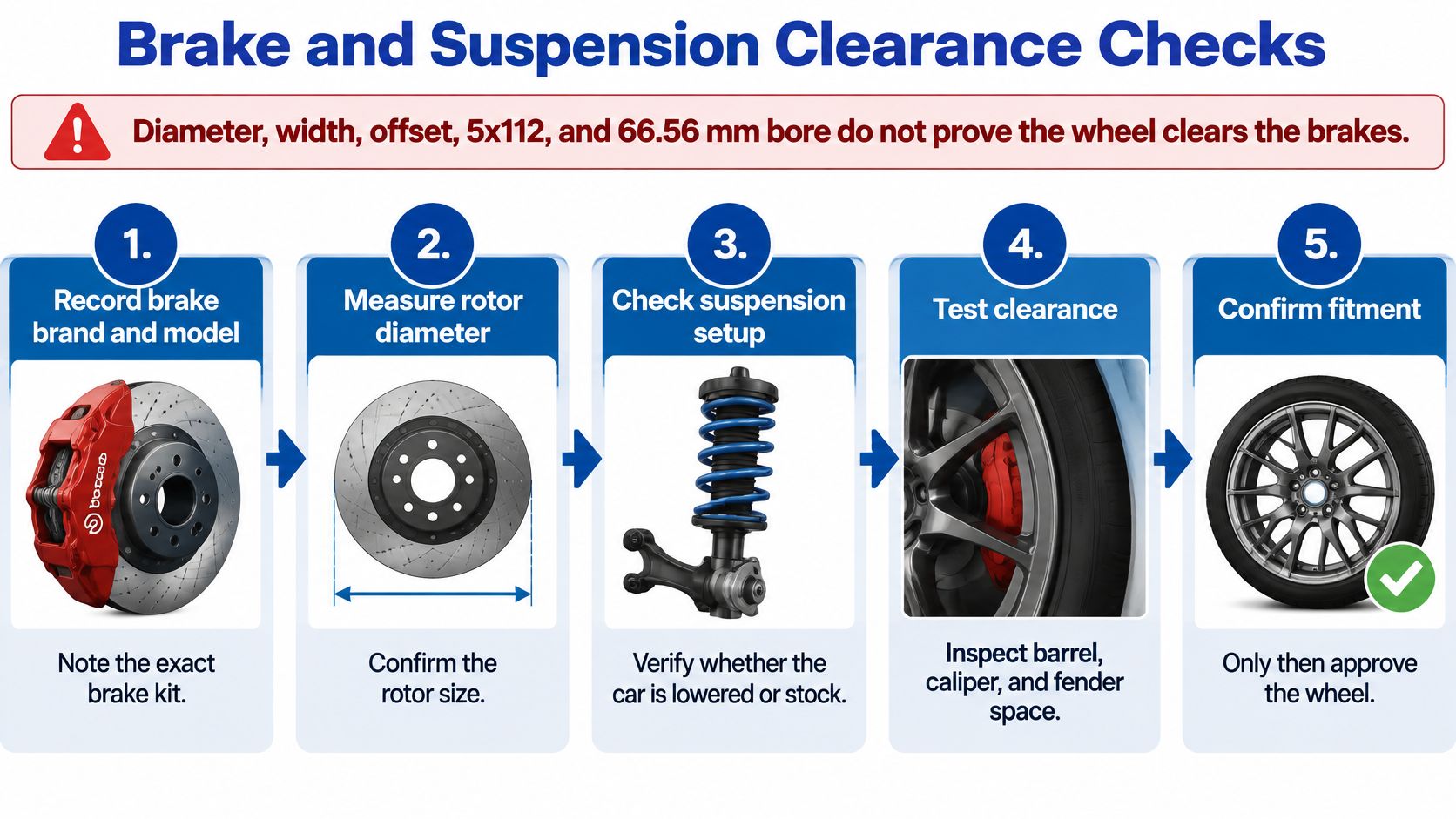
Fitment verification practice is explicit that PCD and center bore stop short of clearance. You still have to check the barrel, the full spoke profile, and the suspension at lock and compression. Model-by-model starting points live in this Audi wheel fitment guide. Run the checks in this order, on your car.
- Record the brake. Brand, model, rotor diameter, and whether the car is stock, an S or RS package, or a big-brake kit. Caliper ears and bridge shape change even when the rotor stamp does not.
- Check radial clearance from the caliper body to the inner barrel, not just to the spoke tips. A barrel that necks in will touch a caliper the spokes appear to clear.
- Check axial clearance from the caliper face to the back of the spokes across the whole profile, including the barrel curve. One tight spot at the spoke root is enough.
- Steer to full lock and compress the suspension. Look for strut, tie-rod, and sway-bar contact. Static photos miss this.
- Repeat with the intended tire. A 275 or 305 section can hit the liner when the bare wheel cleared.
- Recheck if the car is lowered. Less compression travel means the same bump puts the tire into the liner sooner.
Concavity is a result, not a goal
More concavity is not automatically better. Dish is constrained by width, offset, barrel geometry, and brake clearance. An aggressive face on a narrow, high-offset wheel either will not exist, or it drives the spokes into the caliper and forces a spacer. Chasing the photo on an EA837 with a mild front brake often means a low ET that pokes. On an EA825 with a large front caliper, the same chase closes the spoke window.
Ask for a template or measured caliper before the wheel is cut. Once the blank is machined, you own the interference.
Send a packet, not a screenshot of someone else's car. Include brake model, rotor size, caliper dimensions or a template, hub data, tire size, intended ride height, and whether the car is street or track. Load rating belongs in that same packet, tied to axle load, vehicle mass, the tire plan, and duty, not added after the finish is picked.
Load Ratings for Real Audi Axles
A wheel's load rating must cover the ordered design and its intended Audi application. Forging and 6061-T6 describe how a wheel is made and what alloy it uses; neither proves that the finished wheel can carry the axle load.
Use the door-jamb Gross Axle Weight Rating (GAWR) as the starting point: divide the axle rating between its two wheels to get the minimum static load per wheel. Allow additional margin for passengers, cargo, pothole impacts, high-grip tires, braking, and track use. A rating for another diameter, width, or spoke design does not establish capacity for the wheel you are ordering.
A rating needs evidence behind it. Fatigue evaluation combines stress analysis with physical rotary-fatigue testing, and changing spoke thickness can change the result. SAE rotary-fatigue analysis of forged magnesium road wheels illustrates why the test needs to represent the specific wheel design. A brochure line is the weakest form of evidence.
| Evidence level | What you actually have | Enough to order |
|---|---|---|
| Marketing claim | The words forged or 6061-T6 only | No |
| FEA only | A stress map using your axle load and spoke design | Partial |
| Lab fatigue and impact | Radial, cornering, and impact tests to SAE, JWL, or VIA methods | Yes for street use |
| Traceable drawing | The tested sample matches your diameter, width, offset, and spoke design | Required for a made-to-measure wheel |
Heavy cars are a different load case
An EA837 S4 and an EA825 RS6, RS7, or Q7 do not present the same wheel load case. The heavier RS models and SUVs call for more load margin than a light sports-car benchmark. Thinning spokes to reduce catalog weight can compromise fatigue performance on a heavy front axle.
SAE design work comparing FEA with experimental stress in forged aluminum wheels examines how loading assumptions affect wheel design. Lower mass only helps if the stress map accounts for that car's axle load, offset, tire rating, and brake-driven spoke shape. A generic analysis of a similar face is partial evidence, not a certificate.
A made-to-measure order needs three items: the design load, the test method, and confirmation that the certificate covers the ordered size and spoke, including back-milled pockets and bolt seats. Ask for those details before approving the wheel. How to assess cheap forged wheel safety covers why the testing behind the rating matters.
Finishes Coatings and Upkeep
A wheel can clear the brakes and carry the axle, yet still be a poor choice for the way the car is used. Finish affects how visible dust, wash marks, and curb contact will be, and how much care the face needs.
How each face ages
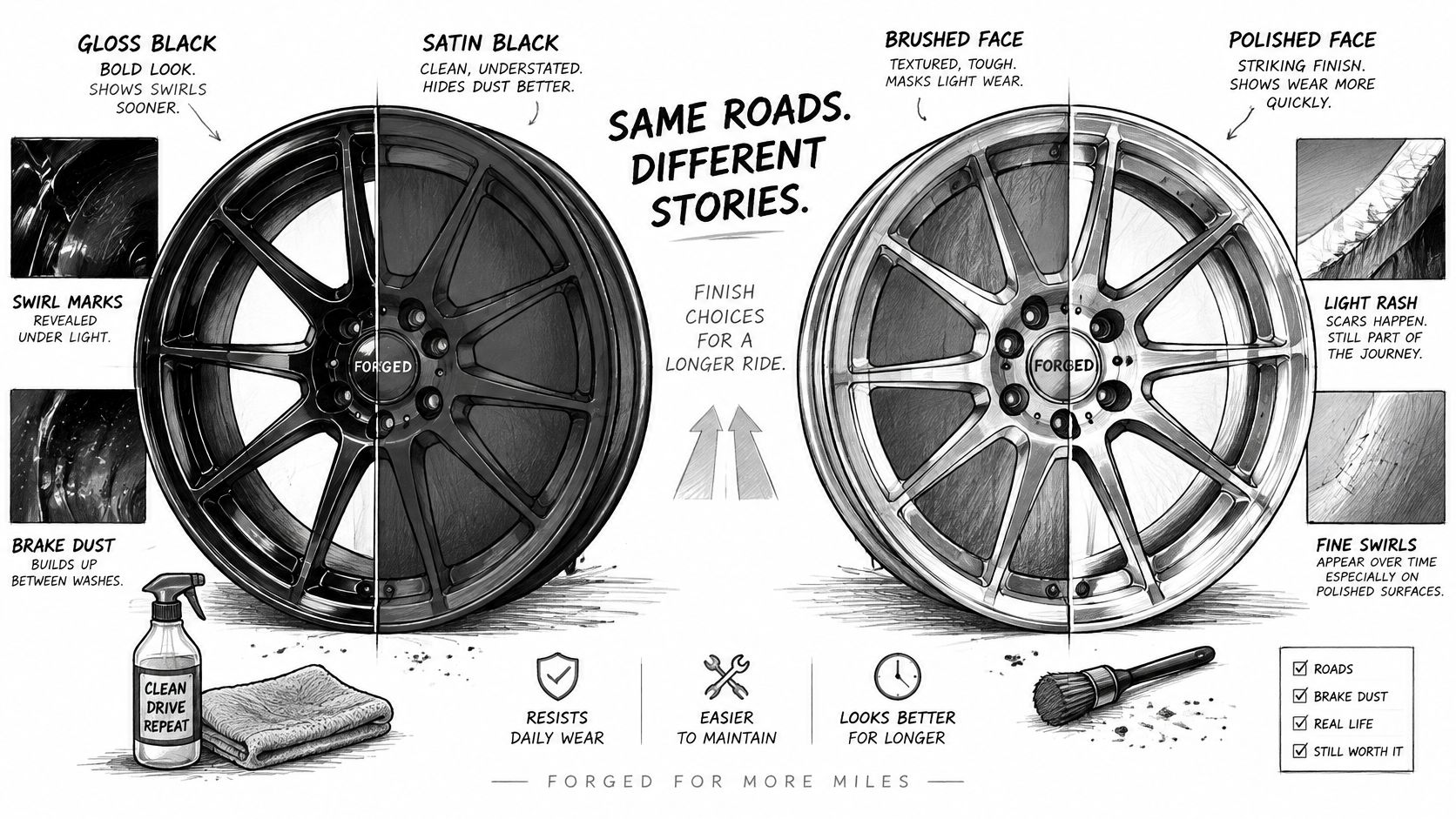
Gloss and satin black keep brake dust less visible between washes, but curb rash shows as a light scar. They suit daily use, including winter driving.
Brushed and polished faces reveal swirl marks and dust sooner. Use soft wash media and avoid acid cleaners. On a multi-piece wheel, the polished outer lip is exposed to curb contact and can be serviced as a separate part.
Paint with a clear powder or liquid coating is a practical daily-driver finish. The coating stack is pretreatment, color, then clear. Clear can fail first at spoke roots, where cleaner may collect if it is not rinsed away.
Care and what a warranty covers
Brake dust can build up on the face and around spoke roots; winter salt can collect in the inner barrel. Rinse both areas thoroughly.
- Wash with pH-neutral soap. Avoid acid wheel cleaners on polished and brushed faces.
- Rinse behind the spokes and through the barrel. Dust and cleaner left at the roots can lift the clear.
- Torque lug bolts to the vehicle specification after the first heat cycles. Recheck multi-piece assembly hardware on the builder's schedule.
- Mount tires with the knurl in mind. A high-torque EA825 launch can spin a tire on a smooth bead seat.
Finish warranties commonly exclude curb rash, pothole bends, and track abuse. A structural warranty should identify the load and test standard it covers. Custom wheels are cut to surveyed specifications, so an offset chosen by the buyer that causes fitment problems is not a manufacturing defect. Because custom sets are machined to order rather than pulled from a shelf, account for the car's downtime before approving the drawing.
Platform Fitment and Order Decision
On an EA825 RS6 or RS7, the expensive mistake is choosing a light spoke that fails fatigue checks. On an EA837 S4, S5, or SQ5, a low-offset wide wheel can poke past the fender. Set the specification for the platform before choosing a face.
| Platform | Typical sizes | Main risk | Fitment focus |
|---|---|---|---|
| EA837 S4, S5, SQ5 | 19 and 20 inch | Low-offset wide wheels poking past the fender | Set width and offset for the car |
| EA825 RS6, RS7 | 21 and 22 inch | Large front brakes, high torque and curb weight | Open spoke window and load margin |
| Q7 | 21 and 22 inch | Heavy curb weight and axle load | Load rating tied to axle; avoid thinning spokes |
Four confirmations before a blank is cut
Confirm these before sending the fitment survey.
- Construction. Choose monoblock unless a replaceable lip or a special barrel width is the point.
- Size per axle. Set diameter, width, and offset for front and rear separately. Stagger is normal.
- Pattern and bore. Keep 5x112 and a 66.56 mm bore, with a ring only if the bore is larger.
- Load story. Require a design load, test method, and certificate that match the ordered spoke.
Use the measurements listed in the Brake and Suspension Clearance Checks section. Vorsprung Autowerk builds made-to-measure forged 6061-T6 sets, monoblock or multi-piece, with custom width, offset, and bore after a fitment survey of the car's brakes. Pricing follows the specification. Request a written quote, and allow for a custom build rather than expecting a set from stock.
For an EA837 or EA825 Audi, start the order with axle ratings, brakes, and offset, not a face photo. Vorsprung Autowerk machines monoblock and multi-piece 6061-T6 sets to surveyed fitment. Visit Vorsprung Autowerk for a written quote.


