

Replacing a factory boost hose with silicone isn't automatically an upgrade. A hose can tolerate impressive heat and still fail because its liner can't handle oil, its pressure rating applies only at room temperature, or its shape forces the joint sideways. If you're searching for intercooler hose silicone, buy from the complete hose specification, not the material name or the number of reinforcement layers alone.
For an Audi EA837 or EA825 installation, the useful questions are specific: what passes through this hose, how hot does its wall become, and how much movement must the connection absorb? Those answers determine whether reinforced silicone, a lined construction, or an OEM-style replacement makes sense.
Table of Contents
- Silicone Versus OEM Rubber at a Glance
- How a Silicone Charge-Air Hose Is Built
- Selection Criteria for Diameter, Hardness, Pressure and Couplers
- Fitment by Location, Heat Soak and Oil Exposure
- How to Install and Inspect Silicone Hoses
- Confirm the Spec Before You Order
Silicone Versus OEM Rubber at a Glance
Silicone suits heat; oil-resistant rubber suits petroleum exposure. The spec sheet, not the material name, determines whether either option fits the route.
Silicone and OEM rubber intercooler hose compared
| Property | Reinforced silicone | OEM-style rubber |
|---|---|---|
| Operating temperature | About −40°C to 200°C, as described in the automotive silicone-hose overview | About −30°C to 140°C |
| Service life in turbo use | 120,000–150,000 km, as described in the automotive silicone-hose overview | 80,000–100,000 km |
| Oil resistance | Moderate for plain silicone; specify an oil-compatible liner for oil-wetted duty | Specialised oil-resistant compounds generally offer stronger resistance |
| Wall construction | Textile-reinforced silicone tube and cover, sometimes with an inner liner | Rubber tube with manufacturer-specified reinforcement and cover |
| Cold flexibility | Retains flexibility within its specified cold-service range | Check the compound's cold-service specification |
| Best fit | Heat-soaked charge-air routes with compatible contents | Stock routing where the original specification suits the heat, pressure and fluid |
Those temperature and service-life ranges are comparative figures, not universal qualification results or replacement intervals. A specific hose still needs a suitable pressure rating at operating temperature and compatibility with the fluid it carries.
Read the construction behind the comparison
Product specifications can be more useful than broad material ranges. Flextech charge-air hose specifications list polyester-reinforced constructions at approximately −65°F to 350°F, and aramid-reinforced versions at approximately −65°F to 450°F. The reinforcement changes the stated temperature range, so compare the specific construction rather than choosing by the word silicone.
A sound factory hose does not need replacing just because silicone is available. Diagnose the restriction, leak or thermal problem first, and keep hose reliability separate from the benefits of an intercooler. Improving the connection will not correct insufficient cooling capacity.
Buying rule: For heat and clean air, reinforced silicone may suit the route. For oil exposure, check that the liner is specified for it.
How a Silicone Charge-Air Hose Is Built
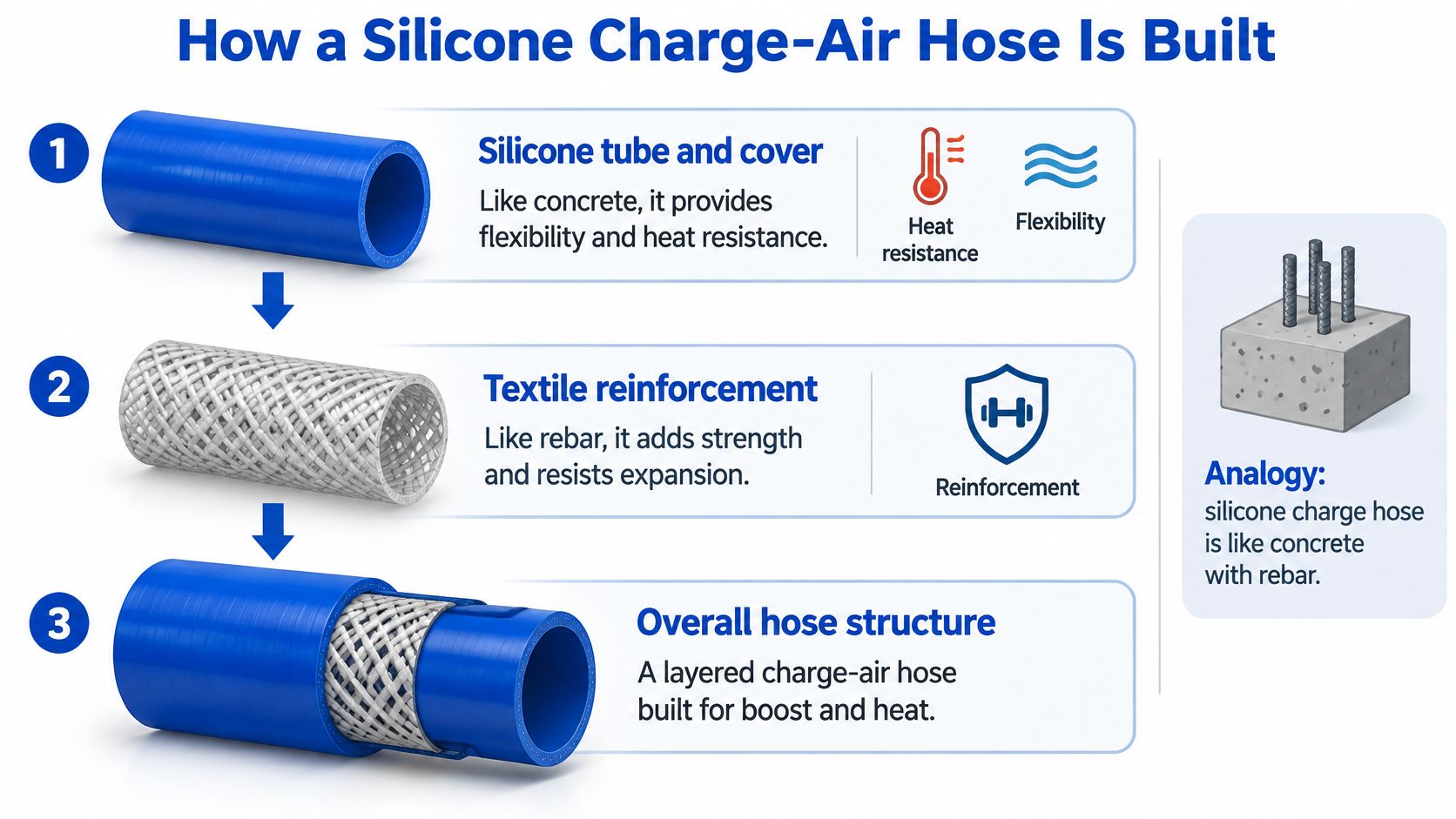
A silicone charge hose is like concrete with rebar. The analogy concerns the division of work, not rigidity: silicone provides flexibility and heat resistance, while textile reinforcement restrains expansion under pressure. Neither part tells you enough about the finished hose by itself.
Read the layers from the inside out
An optional fluorosilicone inner liner separates the main silicone structure from oil-bearing contents. Ask whether the liner is continuous through the formed section and whether the manufacturer approves it for the intended exposure. A coloured inner surface isn't proof of chemical compatibility.
The silicone tube forms the air passage and supplies the flexible sealing surface. Its job includes accommodating thermal cycling without forcing every movement into the pipe ends. A smooth bore is useful, but an attractive finish doesn't establish pressure capability.
The textile reinforcement carries the tensile load generated when boost tries to enlarge the hose. Fabric choice, orientation, bonding and the finished geometry all matter. Comparing layer counts without comparing those details can send you toward a thicker-looking but less suitable part.
The outer silicone cover protects the reinforcement from the surrounding environment. It isn't a substitute for a protective sleeve where a bracket can rub through the wall. Once abrasion exposes fabric, the structural part of the hose is no longer protected.
Material history isn't a finished-hose rating
Silicone's engineering background is substantial. Carnegie Mellon's account of silicone development describes its industrial emergence during the 1940s, including early use in aircraft-supercharger gaskets. That history supports the material's relevance to demanding thermal environments, not the suitability of every modern silicone coupler.
Before ordering, obtain these construction details:
- Liner material: Identify what contacts the air, vapour or liquid.
- Reinforcement: Confirm the fabric and the finished assembly's ratings.
- Cover protection: Check whether the installation needs an abrasion sleeve or radiant shield.
Also distinguish the air circuit from the coolant circuit in an air-to-water intercooler system. Similar-looking connections can carry different fluids and require different approvals. Reinforcement and liner specification, rather than the silicone label, are the construction facts worth paying for.
Selection Criteria for Diameter, Hardness, Pressure and Couplers
Start with a vernier caliper, not the catalogue photograph. Measure the pipe outside diameter at the sealing land, inspect its bead, and check the available insertion length. A nominal size on an old hose may be misleading if the hose has swollen or stretched.
A hose that's too loose invites over-tightening. One that's too tight can be damaged during fitting or leave insufficient engagement because the installer can't push it fully home.
Read the specification in buying order
Selection criteria and reference values
| Criterion | What to check | Example or target |
|---|---|---|
| Inside diameter | Match the pipe's sealing-land outside diameter | Measure the actual connection rather than copying a neighbouring hose |
| Pressure rating | Working pressure at expected wall temperature | Obtain the manufacturer's temperature-dependent rating |
| Temperature rating | Finished-hose approval and reinforcement type | Select for local heat exposure, including radiant loading |
| Wall thickness | Support, clamp fit and available clearance | A 2024 EMIHO charge-cooler hose listing specifies a 3.5-inch inside diameter and 0.19-inch nominal wall |
| Shore hardness | Flexibility, sealing behaviour and resistance to deformation | Request the specified Shore A hardness; don't infer it from colour |
| Coupler type | Straight, reducer, elbow or hump geometry | Use a formed bend for a direction change and a movement-rated connection where needed |
| Clamp | Hose outside diameter, band design and adjustment range | Use a compatible T-bolt or constant-tension clamp |
Pressure at operating temperature is the important specification. If a supplier publishes only an ambient-temperature working pressure, ask for the derating information before using the hose beside a hot compressor housing. A maximum temperature and a maximum pressure printed separately don't necessarily apply simultaneously.
Wall thickness matters, but thicker isn't automatically stronger. Additional wall can interfere with adjacent hardware, move the required clamp size outside its proper adjustment range, or make a short connection too stiff to accommodate movement.
Choose geometry before chasing stiffness
Shore A hardness describes the elastomer's resistance to indentation. Softer material generally conforms more readily; firmer material resists local deformation. Neither tells you whether the complete reinforced hose can survive vacuum, because unsupported length and reinforcement also affect collapse.
Choose the shape that lets the hose sit naturally:
- Straight coupler: Use between aligned pipe ends without forcing an offset.
- Reducer: Match different pipe diameters without crushing an oversized end.
- Formed elbow: Change direction without kinking a straight section.
- Hump coupler: Accommodate movement where the product's design and rating permit it.
For an Audi supercharger upgrade, consider the revised duty rather than assuming the old hose specification remains sufficient. Changed operating conditions can expose a marginal joint.
A working-pressure rating is a service limit, not permission to approach the burst threshold. Heat, oil exposure, abrasion and installation damage all consume the available margin.
Fitment by Location, Heat Soak and Oil Exposure
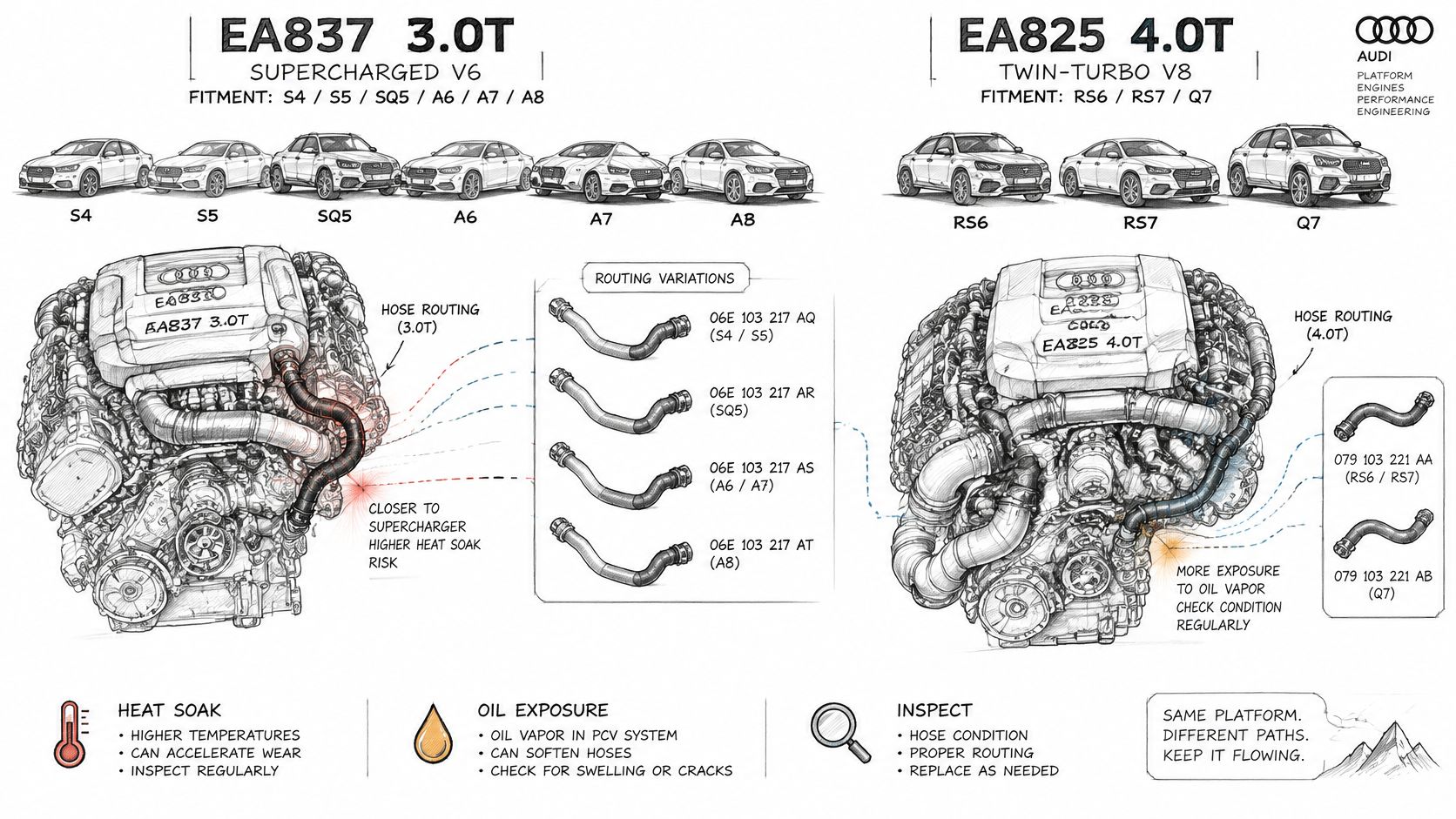
The word “silicone” does not establish that a hose suits a particular Audi circuit. On EA837 supercharged and EA825 turbocharged applications, first identify the exact circuit and hose position. Confirm the vehicle by VIN, then match the OEM part number, end connections and routing before ordering.
Trace both ends of the existing hose. Coolant, breather and pressurised air connections can sit close together, but each carries different contents and has different material requirements.
Match the hose to its location
Hose requirements by location on EA837 and EA825 systems
| Hose location | Typical duty | Hose requirement |
|---|---|---|
| Dry charge-air coupler after the blower or turbo | Pressurised, hot, clean air | Reinforced silicone sized to the pipe and rated at operating temperature |
| Compressor outlet near a hot housing | High discharge temperature and radiant heat | Suitable high-temperature reinforcement, shielding where needed, and clearance from exhaust-side parts |
| Lines carrying oil mist or condensate | Oil contact on the inside | Fluorosilicone liner or another explicitly oil-compatible construction |
| Bypass or recirculation path | Pulsed pressure and possible vacuum | Documented vacuum tolerance and a supported run |
| Routes near belts, brackets or chassis edges | Abrasion and rubbing | Routing clearance, sleeve or shield, with no contact points |
A dry charge-air coupler is a suitable silicone application when its pressure rating covers operating conditions and its ends align without pulling it sideways. The hose should join the pipework, not compensate for hard pipes that sit out of position.
At a compressor outlet, local radiant heat can challenge a hose even when the charge-air temperature appears acceptable. If the route passes near an exhaust-side component, maintain clearance, reroute where possible, or secure a shield with room between it and the hose. A temperature rating does not make direct contact safe.
Oil-carrying branches need an oil-compatible inner surface, not a hose that fits the fittings. A bypass or recirculation run exposed to vacuum also needs a documented vacuum rating and support along the span, particularly where it would otherwise be unsupported.
Separate heat soak from chemical exposure
After a hard pull, nearby housings and exhaust components remain hot as airflow through the engine bay falls. At idle or after shutdown, the hose can continue absorbing heat even when boost production has stopped. Choose a specification for that local heat exposure, not only the temperature seen during steady cruising.
A heat-exchanger upgrade improves the charge-cooling system's ability to reject heat. It does not shield a nearby hose from radiant heat. Cooling-system performance and local hose protection address different conditions.
Oil in charge piping calls for a source check before a hose change. Inspect the crankcase-ventilation path and the compressor-side components for oil mist, then check whether the hose interior is lightly filmed or persistently wet. Pooling or a noticeable increase in contamination is a reason to diagnose the system rather than assume the hose material is the cause.
The Merefsa silicone technical data sheet identifies moderate resistance to aliphatic engine and gearbox oils and relatively high permeability for standard silicone. A hose can therefore look intact outside while the inner surface becomes tacky, swollen or weakened. For ongoing oil contact, specify a fluorosilicone liner or another construction explicitly compatible with the fluid.
Temperature rating addresses heat at the hose. Oil compatibility addresses what its inner surface must withstand.
Accommodate movement without creating another mismatch
Where hard pipes move relative to each other, a purpose-designed hump connector can accommodate movement if its size and specification suit the connection. The Vibrant 4 Ply Reinforced Silicone Hump Hose Connector - 2.75in I.D. x 3in long (BLACK) is one product option. Check its listed specifications against the circuit before ordering, including whether they cover the operating temperature, pressure and fluid exposure.
A flexible shape alone does not make a connector suitable for an oil-wetted breather. Match the internal construction to the fluid, and investigate abnormal oil mist at its source before fitting a replacement.
How to Install and Inspect Silicone Hoses
Install the hose on a cold engine with the system depressurised. Before removing anything, photograph the routing and clamp positions, then inspect the pipe beads and mounting brackets. A damaged sealing land or loose hard pipe can defeat a new hose immediately.
The Zoro Select charge-air-cooler hose specification gives a useful example of rating conditions: its 3-inch fibre-braided hose is rated at 60 psi working pressure at 70°F. That ambient-temperature figure isn't a pressure-test target for the complete Audi system.
Assemble the connection without preloading it
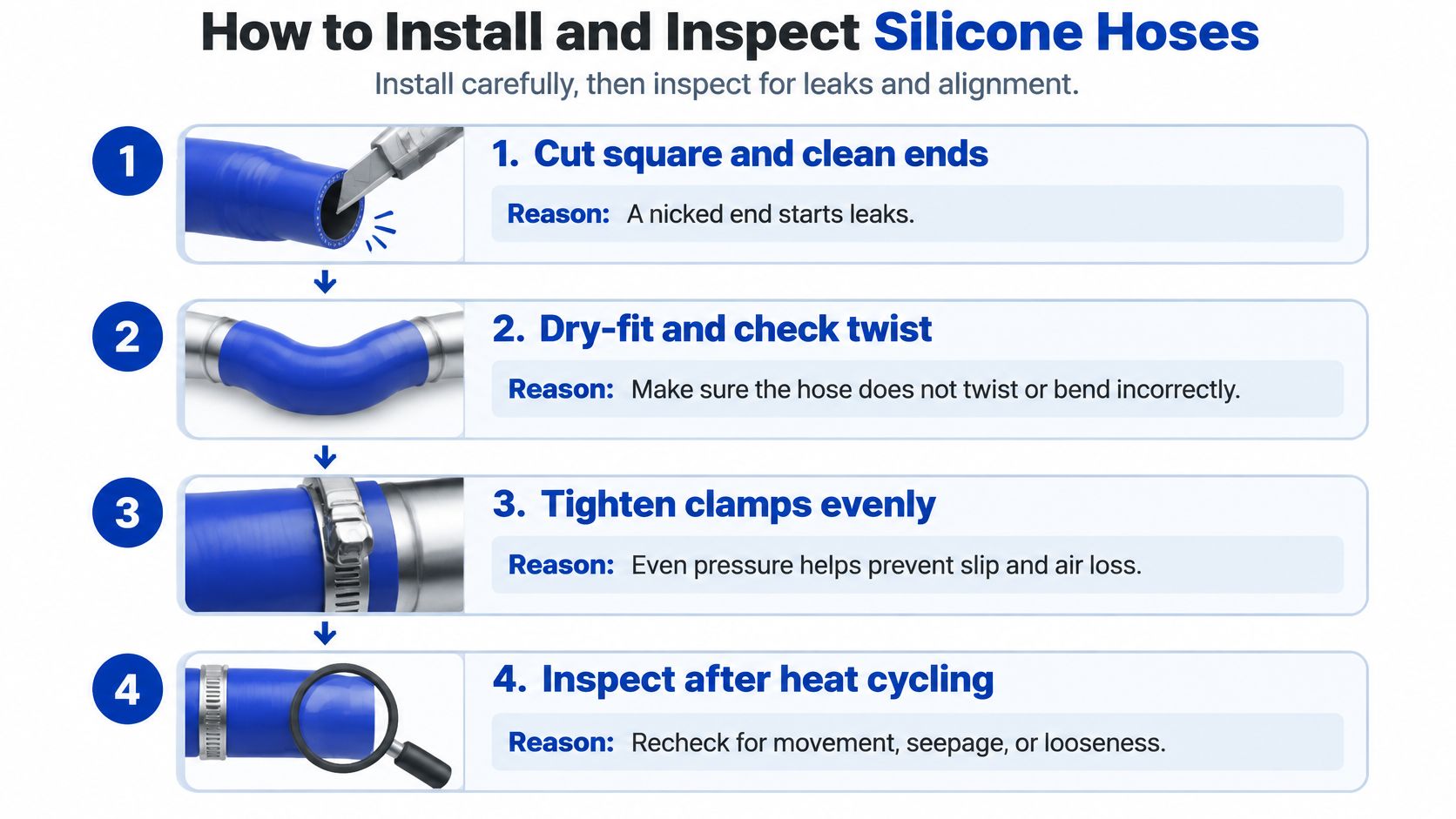
- Cut square and clean the ends. If the hose is designed to be trimmed, use a sharp hose cutter or guided blade, remove debris, and clean the pipe's sealing land with a compatible residue-free cleaner; a nicked edge or oily pipe undermines the joint.
- Dry-fit the complete run. Check bend shape, twist and clearance through the available movement, because a hose that already strains against a bracket will move further under operating loads.
- Engage the pipe bead fully. Push the hose far enough onto the sealing land to provide proper overlap, without bottoming it against an obstruction or leaving the bead at the hose mouth.
- Position and tighten the clamp correctly. Place the compatible T-bolt or constant-tension clamp behind the bead on the supported sealing land, and follow its specified tightening procedure rather than tightening until the silicone bulges.
- Secure any necessary shielding. Keep the shield clear of the hose and moving parts so the protection itself doesn't become an abrasion point.
- Pressure-test with regulated equipment. Use the vehicle's appropriate test procedure, stay below the weakest component's permitted pressure, and apply soapy water to joints to identify bubbling; never connect unrestricted workshop air.
- Recheck after heat cycling. With the system cool again, inspect alignment, clamp position and evidence of movement before applying any further tightening.
Inspect condition, not just age
Use a light and mirror to examine the underside of each bend and the area behind the clamp. If the car still shows intercooler leak symptoms, test the complete circuit rather than assuming the new joint is responsible.
Replace a hose showing:
- Soft spots or tackiness: Investigate chemical exposure or local deterioration.
- Exposed braid or cracking: Treat the damaged wall as unserviceable.
- Local swelling or delamination: Check the inside as well as the outer cover.
- Deep clamp imprinting or cuts: Correct the clamp selection and installation.
- Clamp creep or repeated slipping: Inspect engagement, pipe alignment and contamination.
A shallow seating witness isn't the same as a cut or permanently crushed wall. Judge the damage carefully, but don't try to recover a weakened hose by adding clamp force.
Confirm the Spec Before You Order
Buy a hose only when you can describe its job without using the word silicone. Identify what it connects, what passes through it, and how the installed route behaves. That description is more useful to a supplier than a material label.
Make the order specific
Confirm the EA837 or EA825 application and exact hose position. Record the OEM hose or connection reference, plus the vehicle details. If the car has modified hard piping, include photographs so the supplier can check the actual connection rather than rely on factory fitment alone.
Classify the hose's exposure as dry charge air, oil-bearing vapour or coolant. That determines whether the proposed construction suits the route. A part that resembles the original hose is not automatically suitable for the same fluid.
Then provide the pipe outside diameter, engagement available and clearance along the route. Include the operating conditions and ask the supplier to confirm the rating applies at the expected wall temperature. Request the pressure derating curve, if available, and written approval for the liner where oil exposure is possible.
A concise request works:
I have an EA837/EA825 in [vehicle], and need a hose for [position]. The pipe outside diameter is [measurement], with [engagement] available. The hose will carry [fluid] and follow [route]. Please confirm fitment, pressure rating at the expected wall temperature, the derating curve, liner approval for this exposure, and the correct coupler shape. I can provide photos and the OEM reference.
Resolve fitment questions before ordering
Keep an OEM-style replacement in consideration when the factory routing and duty remain unchanged. A documented reinforced or lined upgrade makes sense when the application calls for it. In either case, the specified shape must fit the installed route without forcing the hose into position.
Compare the supplier's answer against the car by VIN or OEM part reference. If the application or exposure remains unclear, get that resolved before placing the order. Record the confirmed part reference and the supplier's fitment response with the vehicle's service information. This gives you a useful record if the hose needs replacement later.
Vorsprung Autowerk offers Audi-focused cooling upgrades, maintenance components and silicone couplers for building a properly matched installation. Visit Vorsprung Autowerk with your vehicle details and hose specification to select the connection and supporting hardware for your charge-air system.


